How Do Rockets Land Themselves? The "Suicide Burn", Grid Fins and Robot Ships Explained
For decades, the rule of rocketry was simple: a rocket goes up once, and then it is gone. Its giant first-stage booster — the biggest, most expensive part — would fall back into the ocean or burn up in the atmosphere after a single flight. Building a machine that flies to the edge of space, throws away most of itself, and then must be built again from scratch is one reason spaceflight stayed so expensive.
Then, in the mid-2010s, a rocket turned around in mid-flight, came back, and landed upright on a pad — to applause you could hear across the internet. Today, self-landing boosters have become so routine that SpaceX has recovered them hundreds of times. Here is how it actually works, in plain English.
A very short history of the landing rocket
Landing a rocket vertically used to be science fiction, mostly because nobody thought the effort was worth it. That changed quickly:
- November 2015 — Blue Origin, Jeff Bezos's rocket company, landed its New Shepard booster on a pad in West Texas after sending it just past the edge of space (about 100.5 km up). But New Shepard was a suborbital vehicle — it went up and came straight back down, never reaching orbit.
- December 2015 — SpaceX landed the first stage of a Falcon 9 on land at Cape Canaveral, Florida, after it had delivered 11 Orbcomm communications satellites to orbit. This was the first time an orbital-class rocket booster had ever been recovered intact.
- April 2016 — SpaceX landed a Falcon 9 booster on a drone ship in the Atlantic Ocean, during the CRS-8 cargo mission to the International Space Station. That booster, B1021, flew again in March 2017 — the first reflight of a recovered orbital booster.
- October 2024 — SpaceX's Starship programme took things further: the giant Super Heavy booster flew back to its launch tower and was caught in mid-air by two huge mechanical arms, nicknamed "chopsticks". It has been caught several times since.
What was once impossible is now an everyday occurrence — but the engineering behind it is anything but ordinary.
The landing sequence, step by step
A Falcon 9 landing takes about nine minutes from launch to touchdown. Here is what the booster does in that time:
- Separation. About two and a half minutes after launch, the first stage shuts down its nine Merlin engines and separates from the upper stage, which continues to orbit. At this point the booster is roughly 50 miles (80 km) up and travelling at hypersonic speed.
- The flip. Cold-gas thrusters rotate the booster 180 degrees so it is flying engines-first — tail down, nose up. This is sometimes called the boostback preparation.
- The boostback burn. Three of the nine engines reignite briefly. This cancels some of the booster's forward speed and steers it back toward the landing zone — or toward the waiting drone ship at sea.
- The entry burn. As the booster re-enters the thicker atmosphere, one engine fires again to slow it down. Without this, air friction would tear it apart or overheat it. This is also when the grid fins unfold.
- Guided descent. The booster falls engine-first, steered by its grid fins, while its onboard computer constantly adjusts its path using GPS. Four landing legs deploy.
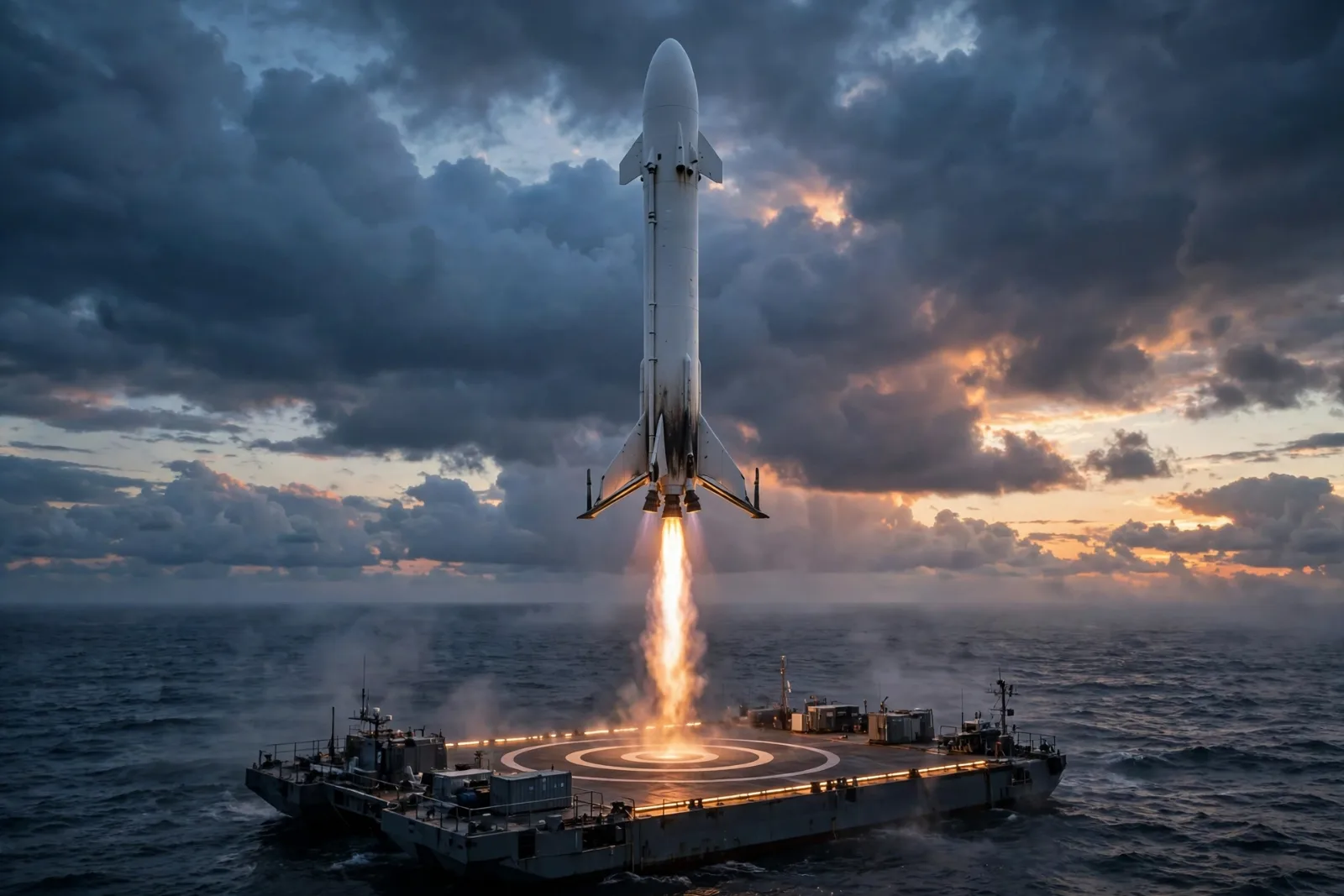
- The landing burn. Seconds before touchdown, a single engine fires one last time to slow the booster to a near-crawl, and it sets down upright on the pad.
The whole thing is fully automatic. No human is flying it — the flight computer is making thousands of corrections per second.
The "suicide burn": why it cannot just hover down
This is the strangest part of the whole process, and the reason engineers sometimes call the landing burn a "suicide burn" or "hoverslam".
The problem is this: even when a Merlin engine is throttled down as far as it can go, it produces more thrust than the nearly-empty booster weighs. A booster coming in for landing has burned almost all its fuel, so it is very light — and one lit engine would push it up faster than gravity pulls it down.
So the rocket cannot hover. Instead, the flight computer has to solve a timing problem: ignite the engine at exactly the right moment so that the booster's speed reaches zero precisely as it reaches the ground. Start the burn a fraction of a second too early, and the rocket climbs again and has to try again. Start it too late, and it hits the ground too fast.
In practice, SpaceX aims the booster to touch down with almost no margin left. That precision is the whole game — and it is why early landing attempts kept exploding on video before it finally worked.
How it steers: grid fins and landing legs
With no pilot on board, the booster needs a way to aim itself during its fall through the atmosphere. That job belongs to four grid fins — lattice-like metal panels near the top of the booster that fold out after separation.
Grid fins act a little like the fletching on an arrow: they catch the rushing air and push the booster's nose around, letting the computer steer it to a precise spot. They work only while the air is thick enough to push against, which is why the engines take over for the final seconds.
Just before touchdown, four landing legs unfold. They are made of carbon fibre and aluminium — light but strong enough to hold the 14-storey-tall booster upright on impact.
Where they land: land versus sea
Not every mission has enough spare fuel to fly the booster back to the launch site. Where it lands depends on the physics of the flight:
- Land — Missions that need less energy (like satellite launches to low Earth orbit) leave enough fuel for the booster to fly back to a ground pad. SpaceX has landing zones at Cape Canaveral in Florida (Landing Zones 1 and 2) and at Vandenberg in California (Landing Zone 4).
- Sea — Heavier or more demanding missions use up too much fuel, so the booster lands downrange in the ocean on an autonomous drone ship — a football-field-sized barge that holds its position with automated thrusters.
The drone ships have wonderfully odd names — Of Course I Still Love You, Just Read the Instructions and A Shortfall of Gravitas — taken from the starships in Iain M. Banks's Culture science-fiction novels. The first ocean landing, in April 2016, was on Of Course I Still Love You.
Falcon 9 versus Starship: the next step
Starship's Super Heavy booster does not use landing legs at all. Compare the two approaches:
| Falcon 9 booster | Starship's Super Heavy booster | |
|---|---|---|
| Height | ~47.5 m (about 14 storeys) | ~71 m (about 23 storeys) |
| Engines | 9 Merlin engines | 33 Raptor engines |
| Lands on | Four deployable legs | Caught by tower arms ("chopsticks") |
| Landing site | Ground pad or drone ship | Its own launch tower |
| First successful landing | 21 December 2015 | 13 October 2024 |
| Reuse design | First stage recovered and reflown | Designed for full reuse — booster and ship |
Catching the booster instead of landing it saves the weight of the legs, and the booster ends up right back at the pad, ready to be stacked for its next flight. It is the next logical step in the same idea: the less you throw away, the cheaper flying gets.
Why it matters: the economics of reuse
A rocket's first stage is its most expensive part — industry analysts estimate it accounts for roughly 60–70% of the cost of a launch. Historically, all of that money burned up or sank after a single flight.
Reuse changed the maths completely. SpaceX's published price for a standard Falcon 9 launch is roughly $67–74 million, far below the price of flying a comparable expendable rocket. Some individual Falcon 9 boosters have now flown more than 30 times. Once the booster is paid for, each additional flight mostly costs fuel and refurbishment — and SpaceX estimates refurbing a recovered booster costs a small fraction of building a new one.
That cost drop is a big part of why you now see rockets launching almost weekly, and why enormous projects like global satellite-internet constellations are affordable at all — something we explored in our explainer on satellite internet. Reuse also means fewer spent stages abandoned in orbit, a small but real contribution to the growing problem of space debris.
What comes next
The industry is clearly moving toward routine reuse. Blue Origin's much larger New Glenn rocket flew its first orbital test in 2025, and other companies around the world are developing boosters designed to come home. The catch-by-tower technique is still new — only a handful of catches have succeeded — but it points at a future where rockets land, refuel, and fly again the way aeroplanes do.
The biggest trick of all is how boring it has become. A manoeuvre that was impossible ten years ago is now just another line in the launch schedule. That is what good engineering does: it turns the extraordinary into the routine.
Takeaway checklist
- Landing a booster is a timing problem, not just a braking problem. The engine is too powerful for a gentle hover, so the rocket must reach zero speed exactly at touchdown — the "suicide burn" or "hoverslam".
- The sequence is: separate, flip, boostback burn, entry burn, guided descent, landing burn. The whole round trip takes about nine minutes.
- Grid fins steer the fall through the air, while four carbon-fibre legs take the landing.
- Where it lands depends on fuel: ground pads for lighter missions, drone ships at sea for heavier ones.
- Starship skips the legs entirely — its booster is caught by the launch tower's "chopstick" arms.
- Reuse is about money: the first stage is most of a rocket's cost, and reusing it is what made cheap, frequent launches possible.