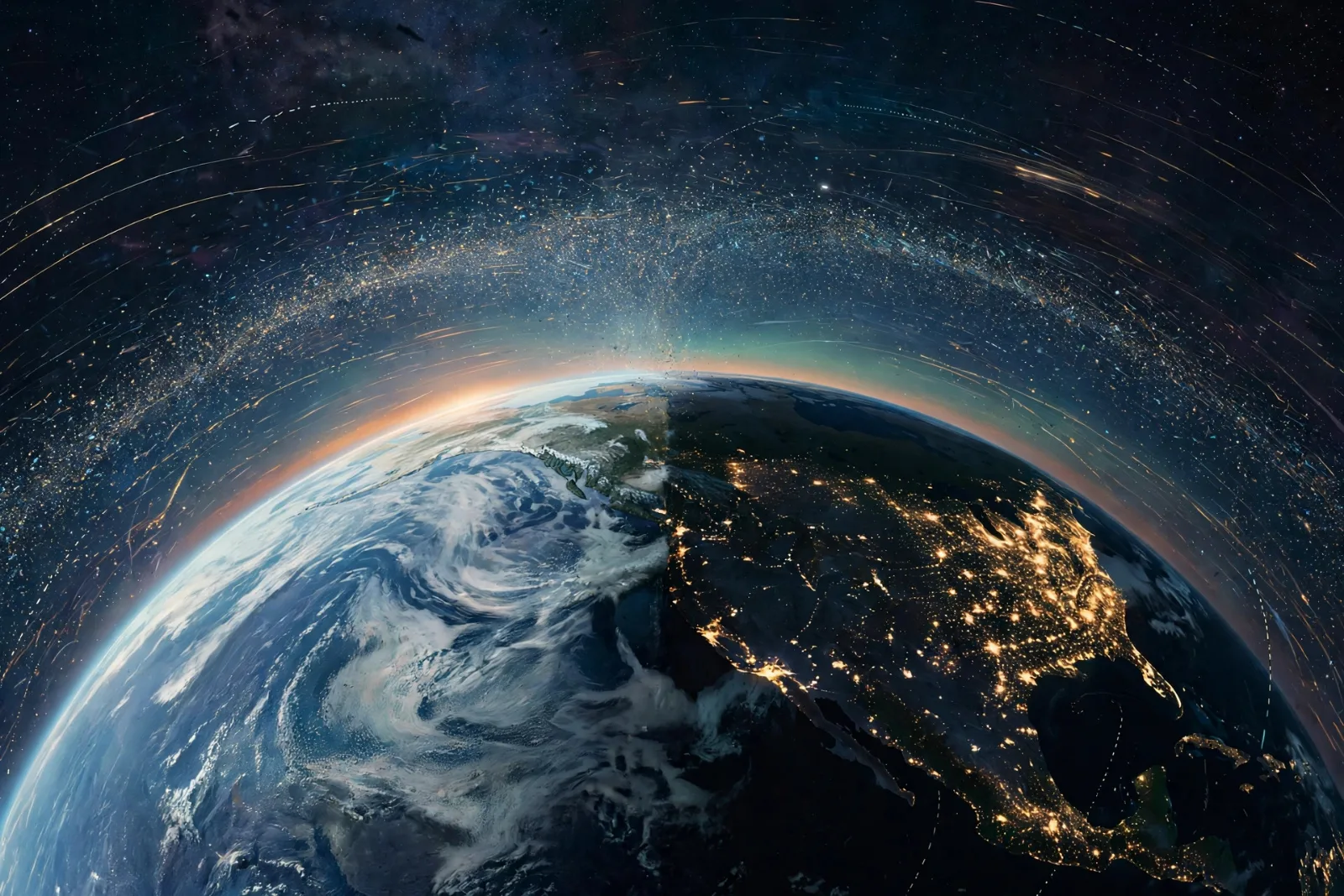
On 5 October 2026, a Soviet-era weather satellite called Meteor 2-7 shattered in orbit, scattering fragments across one of the busiest regions of space (LeoLabs' radar network detected the event as it happened; the company announced it on 7 October). Nobody was hurt, and no spacecraft was hit — but radar trackers at LeoLabs watched dozens of new objects appear on their screens in a single day. It was a reminder of a problem most of us never think about: space is getting dangerously crowded, and the junk we've left up there isn't going away.
What space debris actually is
Space debris is anything in orbit that no longer serves a purpose: dead satellites, spent rocket stages, fragments from explosions, and even paint flecks that have peeled off spacecraft. It comes from several sources:
- Defunct satellites that finished their missions or failed and were left in orbit
- Spent rocket upper stages, abandoned after delivering their payloads
- In-orbit explosions, often caused by leftover fuel or battery failures in old hardware
- Anti-satellite missile tests — the US, Russia, China and India have all blown up their own satellites in such tests
- Collisions between existing objects, which turn two pieces of junk into thousands
Two events dominate the history books. China's 2007 anti-satellite test and the accidental 2009 collision between an Iridium and a Cosmos satellite together produced more than 5,000 tracked fragments — debris that is still circling Earth today and will be for decades.
The numbers, as of October 2026
The European Space Agency published its annual Space Environment Report in September 2026 (using data through 2025), and the trend is unambiguous — every category is growing. Here's the picture:
- Roughly 47,000 objects are tracked and catalogued in orbit, of which only about 16,000 are working satellites. The rest is junk.
- In low Earth orbit specifically, trackers count more than 31,000 objects, including some 18,600 payloads — and over 10,000 of the working satellites are Starlink satellites alone, according to OrbitalRadar data cited by EarthSky.
- About 10 new payloads are launched every day, while more than 3 intact satellites or rocket bodies reenter Earth's atmosphere daily.
- ESA estimates more than 140 million fragments smaller than 10 cm are circling the planet — too small to track.
- Around 1.5 million objects between 1 and 10 cm exist in that dangerous middle ground: big enough to destroy a satellite, too small to see coming.
The speed is what turns junk into a weapon. Objects in low Earth orbit travel at 7 to 8 kilometres per second — roughly ten times the muzzle velocity of a rifle. At those speeds, a fragment just 1 cm across carries the destructive energy of a hand grenade, and a 10 cm object can destroy a satellite outright. Head-on collisions between objects can happen at relative speeds above 15 km/s.
What the Kessler syndrome really says
In 1978, NASA astrophysicist Donald Kessler published a paper with a disturbing piece of arithmetic. As the density of objects in low Earth orbit grows, he argued, random collisions will start generating more new debris than old debris falls out of the sky. That new debris then causes more collisions, which create more debris, in a self-sustaining chain reaction. Eventually, some orbital bands could become too hazardous to fly through — for decades or even centuries.
That's the Kessler syndrome: not an explosion, but a slow cascade. And some researchers now believe we may already be past the tipping point in certain heavily-used low Earth orbit bands — ESA itself has found that even if all launches stopped today, the debris population would keep growing, because break-ups add new fragments faster than atmospheric drag removes them.
A dose of perspective is fair, though. Critics of the alarmist framing — including a 2011 National Academy of Sciences report often cited on both sides — note that the cascade is a slow-motion process unfolding over decades to centuries, not an imminent catastrophe. The most affected regions are specific altitude bands above 800 km. Satellites today routinely perform collision-avoidance manoeuvres — dodging tracked objects is already a normal part of operations. The Meteor 2-7 breakup, debris experts stress, adds to the problem but does not prove a chain reaction has begun.
Why you should care (even though you'll never go to space)
Almost everything modern life depends on runs through low Earth orbit. When satellites are at risk, these are at risk too:
- Navigation — GPS, weather forecasting and the timing signals that keep mobile networks and banking systems synchronised. See our explainer on how GPS actually works.
- Internet and communications — mega-constellations like Starlink are putting thousands of satellites in orbit, which is great for connectivity but also the biggest new source of traffic in space.
- Television, mapping and disaster response — all satellite-dependent.
- The International Space Station — astronauts shelter from debris strikes several times a year; the station's shielding is designed around exactly this threat.
What is being done about it
The first line of defence is prevention. International guidelines ask operators to remove satellites from congested orbits within 25 years of the end of their missions — but compliance is poor. ESA's data shows that of the very largest satellites, weighing over 1,000 kg, only 54% are scheduled to meet even that minimum.
The second is active removal, and this is where the genuinely futuristic work is happening:
- Rendezvous and capture missions — spacecraft designed to grab dead satellites and drag them into the atmosphere. ESA's ClearSpace-1 was the first programme of its kind; others have followed.
- Lasers — ground- or space-based lasers that nudge debris with light pressure, gradually lowering its orbit until it burns up. No contact needed, which matters when targets tumble unpredictably.
- Better tracking — companies like LeoLabs are building radar networks to find smaller objects, because you can only dodge what you can see.
The third is regulation, and it's lagging. Nobody owns orbital space, nobody is clearly liable for a collision, and national licensing rules were written before mega-constellations existed. Lawyers are now arguing about all of this — slowly.
Your takeaway checklist
- Space debris is real and growing: ~47,000 tracked objects, over 140 million untracked fragments, speeds of 7–8 km/s.
- The Kessler syndrome is a cascade, not an explosion: collisions making more collisions, possibly already past the tipping point in some orbits — but unfolding over decades, not days.
- Mega-constellations changed everything: more satellites launched in the last two years than in the previous sixty years combined.
- The ISS, GPS and your internet connection all live in the debris zone.
- Prevention isn't enough anymore: with old debris staying up for centuries, active removal — lasers, capture missions, better tracking — is becoming essential.
- The October 2026 Meteor 2-7 breakup is a case study in the new normal: one old satellite, hundreds of new tracked objects, zero accountability for who cleans it up.