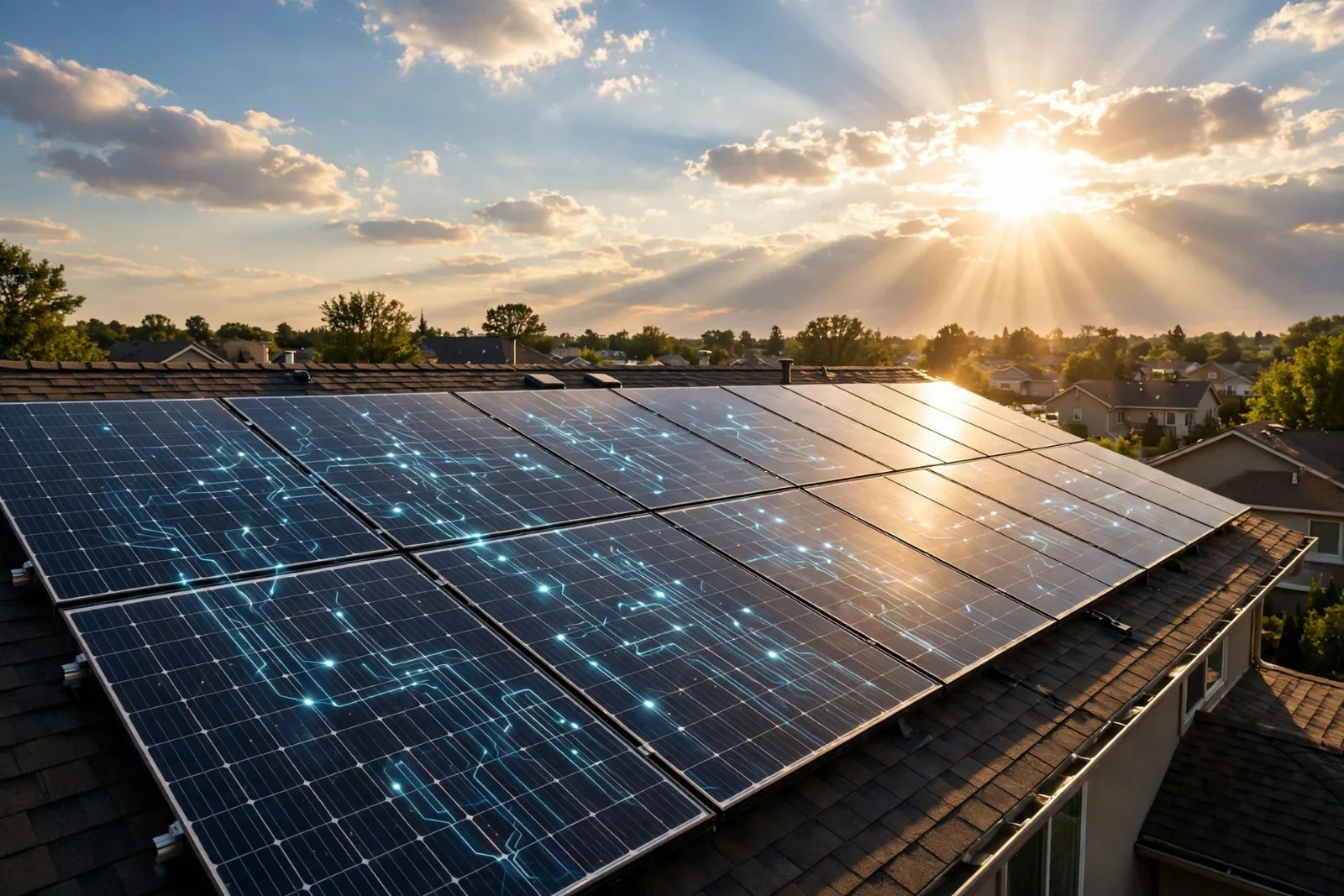
A solar panel has no moving parts, no fuel and no smoke. It just sits on a roof and quietly turns light into the electricity that charges your phone. Under that glass, though, is some of the cleverest physics of the last century. Here is how it actually works, step by step.
Step 1: Photons knock electrons loose
Sunlight is made of tiny packets of energy called photons. A solar cell is made of silicon, a material chosen because it is a semiconductor — it sits halfway between a conductor (like copper, which lets electricity flow freely) and an insulator (like rubber, which blocks it). That middle position is what makes the whole trick possible.
When a photon with enough energy strikes a silicon atom, it transfers its energy to one of the atom's electrons. The electron absorbs the energy and breaks free from its bond, leaving behind an empty spot called a hole. This creation of a free electron plus a hole is the photovoltaic effect — the moment light becomes potential electricity.
Not every photon can do the job. Silicon has a property called a band gap — the minimum energy needed to free an electron, about 1.1 electron-volts. Photons weaker than that simply pass through. Photons stronger than that knock an electron loose, but the extra energy is wasted as heat. This single fact explains a lot about solar efficiency, as we will see later.
Step 2: The p–n junction sorts the charges
Free electrons are useless if they just wander around and fall back into holes — they would simply recombine and release their energy as heat. The cell needs a way to separate the freed electrons from the holes and push them in one direction. That is what the p–n junction does.
A solar cell is a thin wafer of silicon split into two treated layers:
- The n-type layer is doped (deliberately contaminated) with phosphorus, which adds extra free electrons.
- The p-type layer is doped with boron, which creates extra holes.
Where the two layers meet, electrons and holes drift across the boundary and cancel each other out in a thin depletion region. The leftover fixed atoms set up a permanent, built-in electric field pointing from the n-side to the p-side.
That field acts like a one-way street. When sunlight frees electrons and holes near the junction, the field sweeps the electrons toward the n-type side and the holes toward the p-type side before they can recombine. This separation of charge creates a voltage between the two sides of the cell. Connect wires to each side, and the freed electrons have somewhere to go: they flow out through the circuit as direct current (DC).
One cell produces only a tiny voltage — about half a volt. So the panel you see on a roof is many cells wired together to add up to a useful amount.
If the semiconductor side interests you, our explainer on semiconductors goes deeper into how materials like silicon are engineered.
Step 3: From one cell to a whole panel
A standard residential panel strings together 60 to 72 cells, connected in series so their voltages add up. The cells are sandwiched between a glass front sheet and a protective backsheet, framed in aluminium, and wired to a junction box on the back. Typical residential panels sold in 2026 are rated between 350 and 450 watts under standard test conditions — that is, their output in ideal laboratory light at 25°C.
A full home system combines many such panels. Their combined DC output is far more than a phone charger — a typical rooftop system runs to several kilowatts — but it is still in the wrong kind of electricity.
Step 4: The inverter's job — DC to AC
Your home's wiring and the national grid run on alternating current (AC), the kind where the flow of electricity reverses direction fifty or sixty times a second. Solar cells produce direct current (DC), which flows in one direction only. Nothing in your house can use DC straight from the panels.
That is the job of the inverter. It takes the DC from the panels and electronically switches it back and forth to create AC at the right voltage and frequency for your home or the grid. Think of it as a translator between two languages of electricity. Most homes use a string inverter (one unit handling a row of panels) or microinverters (a small one behind each panel, which keeps one shaded panel from dragging down the rest). A good inverter is about 95–98% efficient, so very little energy is lost in translation.
Step 5: Into your home, the grid, and batteries
Once converted to AC, the electricity takes the path of least resistance. Your home uses what it needs first. Surplus can go two places:
- Back to the grid. In many regions, excess solar exports to the grid and your meter spins backwards (or you get credited), a scheme called net metering.
- Into batteries. Home batteries store the daytime surplus so you can run on sunshine after dark — which is exactly what lithium-ion batteries are doing in products like home storage units and EVs.
The system also includes safety disconnects and monitoring, but electrically, the story is: photons → free electrons → DC → inverter → AC → your kettle.
Why efficiency tops out around 20–23%
A modern monocrystalline panel converts roughly 20 to 23% of the sunlight hitting it into electricity. That sounds low, but it is the result of hard physical limits, not lazy engineering:
- Weak photons are invisible to the cell. Anything below silicon's band gap passes straight through.
- Strong photons waste their surplus. A photon with double the needed energy still frees only one electron; the rest becomes heat.
- Some light bounces off. Anti-reflective coatings help, but reflection and the cell's metal contacts and wiring still steal a few percent.
- Some electrons recombine anyway. The electric field catches most, but not all.
Physics sets a hard ceiling for a single silicon cell: the Shockley–Queisser limit of about 33.7%. The best single-junction silicon cells ever made in a lab reached about 26.8% — close to that ceiling.
The exciting escape route is stacking two cells that absorb different parts of the spectrum. Perovskite-on-silicon tandem cells do exactly that, and they have smashed the old records: in July 2026, a perovskite-silicon tandem cell certified by Europe's ESTI laboratory hit 35.5% efficiency, the current world record, held by LONGi. The first commercial tandem modules (from companies like Oxford PV, shipping 24.5%-efficient panels since late 2024) are already on the market — but for the rooftop panels you can buy today, expect the familiar 20–23% range.
The hot-day paradox: why panels hate heat
Here is something that surprises most people: solar panels produce less power when they get hot. Panels are rated at 25°C, but in direct sun the cells often bake at 50 to 65°C. As temperature climbs, electrons recombine more easily and the cell's voltage drops — and the voltage loss outweighs a small rise in current.
Every panel's datasheet lists a temperature coefficient, usually around −0.30% to −0.35% per °C above 25°C for a modern residential panel. A panel baking at 65°C (40°C over its rating) loses roughly 12–15% of its rated power. Premium panels get down to about −0.25%/°C, while thin-film panels are naturally more heat-tolerant at around −0.20%/°C.
Note, though, that this is a temporary dip tied to temperature — it is separate from the slow, permanent degradation of about 0.4–0.5% per year as the panel ages. And a hot, sunny day still produces far more total energy than a cool, cloudy one, because there is simply more light to work with. Still, the paradox stands: panels run best on a cold, bright day.
The main panel types, compared
| Monocrystalline | Polycrystalline | Thin-film | Perovskite (tandem) | |
|---|---|---|---|---|
| How it's made | Cells cut from a single silicon crystal | Cells from silicon melted from many crystal fragments | Photovoltaic material (e.g. cadmium telluride) deposited as a thin layer | Perovskite layer stacked on a silicon cell |
| Typical efficiency | 20–23% (commercial) | 15–17% | 10–16% | 35.5% lab record; ~24.5% in early commercial modules |
| Cost | Medium to high | Low (but increasingly rare) | Low to medium | High / not widely available yet |
| Typical lifespan | 25–30 years | 20–25 years | 15–25 years | Unknown at scale — long-term field data still being gathered |
| Best use case | Homes and businesses with limited roof space | Budget ground arrays with plenty of space | Large utility farms, portable kits, curved or lightweight surfaces | Early adopters and utility-scale projects from ~2027 onwards |
| Main trade-off | Higher upfront cost | Lower efficiency; fading from the market | Needs much more area for the same output | Durability over decades is unproven |
Monocrystalline panels dominate the residential market because they squeeze the most power out of limited roof space. Polycrystalline, once popular for its lower price, is being pushed out as the cost gap has nearly closed. Thin-film rules large solar farms and niche uses where weight and flexibility matter more than area.
Takeaway Checklist
- A solar panel is a sandwich of doped silicon; photons knock electrons loose — that is the photovoltaic effect.
- The p–n junction's built-in electric field separates electrons and holes, creating voltage and a flow of DC electricity.
- Cells are wired together into panels (350–450W typical for homes in 2026), then an inverter converts DC to AC for your home and the grid.
- Commercial panels convert 20–23% of sunlight to electricity; lab tandem cells have hit 35.5%, but those are not on rooftops yet.
- Heat is the enemy: panels lose roughly 0.3–0.35% of output per °C above 25°C, so they sag on the hottest afternoons.
- Monocrystalline is the best all-round buy for a home roof; thin-film wins on weight and flexibility; perovskite tandems are the future to watch.
- Panels degrade only about 0.4–0.5% per year and are typically warranted for 25–30 years — the silent, maintenance-free part is the whole point.