CRISPR and Gene Editing Explained: Rewriting Life's Code
Imagine opening a document in Word, pressing Ctrl+F, and finding an exact typo in a file with three billion letters — then fixing it with one click. Now imagine that document is human DNA, the three billion letters are the base pairs of your genome, and the "click" is a protein called Cas9. That is what CRISPR (short for Clustered Regularly Interspaced Short Palindromic Repeats) gene editing does, and it is one of the most important scientific tools of our century.
Where CRISPR Came From: A Bacterial Immune System
CRISPR did not start in a medical lab. It started inside bacteria.
- In 1987, Japanese researchers spotted strange repeating DNA patterns in E. coli — but had no idea what they were for.
- The name CRISPR was coined in 2002 by Dutch researcher Ruud Jansen and colleagues.
- By 2007, scientists proved these sequences were part of a bacterial immune system: bacteria store snippets of viral DNA in their CRISPR arrays like a mugshot database, and use them to recognize and destroy viruses that attack again.
The real breakthrough came in 2012, when Jennifer Doudna (UC Berkeley) and Emmanuelle Charpentier showed that this bacterial defense system could be reprogrammed to target any DNA sequence — not just viral DNA. That work earned them the 2020 Nobel Prize in Chemistry. In that time, genome editing went from a slow, expensive specialty to something a lab could do in days.
How CRISPR-Cas9 Actually Works
The classic version of the tool has two parts working together:
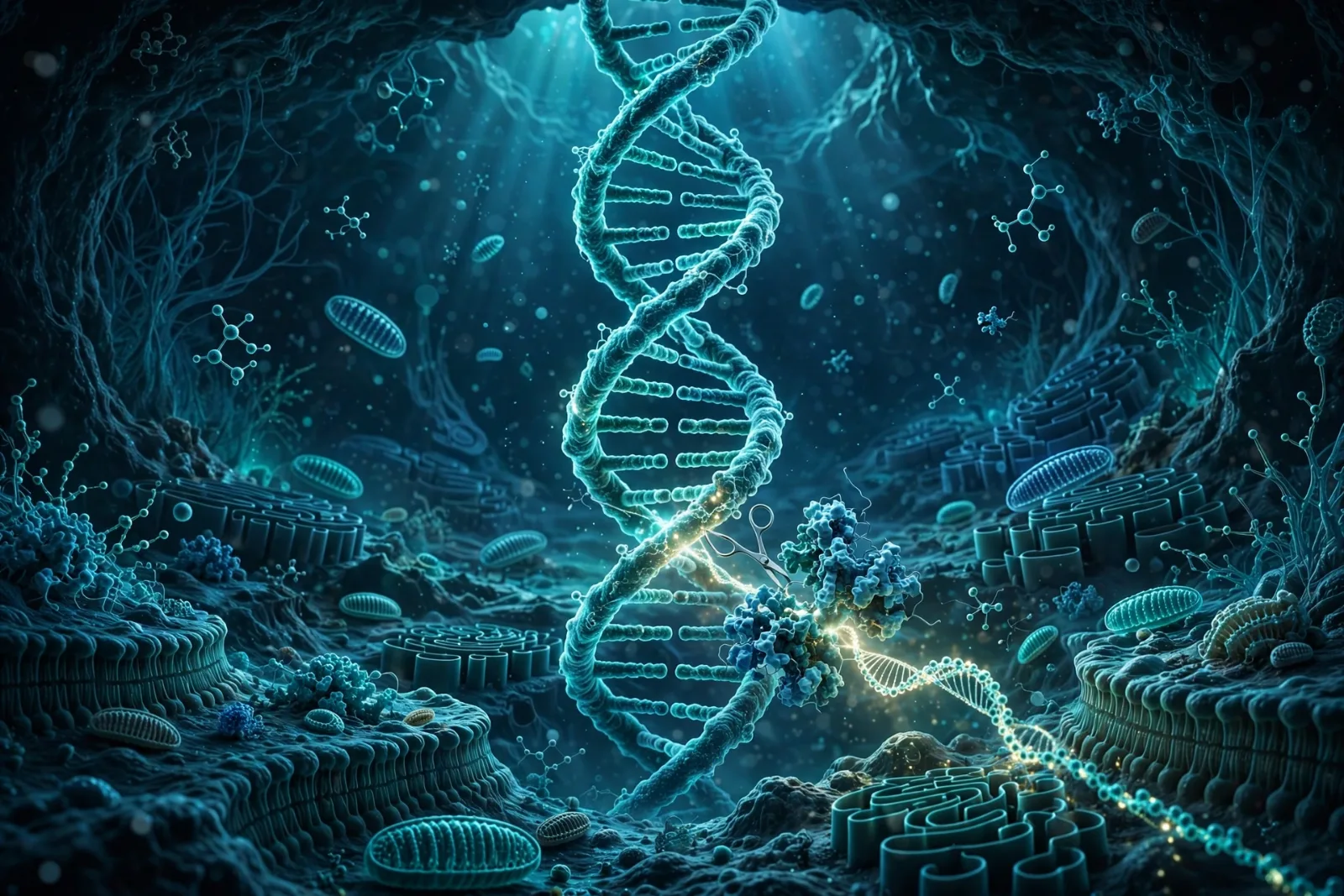
- Cas9 protein — the "molecular scissors." It is an enzyme that cuts both strands of DNA.
- Guide RNA (gRNA) — a short synthetic RNA molecule, about 20 nucleotides long, designed to match the DNA you want to edit. It acts as the GPS.
The process has three clear steps:
- Find. The Cas9–guide RNA complex patrols the DNA. First, it looks for a short tag called a PAM (protospacer adjacent motif) — for the most common Cas9, the three-letter code NGG. The PAM is like a "you may enter here" sign. Without the right PAM, Cas9 moves on.
- Match. Next to the PAM, Cas9 unzips the double helix and lets the guide RNA try to pair with the target strand. If the match is good, the two protein domains of Cas9 — called HNH and RuvC — snap into position. Cas9 cuts the DNA three base pairs upstream of the PAM.
- Repair. Here is the twist: CRISPR does not paste the new sequence in itself. The cut triggers the cell's own repair machinery. Scientists steer that repair to get two kinds of edits:
- NHEJ (non-homologous end joining) — a quick, sloppy repair that often disables the gene. Useful for knocking genes out.
- HDR (homology-directed repair) — a precise repair using a donor DNA template scientists supply. Useful for writing in a corrected sequence.
Key takeaway: CRISPR is an address system (the guide RNA) plus a scalpel (Cas9). It finds the right address in a genome of three billion letters and cuts exactly there.
Meet the Upgrades: Base Editing and Prime Editing
Cutting DNA and letting the cell repair it is powerful, but it can be imprecise. Two newer tools — both pioneered by David Liu at the Broad Institute — skip the double-strand break entirely.
- Base editing (introduced in 2016): instead of cutting, a modified Cas9 fused to a deaminase enzyme chemically changes a single DNA letter — for example, converting a C into a T without breaking the DNA backbone. Think of it as a pencil instead of scissors. It is ideal for point mutations, which cause thousands of inherited diseases.
- Prime editing (introduced in 2019): a "search and replace" tool. It uses a modified Cas9 fused to a reverse transcriptase enzyme, plus a special pegRNA that both finds the target and carries the replacement text. Prime editing can swap, insert, or delete short stretches of DNA. Researchers have estimated it could, in principle, correct up to 89% of known disease-causing genetic variants.
Comparison: The CRISPR Toolbox
| Tool | How it edits | Breaks DNA? | Best for |
|---|---|---|---|
| CRISPR-Cas9 | Cuts DNA; cell repairs it | Yes (double-strand break) | Knocking out genes, large edits |
| Base editing | Chemically converts one base | No | Fixing single-letter typos |
| Prime editing | Copies a new sequence from an RNA template | No (nicks one strand) | Precise insertions, deletions, swaps |
From Lab to Medicine: The First Approved CRISPR Therapy
Editing cells in a dish is one thing; treating patients is another. That milestone arrived with Casgevy.
- Casgevy (generic name exagamglogene autotemcel), developed by Vertex Pharmaceuticals and CRISPR Therapeutics, is the first CRISPR-based therapy approved by the US FDA.
- Approved December 8, 2023, for sickle cell disease (patients 12 and older), and on January 16, 2024, for transfusion-dependent beta thalassemia.
- In July 2026, the FDA expanded approval to children as young as 2 years old — the first gene therapy approved for that young age group in sickle cell disease.
- It carries a US list price of about $2.2 million per patient.
How does it work? Doctors collect the patient's own blood stem cells, use CRISPR-Cas9 to switch off part of the BCL11A gene in a lab — which reactivates production of fetal hemoglobin, the oxygen-carrying hemoglobin babies make before birth — and infuse the edited cells back in a one-time intravenous treatment. Fetal hemoglobin prevents red blood cells from sickling, so in trials, most treated patients became free of painful vaso-occlusive crises and many beta-thalassemia patients became transfusion-independent, with benefits lasting for years.
Clinical trials continue across dozens of conditions, from cancer immunotherapy to heart disease and hereditary blindness — and the next frontier is in vivo editing: delivering CRISPR directly into the body, rather than editing cells outside it.
The Hard Part: What CRISPR Can't Do (Yet)
CRISPR is not magic, and honest reporting means facing its limits:
- Off-target edits. Sometimes Cas9 cuts a similar-but-wrong sequence. Screening and newer high-fidelity Cas9 variants reduce this risk, but it is never zero.
- Delivery. Getting the CRISPR machinery into the right cells inside a human body is the biggest unsolved engineering challenge. Edit blood stem cells outside the body, and it is manageable. Reach the brain or the heart safely, and it is much harder.
- Cost and access. At $2.2 million per treatment, therapies like Casgevy raise brutal questions about who actually benefits. Insurance coverage varies, and most treatments require specialized centers.
- Heritable edits and ethics. In November 2018, Chinese scientist He Jiankui announced he had created the world's first gene-edited babies by altering embryos to resist HIV. He was sentenced to three years in prison in December 2019. The global consensus today: editing embryos whose changes would be inherited by future generations is off-limits without far stronger evidence of safety.
Where CRISPR Shows Up Beyond Medicine
Medicine gets the headlines, but CRISPR is quietly transforming other fields:
- Agriculture. Crops edited for drought tolerance, disease resistance, and longer shelf life — without the foreign DNA that defines traditional GMOs.
- Diagnostics. CRISPR-based tests can detect viruses and pathogens from a drop of blood, cheaply and quickly.
- Research. CRISPR screens let scientists switch off genes one by one across whole genomes, mapping what every gene actually does — a technique accelerating drug discovery, including in areas like AI-assisted medicine.
Takeaway Checklist
- CRISPR stands for Clustered Regularly Interspaced Short Palindromic Repeats — a pattern bacteria use as an immune system, repurposed by humans into an editing tool.
- Classic CRISPR-Cas9 = guide RNA (finds the address) + Cas9 protein (cuts the DNA), guided by a PAM tag.
- After the cut, the cell's own repair machinery does the editing: sloppy repair (NHEJ) knocks genes out; template repair (HDR) writes corrections in.
- Base editing (2016) and prime editing (2019) make precise changes without breaking both DNA strands.
- Casgevy (FDA-approved Dec 2023 for sickle cell, Jan 2024 for beta thalassemia, expanded to ages 2+ in July 2026) is the first CRISPR therapy — priced around $2.2 million.
- The big unsolved problems are delivery, off-target edits, cost, and the ethics of editing heritable embryos.
- Doudna and Charpentier won the 2020 Nobel Prize in Chemistry for the 2012 breakthrough — the moment "rewriting life's code" stopped being a metaphor.
Want to see how AI is joining this revolution? Read our piece on AI in healthcare — and for the broader tech landscape behind all of this, check out how large language models work.