The internet is not in the cloud
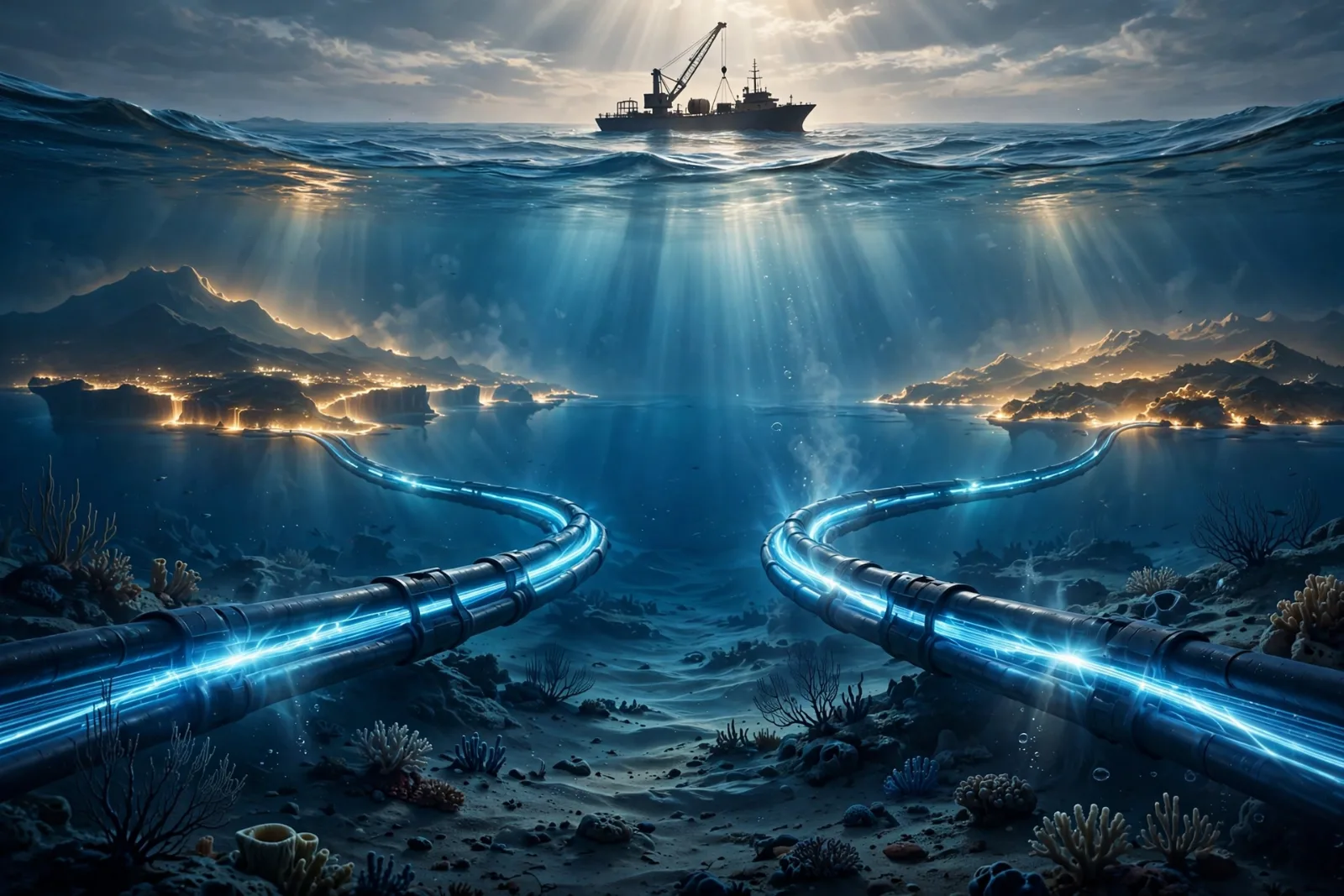
When you video-call someone on another continent, your voice doesn't bounce off a satellite. It travels through fibre-optic cables lying on the ocean floor — roughly 1.4 million kilometres of them, in about 400 to 600 cable systems, spanning every ocean on Earth. Around 99% of all intercontinental digital communications — internet traffic, phone calls, financial transactions worth trillions of dollars a day — travels through these submarine cables. Satellites, for all their glamour, carry the remaining sliver. The "cloud" you hear about is really a fleet of data centres connected by very physical, very wet cables.
Why cables beat satellites
It comes down to physics:
- Capacity. A single modern fibre pair can carry tens of terabits per second — millions of simultaneous video streams. A satellite's capacity is a fraction of that.
- Latency. Light in fibre travels fast, and the path is short. A signal to a geostationary satellite must travel 36,000 km up and back down, adding half a second of delay. Through a cable, the delay is measured in tens of milliseconds.
- Cost per bit. Once laid, moving data through a cable is extraordinarily cheap. Satellites win where cables can't go — remote areas, ships, planes — which is exactly why services like Starlink exist. But for the heavy lifting between continents, cables are unbeatable.
Anatomy of a cable: thinner than a garden hose
Despite carrying the world's data, a deep-sea cable is surprisingly slim — in the open ocean, about as thick as a garden hose. Layer by layer, from the outside in:
- Polyethylene outer sheath — waterproof insulation.
- Steel wire armour — in shallow water, extra layers of galvanised steel protect against anchors and fishing trawlers.
- Copper tube — carries electricity along the entire cable.
- Fibre-optic core — hair-thin glass strands that carry data as pulses of light. The copper layer has a vital job: powering repeaters — amplifier stations spliced into the cable roughly every 60 to 100 kilometres that boost the light signal before it fades. Without them, the signal would die within a few hundred kilometres. The electricity flows down one conductor and returns through the ocean itself.
How you lay a cable across an ocean
Specialised cable ships — there are only a few dozen in the world — spool thousands of kilometres of cable into giant tanks and pay it out as they sail. In shallow water, a towed plough cuts a trench in the seabed and buries the cable to protect it; in the deep ocean, where nothing much disturbs it, the cable simply rests on the bottom, at depths reaching 8,000 metres. The first fibre-optic transatlantic cable, TAT-8, entered service in 1988. Before fibre, the same route relied on coaxial copper cables carrying a few thousand phone calls. Today, a single cable system carries more data than the entire global internet of the 1990s — and new systems are switched on every year.
Cables vs satellites, compared
| Undersea cable | Satellite internet | |
|---|---|---|
| Share of intercontinental traffic | ~99% | ~1% |
| Capacity per system | Tens of terabits per second | Gigabits per satellite |
| Latency (continent to continent) | ~50–150 ms | ~500 ms+ (geostationary) |
| Main weakness | Anchors, trawlers, earthquakes | Weather, line-of-sight |
| Best for | Backbone of the global internet | Remote areas, ships, planes |
Who owns the ocean floor?
Historically, cables were built by consortia of telecom companies. Today, the biggest investors are the tech giants: Google, Meta, Microsoft and Amazon now own or part-own a large share of new cable systems, because AI and cloud demand keeps pushing their bandwidth needs higher. When you use Google Search or watch a Netflix show hosted in another country, there's a good chance your data crosses a cable those companies helped pay for.
When cables break
The network is resilient — traffic reroutes around damage automatically — but it is not invulnerable. There are roughly 200 cable faults a year worldwide. The causes are refreshingly ordinary:
- Ship anchors and fishing trawlers — the top culprits in shallow water.
- Earthquakes and underwater landslides, which can snap multiple cables at once.
- Occasionally, sabotage — which is why cable routes and landing stations are treated as critical infrastructure. In 2008, cables cut near Egypt knocked out or degraded internet for around 250 million people across the Middle East and India within hours — a vivid reminder that the global internet has physical chokepoints. Repairing a break means sending a cable ship to the location, grappling the cable up from the seabed, splicing in a new section, and lowering it back down — a job that can take days to weeks.
Takeaway checklist
- The big fact: ~99% of intercontinental internet traffic travels through ~1.4 million km of undersea fibre-optic cables — not satellites.
- Why cables win: far more capacity, far lower latency, far cheaper per bit than satellite links.
- How they work: data travels as light through glass fibres; repeaters every ~60–100 km re-amplify the signal, powered by electricity in the cable itself.
- How they're built: specialist cable ships lay them across ocean floors; the first fibre transatlantic cable, TAT-8, went live in 1988.
- Who owns them: telecom consortia plus Google, Meta, Microsoft and Amazon, who keep funding new systems for AI and cloud demand.
- The fragility: ~200 faults a year, mostly anchors and fishing; redundancy usually absorbs the damage — until it doesn't. Related reading: How Satellite Internet Works: From Space to Your Rooftop · How 5G Is Changing Mobile Connectivity