The Hubble Space Telescope is falling. Slowly, silently, and with no engine of its own to stop it, the most famous observatory in history is losing altitude — and NASA now expects it to burn up in Earth's atmosphere sometime in the early 2030s. On 29 October 2026, the agency made its most serious move yet to prevent that: it formally asked the commercial space industry to come up with a rescue plan.
Here is what NASA actually asked for, why Hubble is worth saving, and why this rescue attempt might succeed where earlier ones fizzled out.
Why Is Hubble Falling Out of the Sky?
Hubble orbits about 480 kilometres above Earth — low enough that the wispy outer edges of the atmosphere still reach it. That thin air creates atmospheric drag, a gentle but relentless friction that steals a little orbital energy on every lap. Without a push back up, the telescope's orbit shrinks year after year.
The numbers tell the story. When the Space Shuttle Columbia last nudged Hubble higher during a 2002 servicing mission, the telescope sat at roughly 583 km. Today it is down near 470 km — a drop of more than 110 km in 24 years, and the descent is accelerating as the orbit gets lower. A NASA lifetime analysis from July 2026 now puts a 10% probability on re-entry by September 2032, rising to 50% by December 2033, with the most likely window being 2033–2034.
Solar activity adds uncertainty: when the Sun is active, the upper atmosphere puffs up and drag increases, pulling Hubble down faster. That is why the forecast comes as probabilities, not a single date.
Unlike the International Space Station, which fires thrusters regularly to stay aloft, Hubble has no engines at all. It cannot save itself. Someone has to go up there and push it.
For more on this, see our explainer on space debris.
What Did NASA Actually Ask For?
On 29 October 2026, NASA's Goddard Space Flight Center published a Request for Information (RFI) on the US federal contracting site SAM.gov, and announced it publicly the next day. An RFI is not a contract and not a promise of money — it is the agency asking industry: what could you do, and what would you need from us?
The RFI lays out three mission options:
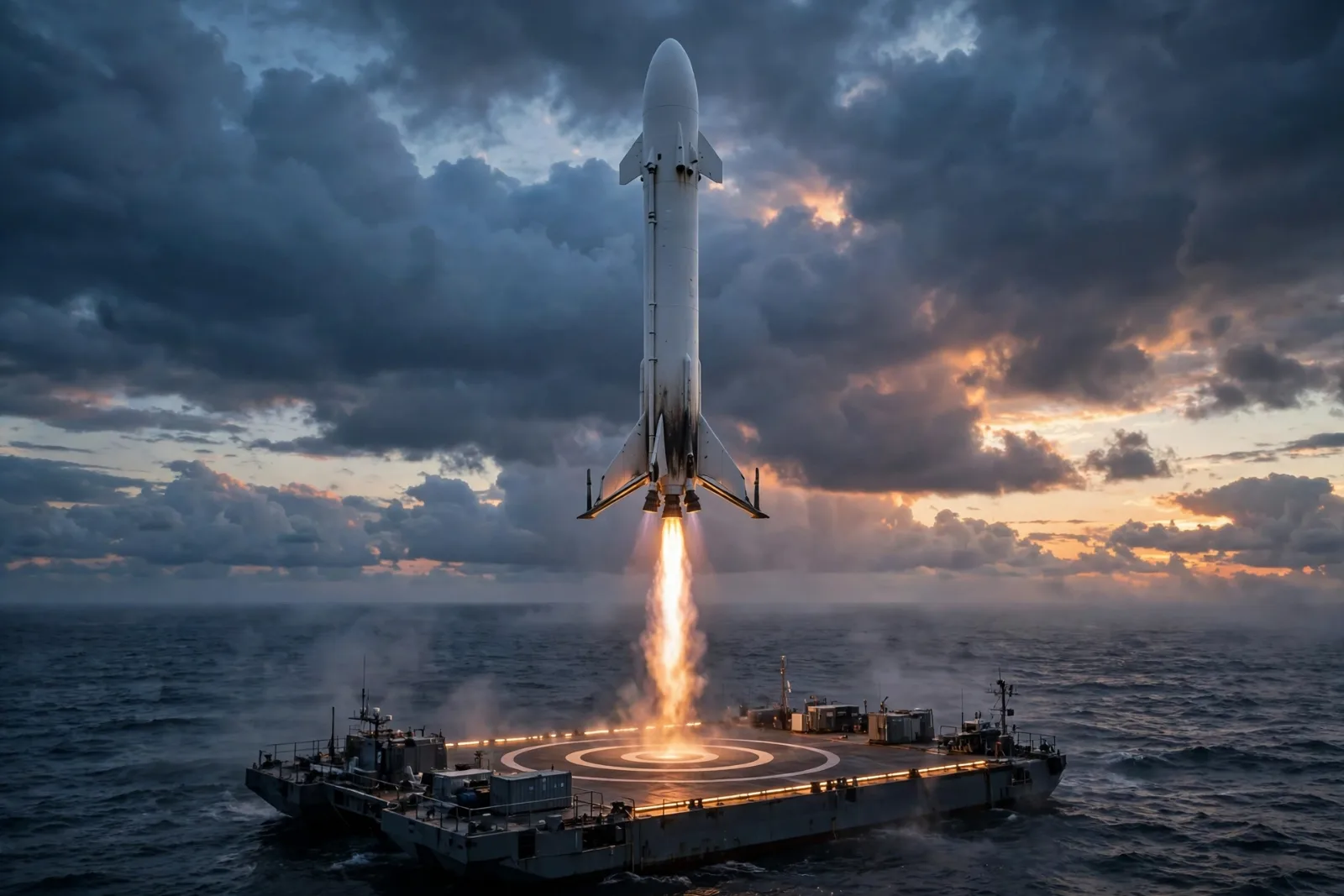
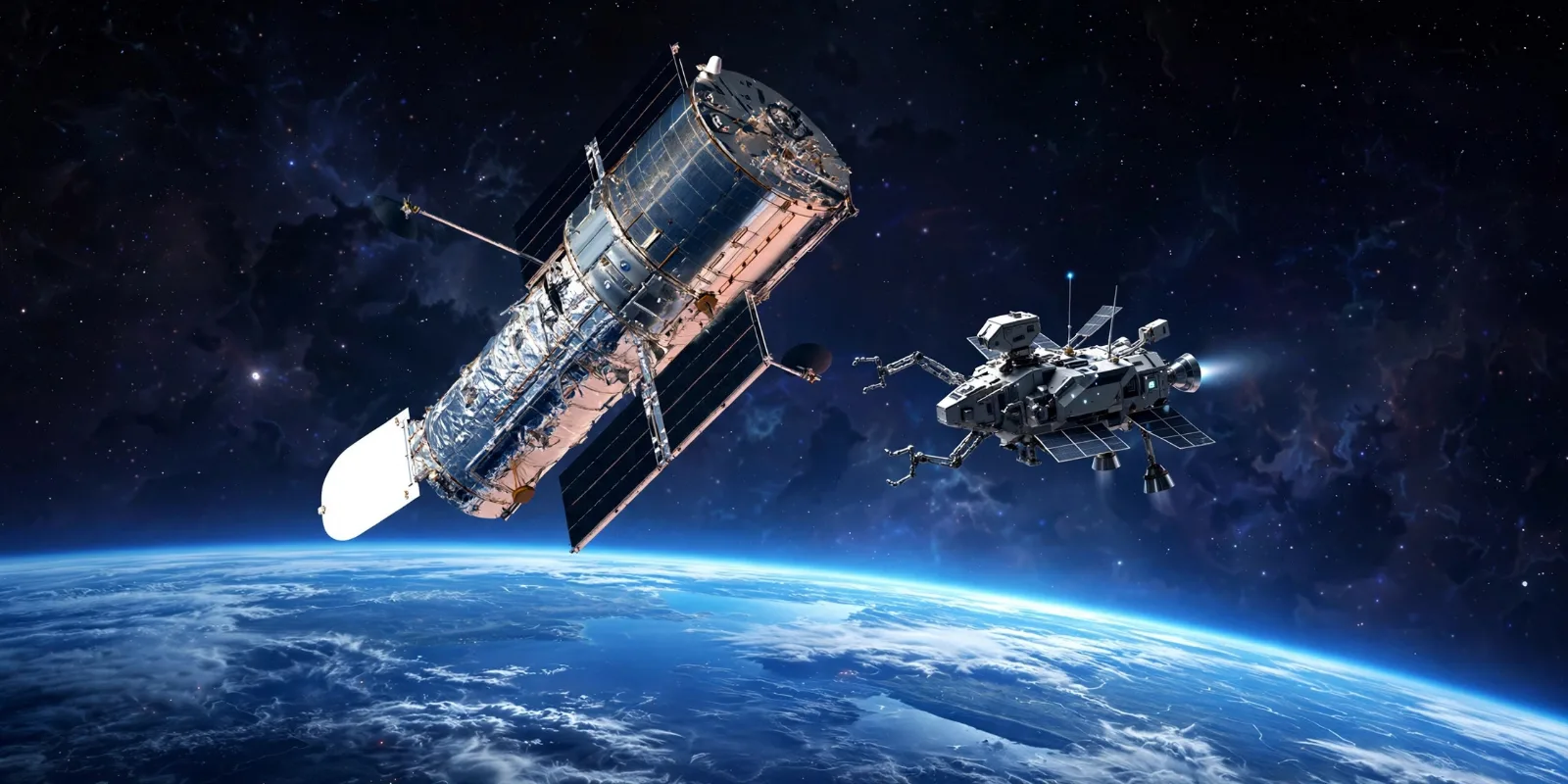
- Reboost: Capture Hubble and lift it to at least 600 km (about 373 miles). At that altitude, the telescope would likely keep working for another 25 years.
- Servicing: Fly a mission that repairs, upgrades or otherwise improves the telescope's capabilities and resilience against ageing.
- Controlled disposal: Guide Hubble to a safe, controlled re-entry — or move it to a disposal orbit — when the science is done. NASA has to plan for an ending either way.
The conditions are strict on one point: any boost or servicing mission must not harm the telescope. The contractor would supply the launch vehicle, the servicing spacecraft, all mission operations — and a crew, "if applicable". NASA wants the mission flown by 2032, and companies must submit their proposals by 3 p.m. Eastern on 30 November 2026.
"Hubble still has important science ahead of it, and we should be looking at every reasonable opportunity to keep it delivering for as long as possible," NASA Administrator Jared Isaacman said in the agency's announcement. "If there are innovative and cost-effective ways to extend the life of an asset already on orbit, we owe it to the American taxpayer and the scientific community to explore them."
Why Hubble Is Worth Saving
Hubble launched in April 1990 — 36 years ago — and it remains one of the most productive scientific instruments ever built. According to NASA, the telescope is still oversubscribed by more than seven to one: astronomers request seven times more observing time than it can provide. It still produces over 1,000 research papers a year.
Its unique value is in ultraviolet and optical light. The newer James Webb Space Telescope sees in infrared; Hubble's ultraviolet vision has no replacement and won't get one until the proposed Habitable Worlds Observatory launches — currently expected around 2040. Letting Hubble die in the early 2030s would leave a years-long gap in capabilities astronomers cannot get anywhere else.
Then there is the cultural weight. Hubble's images — the Pillars of Creation, the Deep Field, the eXtreme Deep Field — defined how humanity pictures the universe. Letting it burn up uncontrolled when a rescue might be possible would be an ignominious end for one of science's greatest achievements.
Why This Time Might Be Different
This is not NASA's first attempt. In 2022, Isaacman — then a private astronaut, before his appointment as NASA Administrator — proposed a mostly self-funded mission using a SpaceX Crew Dragon to raise Hubble's orbit. NASA ran a similar RFI that year and received eight responses, including robotic proposals from companies like Astroscale and Momentus. In 2024, the agency walked away, with its then-astrophysics chief dismissing the plans as "really just notional concepts."
Three things have changed since then:
- The technology matured. Northrop Grumman launched an advanced robotic servicing satellite with DARPA this year. Startups such as Astroscale and Starfish Space hold servicing and refuelling demonstration contracts. Catching and handling another spacecraft in orbit is becoming routine rather than experimental.
- NASA has a test case. The agency gave Katalyst Space Technologies $30 million and nine months to build a craft capable of grabbing the Swift observatory and lifting it — a smaller-scale version of exactly what Hubble needs.
- The man who proposed the rescue now runs NASA. Isaacman's 2022 Dragon proposal was shelved; as Administrator, he can reopen the question with the agency's full weight behind it.
The flip side: a crewed mission looks harder now than in 2022, because SpaceX plans to retire Crew Dragon by 2030. Robotic servicers are the likelier candidates this time.
The Three Rescue Options, Compared
| Option | What it involves | Likely outcome | Main risk |
|---|---|---|---|
| Reboost | A spacecraft grabs Hubble and pushes it to 600 km+ | ~25 more years of science | A failed capture could damage the telescope |
| Servicing | Robotic repairs/upgrades in orbit | Better performance, longer life | Complex, expensive, first-of-its-kind at this scale |
| Controlled disposal | Guided re-entry into the ocean | A safe, dignified ending | Admits defeat — but protects people on the ground |
The "must not harm" condition is the crux of the whole exercise. Any docking attempt risks damaging the very telescope it means to save — and a botched capture could end Hubble's science years early. That is why NASA is asking for detailed technology-readiness assessments and risk-mitigation plans, not just ideas.
What Happens Next
Responses are due by 30 November 2026. After that, NASA will study what industry offers — and, crucially, what it would cost. There is currently no budget line for a Hubble rescue, and the RFI explicitly asks companies what funding and other help they would need from NASA, suggesting the agency is open to cost-sharing.
A formal Request for Proposals could follow, but no date has been set. For now, this is NASA taking the market's temperature: who is interested, what can they realistically do by 2032, and at what price?
One honest caveat: an RFI guarantees nothing. The 2022 round also drew serious interest and went nowhere. But with the re-entry clock now reading single digits in years rather than decades, and with in-orbit servicing finally moving from PowerPoint to practice, Hubble's chances of rescue have never been better.
Takeaway Checklist
- Hubble is falling — atmospheric drag has pulled it from ~583 km to ~470 km since 2002, and it has no engine to climb back up.
- The deadline is 2032 — NASA wants a rescue mission flown by then; companies must pitch by 30 November 2026.
- Three options are on the table — reboost to 600 km, a servicing mission, or a controlled re-entry.
- No money is attached yet — the RFI is information-gathering, not a contract; a formal bidding process could follow.
- The stakes are real — Hubble is 7x oversubscribed, produces 1,000+ papers a year, and has no successor until ~2040.
- This attempt has better odds — in-orbit servicing tech has matured since NASA walked away in 2024, and the man who proposed the 2022 rescue now runs the agency.