You buy a smart bulb, a smart lock and a smart speaker — from three different brands — and expect them to work together. Sometimes they do. Often they do not, and the reason is buried in three words on the box: Matter, Thread and Zigbee. These are not competing brands. They are different layers of the same conversation, and once you know which layer each one sits on, the whole smart home starts to make sense.
The Short Version
- Wi-Fi, Thread and Zigbee are the networks — the roads the messages travel on.
- Matter is the language — the shared standard that lets devices from different brands understand each other.
- A Matter device is not automatically a Thread device, and a Thread device is not automatically a Matter device. They solve different problems.
Wi-Fi: The Road You Already Have
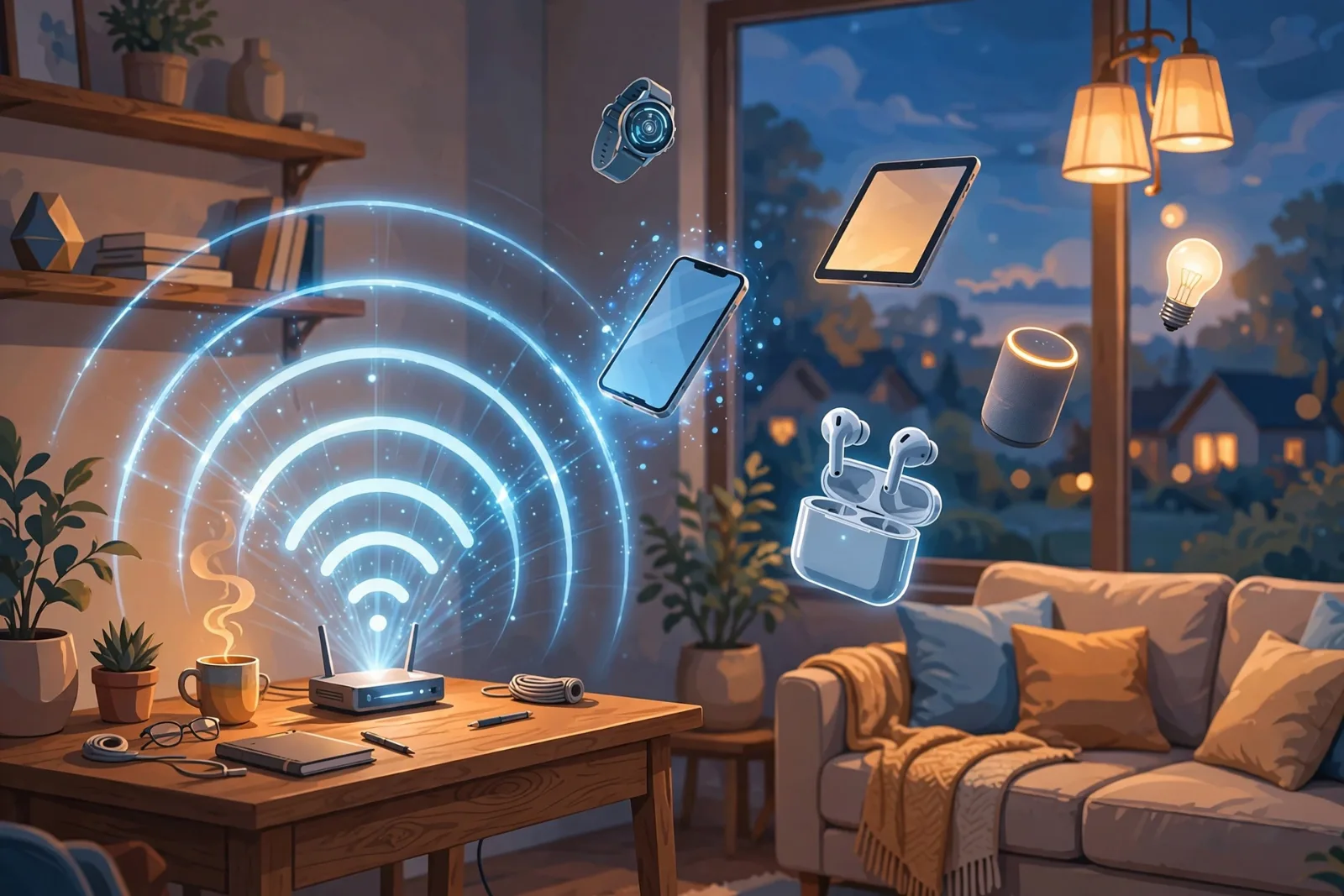
Wi-Fi is the network your phone and laptop already use. It is fast, it reaches across the house, and every smart home hub already speaks it. It is also power-hungry: a Wi-Fi radio in a battery-powered door sensor would drain it in weeks. So Wi-Fi is perfect for things that are plugged in and need bandwidth — cameras, speakers, TVs — and a poor fit for the dozens of tiny battery sensors a smart home accumulates. That is why the other two networks exist.
Zigbee: The Old Reliable Mesh
Zigbee is a low-power wireless mesh network that has been in smart homes since the early 2000s — commercially launched in 2005, built on the IEEE 802.15.4 radio standard at 2.4 GHz, the same band as Wi-Fi.
A mesh network is the key idea. Instead of every device talking directly to a central hub, each mains-powered device — a smart bulb, a smart plug, a light switch — acts as a relay, passing messages along to its neighbours. A command can hop from device to device until it reaches its destination. That extends coverage around thick walls and across floors, and if one device is unplugged, the network routes around it.
Battery-powered devices — sensors, remotes, buttons — do not relay. They just join the mesh and sleep most of the time, which is why a Zigbee door sensor can run for years on a coin cell.
The catch: every Zigbee network needs a coordinator hub — a Philips Hue Bridge, a Samsung SmartThings hub, an IKEA DIRIGERA, or an Amazon Echo with Zigbee built in. The hub manages pairing and routing, and translates Zigbee's own device language for your Wi-Fi network. And Zigbee speaks a proprietary language, so without that hub, a Zigbee bulb cannot talk to anything else.
Thread: The Newer Mesh That Speaks Internet
Thread was introduced by Nest in 2014 and is backed by the Thread Group, whose members include Apple, Google and Samsung. It runs on the same 802.15.4 radio at 2.4 GHz and forms the same kind of self-healing mesh as Zigbee — mains-powered devices relay, battery devices sleep.
The big difference is what rides on top of the radio. Thread is built on IPv6, the same addressing system the internet uses. Every Thread device gets its own IP address, just like your laptop. Zigbee devices, by contrast, speak a proprietary protocol that must be translated by a hub before it can reach your network. Thread devices speak the internet's language natively, which removes a whole layer of translation.
Thread is designed for small messages, not heavy data: the radio's total bandwidth is 250 kbps, typically around 125 kbps after overheads. That is plenty for a switch telling a light to dim, and far too little for a video camera — which is why cameras still use Wi-Fi.
Thread needs one piece of infrastructure: a border router, the device that connects the Thread mesh to your home Wi-Fi or Ethernet network. The good news is that border routers are now hiding in devices you may already own — recent Apple TVs, HomePods, Google Nest Hubs and Echo speakers all include one, and a home can have more than one for resilience.
Matter: The Language on Top
Matter is not a radio and not a network. It is an application standard — a shared language — created by the Connectivity Standards Alliance (CSA), the same body that used to be called the Zigbee Alliance. Announced in May 2021 under the name Project Connected Home over IP (CHIP), it launched in late 2022, backed by Apple, Google, Amazon and Samsung.
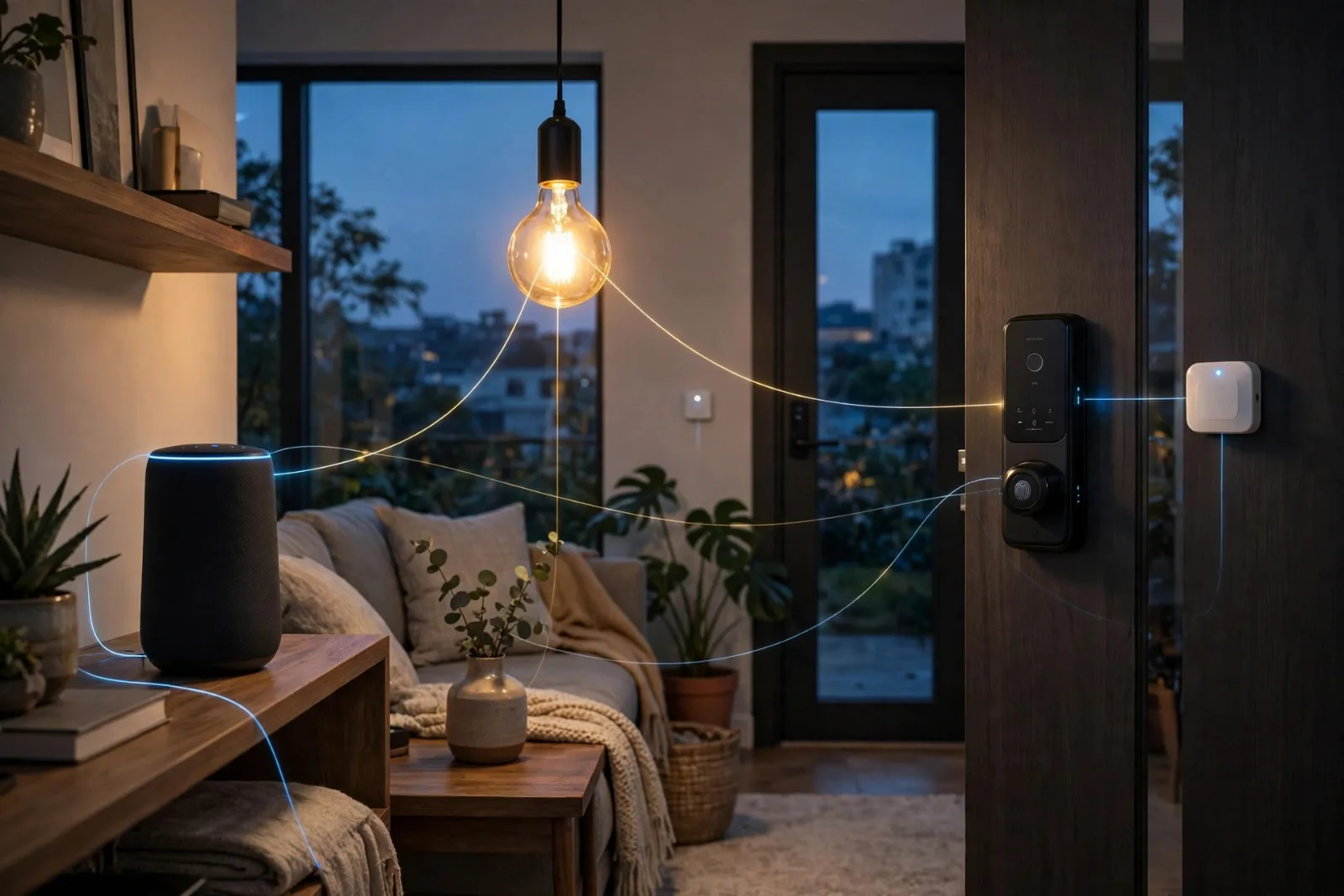
Here is the analogy that makes it click. Think of a smart home as a group of people in a room. Wi-Fi, Thread and Zigbee are the ways they can reach each other — shouting across the room, passing notes, using a phone. Matter is the agreement that they will all speak the same language once they are connected. A Matter-certified bulb from one brand and a Matter-certified controller from another can work together, because both sides agreed on what "turn on", "dim to 40%" and "you are a light" mean.
Matter runs over Wi-Fi, Thread or Ethernet, and uses Bluetooth LE only for the initial setup. The latest release, Matter 1.6, announced in June 2026, adds setup by NFC and easier sharing of devices between ecosystems. Since Matter 1.5, cameras are also covered as a device type.
Crucially, Matter does not replace Zigbee or Thread — it sits on top of them. A native Zigbee device cannot speak Matter directly; it reaches Matter only through a bridge, such as the Philips Hue Bridge exposing Zigbee bulbs to Matter controllers.
So What Should You Buy?
| Matter | Thread | Zigbee | |
|---|---|---|---|
| What it is | Application standard (the language) | Low-power IPv6 mesh network | Low-power mesh network (full stack) |
| Introduced | 2022 | 2014 | 2003 (commercial 2005) |
| Runs over | Wi-Fi, Thread, Ethernet | 802.15.4 radio, 2.4 GHz | 802.15.4 radio, 2.4 GHz |
| Needs | A Matter controller | A Thread border router | A Zigbee coordinator hub |
| Mesh? | Inherits from the network below | Yes, self-healing | Yes |
| Works locally without cloud? | Yes, designed for it | Yes | Yes |
| Typical devices | Lights, plugs, locks, sensors, thermostats, cameras | Switches, lights, sensors, locks | Lights, sensors, plugs |
For new purchases in 2026, the practical advice is simple:
- Buy Matter-certified devices where you can. They are the most likely to work with whatever app or voice assistant you use today — and the one you switch to tomorrow.
- For battery-powered sensors and switches, prefer Thread underneath (a "Matter over Thread" device). You get the mesh range and battery life, plus a border router you probably already own.
- Zigbee is not dead. If you already have a Hue or IKEA setup, it works fine and will keep working — just know that new Zigbee gear needs its own hub or a Matter bridge to join a modern setup.
- Check the box for the words "Matter over Thread" or "Matter over Wi-Fi", not just "Matter". The network underneath decides what extra hardware you need.
Why It Took So Long
It is worth asking why the smart home needed a rescue mission at all. The honest answer is that every big company tried to own the standard, and customers paid the price in incompatible gadgets and abandoned hubs. Matter is the industry's admission that a smart home only works if devices from different brands cooperate — and the fact that Apple, Google, Amazon and Samsung all signed up is what makes it different from the dozen forgotten standards before it. It is not perfect — setup can still be fiddly, and not every device type is covered — but for the first time, the box actually tells you whether something will work with your home.
Read next: How Wi-Fi Actually Works · How Bluetooth Works
Takeaway Checklist
- Networks vs language: Wi-Fi, Thread and Zigbee carry messages; Matter is the shared language that lets different brands understand each other.
- Zigbee is the veteran: a low-power mesh since 2003/2005, great battery life, but it needs its own coordinator hub and speaks a proprietary language.
- Thread is the modern mesh: same radio idea as Zigbee, but built on IPv6 so devices speak the internet's language — it needs a border router (often already inside a speaker or TV box).
- Matter sits on top: launched late 2022, runs over Wi-Fi, Thread or Ethernet; Matter 1.6 (June 2026) adds NFC setup. It does not replace the networks below it.
- "Matter vs Thread" is not a real choice — they are different layers, and most new devices are "Matter over Thread" or "Matter over Wi-Fi".
- Buying rule for 2026: choose Matter-certified devices, prefer Thread underneath for battery gadgets, and keep existing Zigbee gear — it still works, via its hub or a Matter bridge.