Your phone, your car, the traffic lights on your street — all of them run on semiconductors. These tiny slivers of engineered silicon are the foundation of modern life, yet most of us have only a vague idea of what they actually are.
This guide explains them in plain English: what a semiconductor is, how a chip travels from a pile of sand to the device in your pocket, why manufacturing them is one of the hardest things humans do, who the key players are, and what comes next.
What a semiconductor actually is
A semiconductor is a material that conducts electricity only halfway — somewhere between a conductor like copper wire and an insulator like rubber. The star of the show is silicon, refined from ordinary sand.
The trick is doping: adding tiny, precise amounts of other elements to the silicon. Doping lets engineers control exactly when and where electric current flows. That control is the basis of the transistor — a microscopic switch with no moving parts that flips on and off billions of times per second.
Think of a transistor as a microscopic tap for electricity: a modern chip packs billions of them onto silicon smaller than a postage stamp, flipping in choreographed patterns. Open and closed become the 1s and 0s of binary code, and from that simple alphabet every photo, message, and video call is built.
So when people say "semiconductor," "chip," or "microchip," they usually mean the same thing: an integrated circuit — a huge number of transistors, plus the wiring connecting them, manufactured together on one piece of silicon.
How a chip is made
Making a chip happens in three stages: design, fabrication, and packaging.
Design. Long before any silicon is touched, engineers draw the chip's circuits in specialised software — work that can take years. Companies like Apple, NVIDIA, AMD, and Qualcomm only do this step. They are "fabless": they design the chips, then pay someone else to manufacture them.
Fabrication. Sand is refined into an ultra-pure silicon crystal, sliced into thin discs called wafers. Then photolithography shines light through a stencil-like mask to etch the circuit pattern onto the wafer, layer upon layer, dozens of times. One wafer can hold hundreds of chips.
These factories — fabs — cost many billions of dollars apiece and must be cleaner than an operating room: one speck of dust can ruin a wafer.
Packaging and testing. The wafer is cut into individual chips, each wired into a protective package and rigorously tested. Only chips that pass every test get sold.
The nanometer scale. Chip generations are named in nanometers — billionths of a meter. The catch: names like "5nm" or "3nm" no longer measure anything specific on the chip. They are generation labels, like model years for cars — each new number means a denser, more efficient process, but nothing on the chip is literally 3 nanometers wide. The labels still matter: packing transistors closer makes chips faster and less power-hungry, which is why your phone does more every year on the same battery.
Why they're so hard to make
Drawing patterns smaller than the wavelength of visible light sounds impossible — with ordinary light, it is. Chipmakers get around it with extreme ultraviolet (EUV) lithography, which uses light of a far shorter wavelength to print ultra-fine features.
Here is the remarkable part: only one company on the planet builds EUV lithography machines — ASML, based in Veldhoven in the Netherlands. Its bus-sized machines are among the most complex devices ever mass-produced, the product of decades of research. Without them, nobody can manufacture the most advanced chips — giving a single Dutch company an outsized role in the entire digital economy.
Beyond the machines, chipmaking demands ultra-pure chemicals, flawless wafers, and atomic-level precision from a small club of specialist suppliers. The whole chain must work perfectly, or nothing ships.

Who makes them
The industry splits into designers and foundries — companies that manufacture chips for others.
TSMC (Taiwan Semiconductor Manufacturing Company) is the foundry giant: about 67.6% of the global contract-chipmaking market in early 2025, per industry tracker TrendForce — roughly seven of every ten made-to-order chips. It builds processors designed by Apple, NVIDIA, AMD, Qualcomm, and Broadcom.
Samsung, the South Korean electronics giant, is the world's second-largest contract chipmaker — and unlike TSMC, it also designs its own chips and sells finished phones and TVs.
Intel, the American veteran, traditionally designed and manufactured its own processors. It remains the only U.S. chipmaker with leading-edge manufacturing on American soil, and now sells factory capacity to others through its Intel Foundry business.
Notice the geography: the most advanced chipmaking sits mostly in Taiwan and South Korea — the concentration that made the chip shortage so painful, and on which data centres and self-driving cars depend.
The chip-shortage lesson of 2020–2022
In 2020 the pandemic scrambled the chip market: homebound consumers bought electronics in record numbers while carmakers — bracing for recession — cancelled chip orders. Then car demand roared back, and automakers were stuck at the back of a very long queue. Chips take months to manufacture; you cannot just restart the line.
The result: car factories idled for want of inexpensive microcontrollers, consoles stayed sold out for months, and used-car prices soared. Consulting firm AlixPartners estimated 7.7 million vehicles of lost production in 2021 alone — about $210 billion in lost revenue for automakers.
The lesson stuck: semiconductors are infrastructure, as essential as electricity. Governments answered with subsidy programs, including the U.S. CHIPS Act, to build more chipmaking at home — and companies began treating chip supply as a strategic risk, not an afterthought.
What's next
2 nanometers and beyond. TSMC began volume production of its 2-nanometer process in late 2025 at Fab 22 in Kaohsiung, Taiwan (an enhanced N2P version follows in the second half of 2026). Its redesigned "nanosheet" transistor promises roughly 10–15% more performance or 25–30% lower power than the previous 3nm generation.
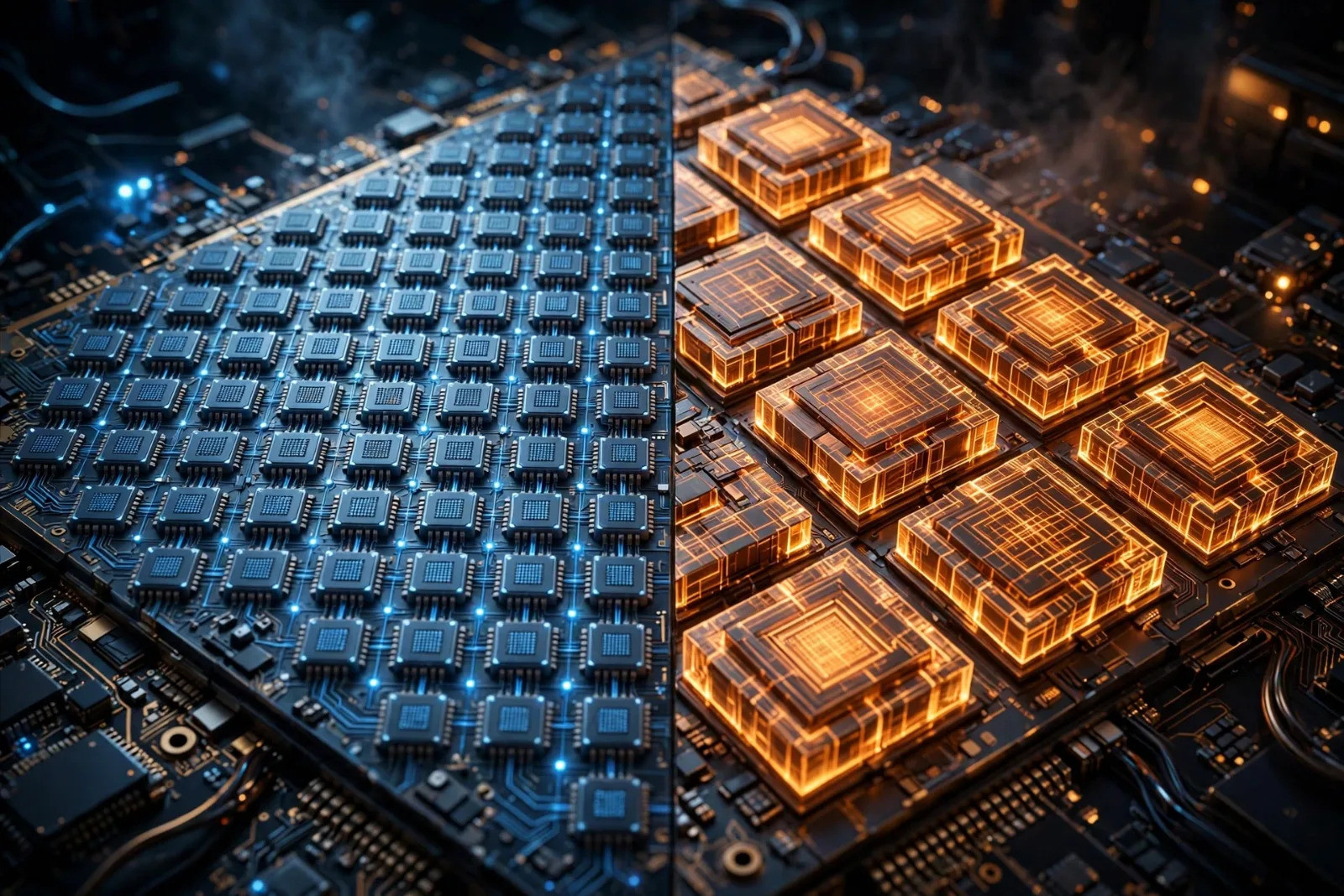
Chiplets. Instead of one giant chip, manufacturers combine smaller "chiplets" in a single package — Lego bricks rather than one carving. AMD pioneered the approach with its Zen-based Ryzen and EPYC processors; Intel uses chiplets too. Smaller dies are cheaper, easier to get right, and can mix manufacturing processes.
Up, not just smaller. As shrinking gets harder, engineers stack chips vertically in 3D, improve packaging, and design specialised AI accelerators — the same kind of efficient processors that edge computing pushes into everyday devices. The future is less about one magic number, more about clever architecture: thousands of engineers solving problems at the edge of physics.
Related reading
- Inside the Data Centers Powering AI — where millions of chips work together to train AI models.
- How Self-Driving Cars See the World — cars have become some of the hungriest chip consumers on the road.
- What Is Edge Computing and Why It Matters — why more computing is moving onto efficient chips inside your devices.
The takeaway: chips in six points
- A semiconductor (usually silicon) is a material whose conductivity engineers can switch — the basis of the transistor, a microscopic electrical switch.
- Modern chips pack billions of transistors onto silicon smaller than a postage stamp; their on/off patterns are the 1s and 0s behind all computing.
- Chips are designed in software, etched with light in ultra-clean multi-billion-dollar fabs, then cut, packaged, and tested.
- "5nm," "3nm," and "2nm" are generation names, not literal measurements — each generation denser and more efficient than the last.
- Only ASML in the Netherlands builds EUV machines; TSMC makes roughly two-thirds of the world's contract chips, with Samsung and Intel as the other giants.
- The 2020–2022 shortage (7.7M vehicles lost, $210B in lost auto revenue) proved chips are critical infrastructure. Next: 2nm, chiplets, and building upward in 3D.