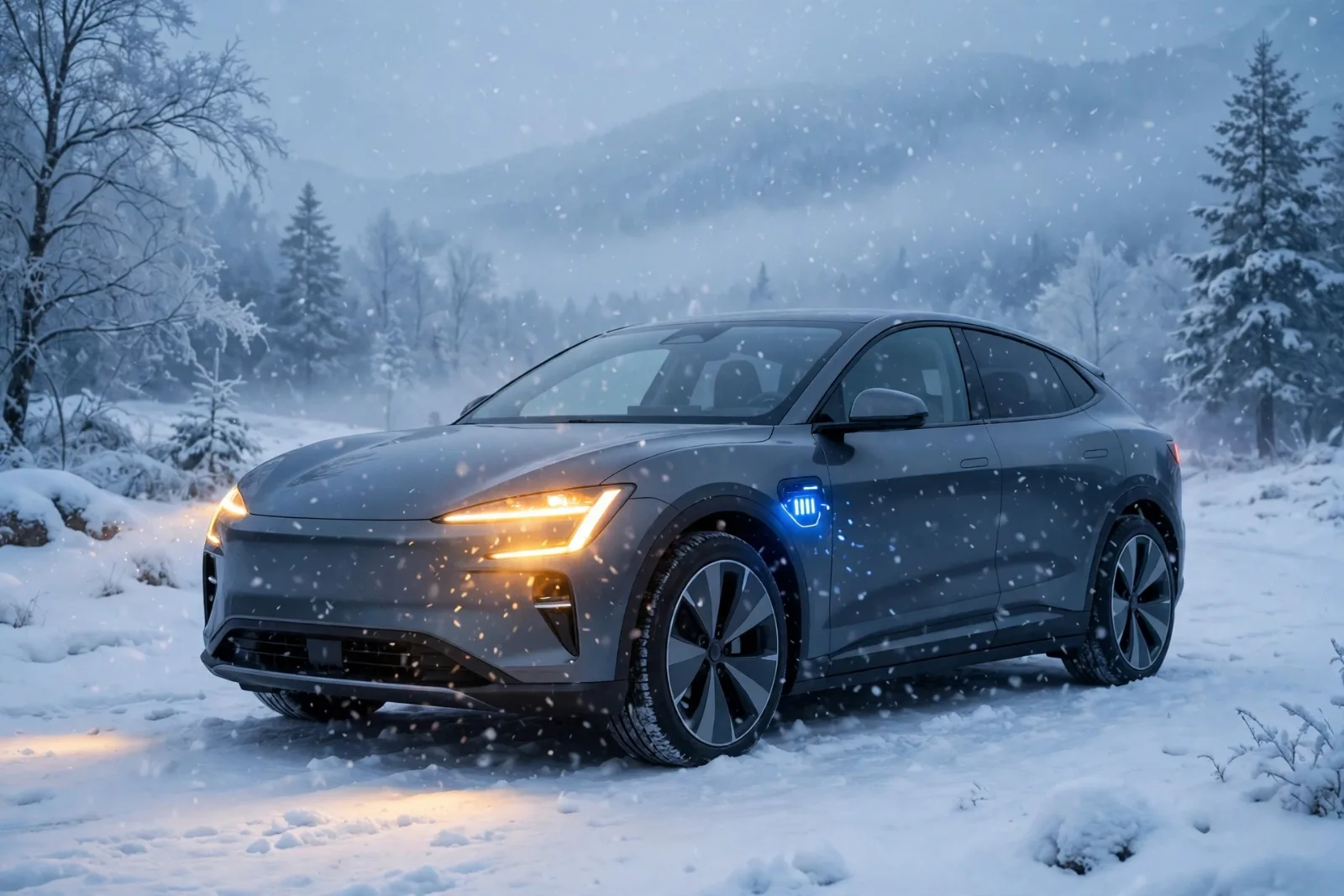
Every winter, electric car owners rediscover the same unpleasant surprise: the range estimate on the dashboard shrinks. A car that happily does 300 miles in summer might manage barely 210 in January. This isn't a defect, and it isn't your imagination. It's physics — and once you understand the two real causes, you can fight most of the loss.
Cause 1: the battery chemistry slows down
An EV battery is a lithium-ion battery — the same basic technology as your phone, just much bigger. And lithium-ion chemistry hates the cold.
Inside the battery, lithium ions shuttle back and forth through a liquid electrolyte. When temperatures drop, that electrolyte thickens like cold honey. The ions move more sluggishly, and the battery's internal resistance climbs — it can rise sevenfold or more below freezing.
What does that mean in practice? The battery can't deliver its full power, and its voltage sags under load. The car's battery management system (BMS) sees the voltage hitting its lower safety limit early and calls it quits — even though plenty of energy is technically still in there. Crucially, this effect is temporary: warm the battery back up and the "lost" range comes back. Nothing is permanently damaged by cold alone.
How big is the effect? A large 2025/26 study of 34 popular EV models found cars retained on average ~78% of their maximum range at 0°C, and ~70% at -7°C — though individual models varied widely. For the chemistry side of the story in more depth, see our explainer on lithium-ion batteries, and for what the next generation promises, solid-state batteries.
Cause 2: heating the cabin costs battery power
Here's the surprise most new EV owners don't expect: the heater can cost you more range than the cold battery does.
A petrol or diesel car is horribly inefficient — roughly two-thirds of the fuel's energy is wasted as heat. That sounds bad, but in winter it's free cabin heating: the engine is a furnace anyway, so warming the car costs nothing extra.
An electric motor is far more efficient, which means there is no waste heat to borrow. Every joule of warmth for the cabin must be manufactured from battery electricity. A conventional resistive heater — basically a giant hair dryer — draws 3 to 5 kW continuously. On a short cold-start trip, heating can easily consume more energy than actually moving the car.
This is why short winter trips are the worst case: the cabin starts freezing, the heater runs at full blast the whole way, and you arrive having used a huge fraction of the battery just to stay warm.
Heat pumps: better, but not magic
Many modern EVs now come with a heat pump instead of (or alongside) a resistive heater. A heat pump doesn't create heat — it moves it, pulling warmth from the outside air (or the battery and motors) and concentrating it into the cabin. The result: 2–3 times more warmth per kilowatt-hour, typically delivering 3–4 units of heat for every unit of electricity.
But heat pumps have a limit. Below roughly -10 to -14°C, there's so little warmth in the outside air that the pump's efficiency collapses, and the car falls back to good old resistive heating. So heat pumps are a big win for mild winters and a shrug for deep freezes.
| Resistive heater | Heat pump | |
|---|---|---|
| How it works | Converts electricity directly into heat | Moves existing heat from outside air/components |
| Efficiency | ~1 unit of heat per unit of electricity | ~3–4 units of heat per unit of electricity |
| Best for | Extreme cold (simple, always works) | Mild cold (0 to -10°C) |
| Weakness | Huge energy draw (3–5 kW) | Efficiency collapses below ~-10 to -14°C |
The winter checklist: getting your range back
You can't change the weather, but you can claw back most of the loss with a few habits:
- Precondition while plugged in. Warm the battery and cabin using wall power before you leave — preheating the cabin uses roughly 0.5–1.5 kWh that then doesn't come from your range. Most EVs let you schedule this in the app.
- Use seat and steering-wheel heaters first. Warming your body directly uses far less energy than warming all the air in the cabin. Drop the cabin thermostat a degree or two and let the seat heater do the work.
- Keep the battery's comfort zone in mind. Lithium-ion cells are happiest around 15–35°C. Parking in a garage — even an unheated one — beats parking on the street.
- Expect slower fast charging. Cold batteries charge slowly because the BMS limits current to avoid lithium plating (permanent damage). Preconditioning the battery before a charging stop helps a lot.
- Know that regen braking weakens in the cold. The car can't dump energy back into a freezing battery as aggressively, so the car may coast more and brake less regeneratively until things warm up.
- Winter tyres cost a little range. Their softer compound and chunkier tread add rolling resistance — worth it for safety, but factor in a few percent.
Takeaway checklist
- Two stacked causes: cold slows the battery chemistry (temporary, recovers when warm) and the cabin heater burns battery electricity (the bigger hit on short trips).
- Expect ~78% of summer range at 0°C and ~70% at -7°C on average, with wide variation by model.
- Heat pumps help a lot above -10°C (3–4x efficiency) but give up below about -10 to -14°C.
- Precondition while plugged in — the single most effective winter habit, costing you zero range.
- Seat heaters beat cabin heaters for energy efficiency; park in a garage if you can.
- Nothing here damages the battery permanently — cold range loss is physics, not degradation.