Solid-State Batteries Explained: The Battery That Could Double Your EV's Range
If you own a phone or an electric car, you run on lithium-ion batteries — the same basic technology that has powered gadgets since the 1990s. (We covered how they work in our lithium-ion batteries explainer.) They're good, but they're hitting their limits: charging takes too long, range anxiety is real, and every year or two a battery fire makes the news.
The technology meant to replace them is called the solid-state battery — and it has been "five years away" for about a decade. So where does it actually stand in 2026? Which companies are closest? And when will you actually be able to buy one? Here's the honest version.
The One Change That Changes Everything
A lithium-ion battery has three parts: a positive electrode (cathode), a negative electrode (anode), and the electrolyte — the medium that lithium ions travel through as the battery charges and discharges. In today's batteries, that electrolyte is a flammable liquid.
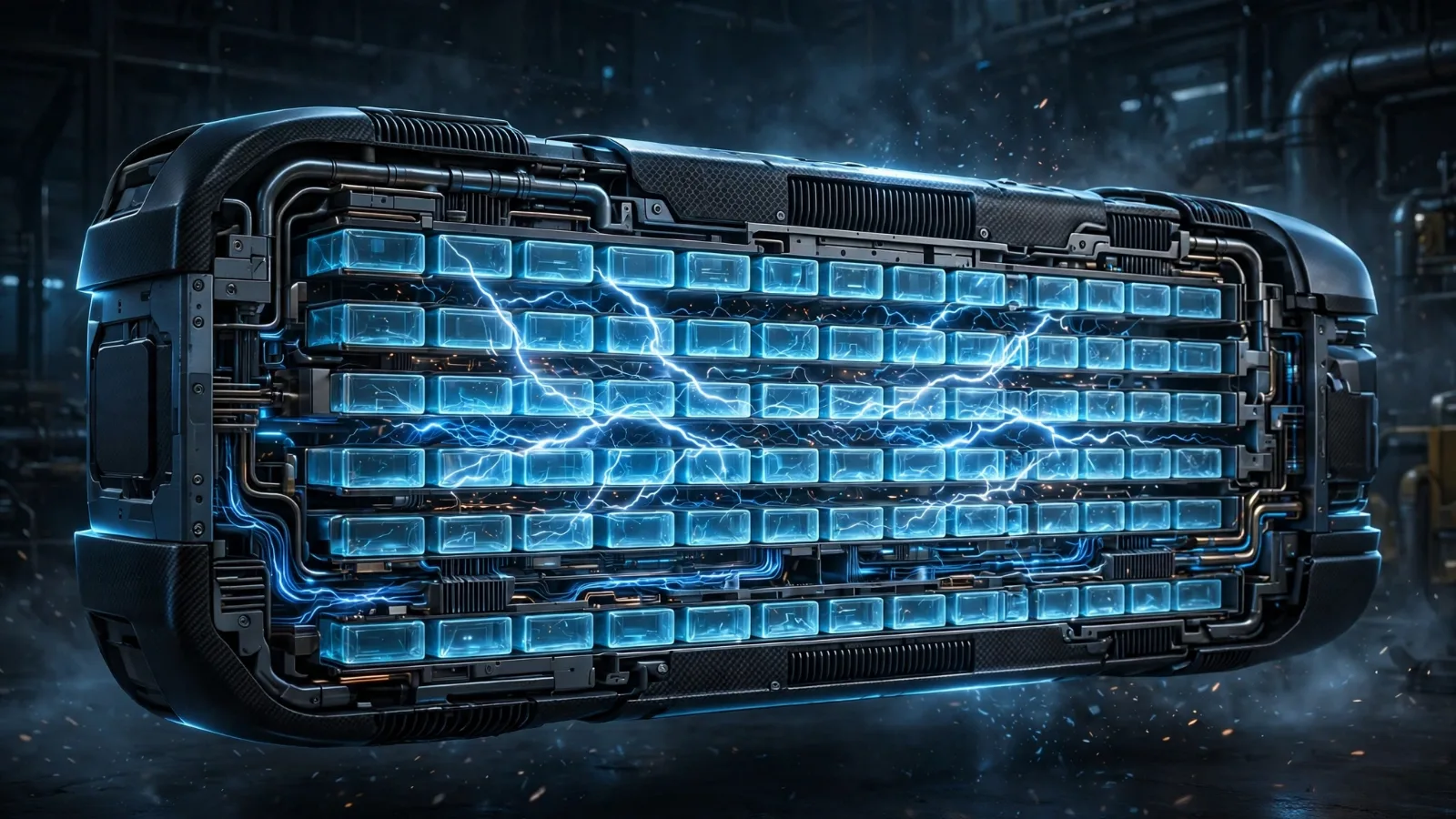
A solid-state battery keeps the same basic idea but replaces the liquid with a solid material — usually a ceramic or a sulfide-based compound. That single swap unlocks three huge advantages:
- Much higher energy density. Solid electrolytes allow the use of a lithium-metal anode, which stores far more energy in the same space. Claims range from ~450–500 watt-hours per kilogram — roughly double today's 200–300 Wh/kg. Double the density means double the EV range, or a phone battery half the size.
- Dramatically faster charging. With less resistance and better heat behavior, solid-state cells promise 10–80% charges in about 10 minutes — close to a petrol-station stop.
- Far better safety. The flammable liquid is the reason lithium-ion batteries can catch fire in a crash or after damage (engineers call this thermal runaway). No liquid, no thermal runaway — a solid-state pack is inherently much harder to set alight.
So why isn't one in your phone already? Because making the idea work in a lab and making it work in a factory are entirely different problems.
Why It's So Hard to Build
Solid electrolytes are brittle — think ceramic plate, not rubber. A battery swells and shrinks slightly with every charge cycle, and that mechanical stress can crack the solid material. They're also sensitive to moisture, and the interface where the solid meets the electrodes degrades over time.
Then there's the killer problem: dendrites. In lithium-metal batteries, tiny needle-like metal crystals can grow through the electrolyte and short-circuit the cell. Solid electrolytes were supposed to stop dendrites — in practice, they can still find their way through microscopic cracks.
Solving all of this for one cell in a lab: done. Solving it for millions of cells, made cheaply, that survive 10+ years of potholes, winters, and warranty departments: that's the frontier.
The Honest Truth: You Can't Buy One Yet
Here's the part the breathless headlines skip. As of 2026, exactly zero all-solid-state cells are installed in any vehicle a customer can buy — anywhere on Earth.
What is on the road is a bridge technology called semi-solid batteries: cells with a small amount of liquid electrolyte mixed in. Chinese automakers are selling these now — NIO's 150 kWh semi-solid pack drove an ET7 sedan 1,070 km on a single charge. Genuinely impressive, but it's a half-step, not the revolution.
And the cost gap is brutal. Current solid-state production runs roughly $600–800 per kWh, against about $130 per kWh for lithium-ion (and as low as $63–99 in China's oversupplied market). Today's solid-state cells cost 3–5 times what lithium-ion costs. Nobody reaches price parity before around 2030.
The Race: Who's Actually Closest
Dozens of companies are chasing this, but the frontrunners are pulling ahead on real hardware — not slide decks:
| Company | Battery approach | Furthest real-world step | Target |
|---|---|---|---|
| Toyota | Sulfide all-solid-state | Holds 1,000+ solid-state patents (most in the world); electrolyte plant with Idemitsu due June 2027 | First cars 2027–28, ~450 Wh/kg, ~10-min charging |
| Samsung SDI | Sulfide all-solid-state | Cells above 900 Wh/L already sampling with automakers; Korea's first all-solid-state pilot line running | Mass production H2 2027 at Ulsan |
| QuantumScape (VW-backed) | Anode-free lithium-metal, ceramic separator | QSE-5 cells: 844 Wh/L, 10–80% in ~12 min; shipping samples for pack integration in 2026 | Series production target 2029 |
| Nissan | All-solid-state | Yokohama pilot line running since Jan 2025; 23-layer prototype pack hit its targets in April 2026 | First EV in fiscal 2028, targeting $75/kWh |
| CATL (world's biggest battery maker) | All-solid-state | Technology at readiness level 4 of 9 (June 2026) | Small batches 2027 |
| Mercedes + Factorial | Lithium-metal "quasi-solid" | EQS test car drove 1,205 km (Stuttgart to Malmö) on one charge, Sept 2025 | Series production "by the end of the decade" |
| BMW + Solid Power | Sulfide all-solid-state | i7 test car running near Munich since May 2025 | No date announced |
The dates have actually firmed up rather than slipped in 2026 — which is new for this technology. The industry consensus: first commercial vehicles around 2027–29, mass production at competitive costs around 2030 or later.
What About Your Phone?
EVs get the headlines, but phones and laptops would love solid-state too — double the battery life in the same space. The catch is cost: phone batteries are a commodity business, and a 3–5× cost premium doesn't fly in a $500 phone. Expect solid-state to debut in flagship EVs and premium devices first, then trickle down as factories scale and prices fall — the same path lithium-ion took in the 2000s.
One more thing to watch: sodium-ion batteries. They use cheap, abundant sodium instead of lithium, and they're advancing fast — GM led a $108 million funding round for sodium-ion startup Peak Energy in October 2026. They won't match solid-state's density, but for cheap EVs and grid storage (see our piece on renewable energy technology), they could arrive sooner and cheaper.
Takeaway Checklist
- The idea: replace the flammable liquid electrolyte in lithium-ion cells with a solid ceramic/sulfide material — same battery concept, one big swap.
- The payoff: ~double the energy density (450–500 Wh/kg vs 200–300), ~10-minute fast charging, and no thermal-runaway fires.
- The hard part: brittle ceramics crack, moisture ruins them, and lithium dendrites still find a way through — lab success ≠ factory success.
- The honest truth: zero all-solid-state cells are in any buyable vehicle as of 2026; only "semi-solid" bridge cells (NIO, 1,070 km) are on real roads.
- The cost gap: $600–800/kWh vs ~$130/kWh for lithium-ion; parity not before ~2030.
- The leaders: Toyota (2027–28 cars), Samsung SDI (mass production H2 2027), QuantumScape (samples now, series 2029), Nissan (fiscal 2028, $75/kWh target).
- Watch sodium-ion too: cheaper and faster to market for budget EVs and grid storage — GM's $108M Peak Energy round (Oct 2026) is the signal.
Better batteries matter most for electric and self-driving cars, whose sensors and computers draw constant power.