The short answer: your phone finishes the photo for you
When you press the shutter on a modern phone, it does not take one photo. It takes a burst of frames — sometimes 10 or more — in the fraction of a second around your tap, including some captured before you even pressed. It then blends the best parts: the sharpest face, the best-exposed sky, the least-noisy shadows. This is computational photography: using processing power to overcome the limits of tiny hardware. A DSLR, by contrast, typically captures exactly what its sensor saw in a single exposure and hands it to you largely unedited. One is a finished print; the other is a negative waiting for the darkroom.
What your phone is actually doing
Multi-frame HDR
The classic trick is HDR, or high dynamic range. A sunset scene has a bright sky and dark foreground that no single exposure can capture well. Your phone shoots several exposures — some dark, some bright — and merges them, so the sky keeps its colour and the shadows keep their detail. A DSLR can do this too, but usually only if you set it up and merge the shots yourself afterwards.
Night mode
In low light, your phone takes a longer series of frames, aligns them to cancel out your shaky hands, and averages away the grainy noise. The result is a bright, clean night shot from a sensor the size of a fingernail.
Scene detection and colour
Your phone recognises what it is looking at — a face, food, a sunset, text — and adjusts colour, contrast and exposure for that subject before you see the result. Skin gets brightened, skies get deepened, food gets warmed up. A DSLR's default JPEG does some of this, but far more conservatively, because its maker assumes a photographer wants a neutral starting point.
Portrait mode
That creamy blurred background used to require a large sensor and an expensive fast lens. Your phone fakes it: it estimates depth across the scene, keeps the subject sharp, and blurs the rest with software. On a phone screen it is often convincing. Look closely at hair edges and glasses, though, and the fakery sometimes shows.
Why the small sensor still matters — and why phones win anyway
A full-frame camera sensor is roughly 30 times larger than a typical phone sensor. It gathers far more light, which means less noise, more genuine detail, and more room to recover a badly exposed shot later. Phone sensors have grown — some flagships now use 1-inch sensors — but the gap remains enormous. So why do phones still win the first impression? Because most photos are judged on a phone screen, not printed large, and because most DSLR owners never edit their shots. There is also an underrated advantage of tiny sensors: depth of field. A small sensor keeps almost everything in focus, so a casual snapshot of friends at dinner is sharp front to back.
Where the DSLR still wins — clearly
- Quick snapshot for social media: phone wins — finished instantly
- Large prints: DSLR wins — huge files, real detail
- True low light (concerts, astro): DSLR wins — more light, cleaner files
- Fast action and wildlife: DSLR wins — fast autofocus, long lenses
- Zoom beyond 5x–10x: DSLR wins — real optical lenses
- Editing freedom afterwards: DSLR wins — RAW files forgive mistakes The pattern is simple: phones win at convenience and instant finish; big cameras win at raw quality and flexibility. If you shoot in RAW on a DSLR and spend ten minutes editing, the result will beat the phone in almost every hard situation. But most people do not want a ten-minute homework assignment with every photo.
The honest verdict
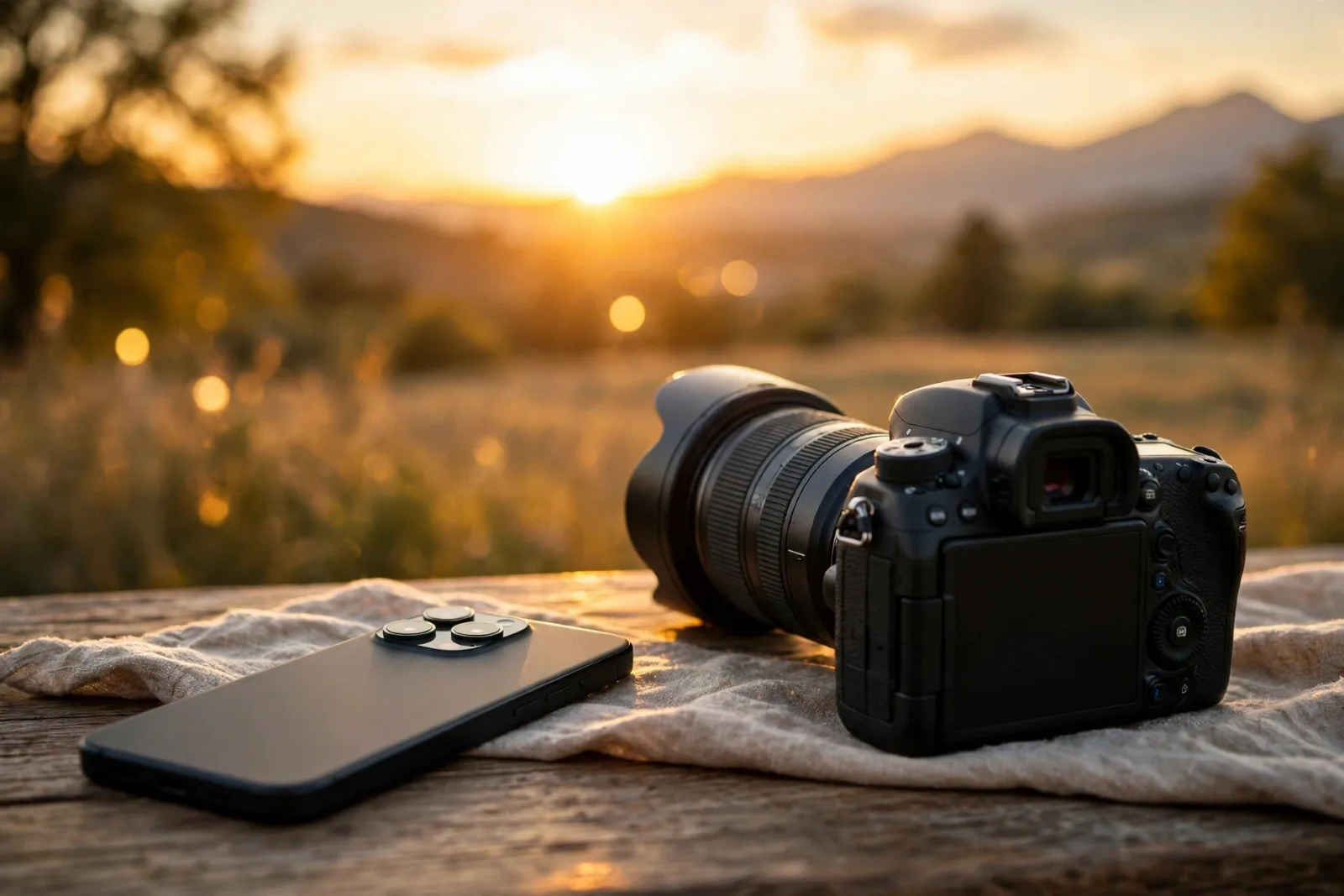
Neither side is "better" in the abstract. Your phone looks better because it does the photographer's second job — editing — automatically, in milliseconds. Your DSLR looks worse out of camera because it refuses to make those decisions for you, trusting you to make them better yourself. The two are converging: phones keep adding larger sensors and more manual control, while big cameras keep adding computational tricks. If you want to understand the hardware behind all this, read our guide to how camera image sensors work. And if you ever wonder why those finished photos look so vivid on your screen, our explainer on how OLED displays work covers the other half of the illusion.
Takeaway checklist
- Phones win instantly because they merge many frames, fix exposure, and finish the edit for you.
- DSLRs win on quality thanks to a far larger sensor, real lenses, and editable RAW files.
- Portrait blur on phones is software — convincing on screen, imperfect at the edges.
- Tiny sensors have one real perk: almost everything stays in focus, which flatters casual shots.
- For prints, zoom, and extreme low light, a big camera still wins — physics has not been repealed.
- The best camera is the one whose workflow you will actually use — instant finish versus full control.