Hold an old LCD phone next to a modern flagship and the difference is obvious: truly black blacks, richer colours, crisper motion. That gap comes down to one technology: the OLED display, now used in almost every high-end phone and smartwatch. Here is how it works, in plain English.
Each Pixel Makes Its Own Light
An LCD (liquid crystal display) works like a window with blinds: a bright white backlight shines from behind, and each pixel is a tiny shutter blocking or passing that light. The backlight stays on even for pure black — which is why LCD blacks look dark grey.
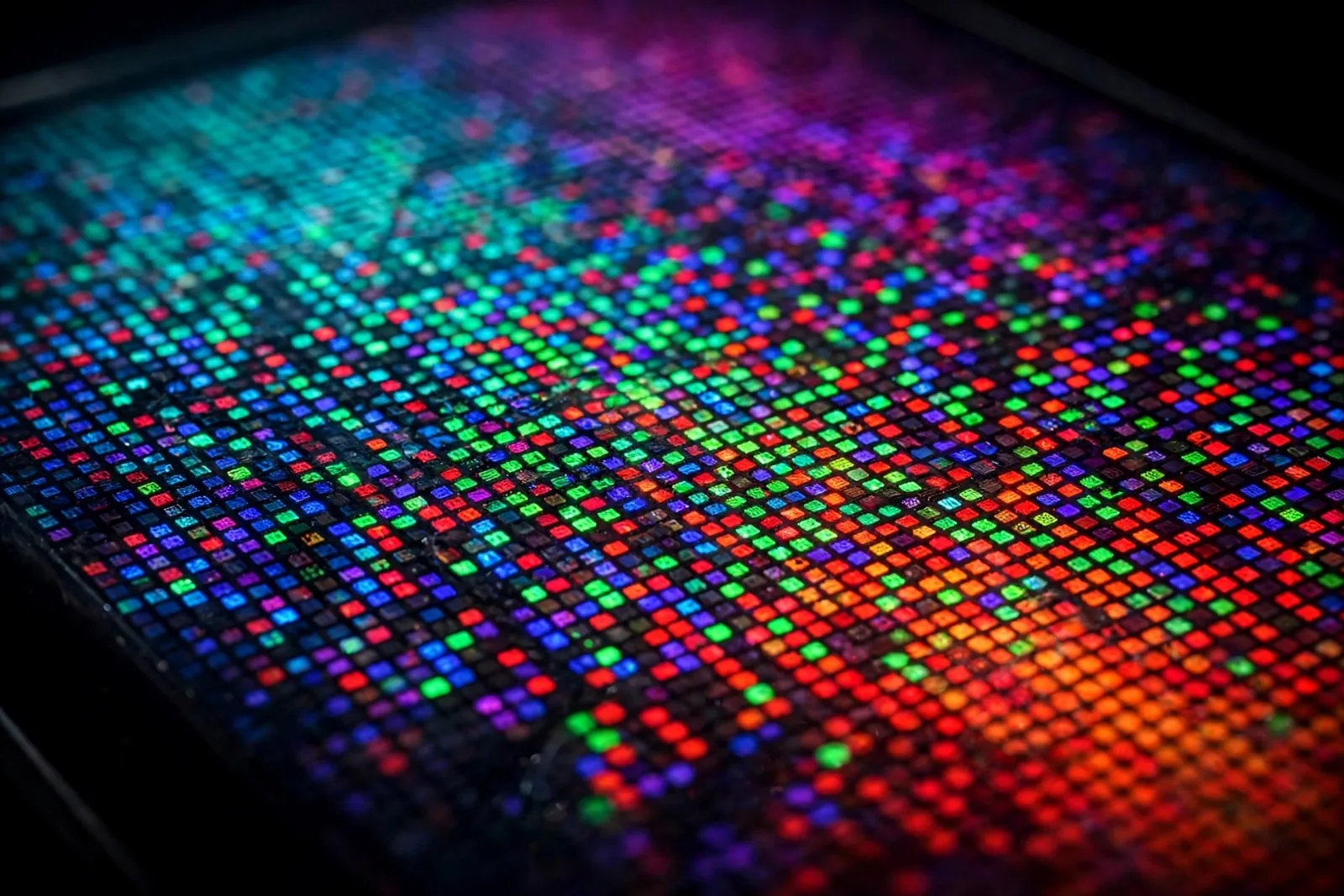
OLED — organic light-emitting diode — flips this around. "Organic" means the light comes from carbon-based chemical compounds. In an OLED screen, every pixel is its own tiny lamp, with no backlight: to show black, a pixel simply switches off. That is why OLED blacks are genuinely black.
This is also why OLED screens are so thin: with no backlight stack, the whole panel can be built from films thinner than a human hair — and it can even bend.
Inside an OLED Pixel: A Tiny Light Sandwich
Each pixel is a sandwich of extremely thin layers between two electrodes:
- Anode — a transparent electrode (usually indium tin oxide) feeding positive "holes" (missing electrons) into the layers.
- Hole transport layer (HTL) — a lane carrying those charges toward the middle.
- Emissive layer (EML) — the heart of the pixel, where light is made.
- Electron transport layer (ETL) — a lane carrying electrons in from the other side.
- Cathode — the negative electrode (often aluminium) injecting the electrons.
Apply a small voltage — typically 2 to 10 volts — and the charges race toward each other. When an electron and a hole meet in the emissive layer, the energy escapes as a photon, a particle of visible light — a process called electroluminescence.
Each pixel is built from three sub-pixels — red, green, and blue — mixed by the phone to create every other colour.
What "AMOLED" on the Phone Box Actually Means
Spec sheets usually say AMOLED: the "A" stands for active matrix — how the pixels are controlled, not a different light source.
Behind the glowing layers sits a grid of microscopic thin-film transistors (TFTs) — one per sub-pixel — switching each pixel many times per second. That enables smooth 120Hz refresh rates and snappy touch response. Most flagships add an LTPO backplane that drops the refresh rate when the screen is idle to save battery.
Why OLED Looks Better Than LCD
- True blacks and near-infinite contrast. A pixel showing black is literally off, giving dark scenes depth LCDs cannot match.
- Wide viewing angles. Each pixel shines on its own, so colours stay accurate when you tilt the phone.
- Blazing response time. An OLED pixel switches in under 10 microseconds — roughly 1,000 times faster than an LCD pixel — so scrolling stays crisp.
- Thinner and lighter. No backlight means slimmer devices — and foldables.
- Battery-friendly dark modes. Displaying black costs nothing because those pixels are off.
Quick comparison:
| Feature | OLED / AMOLED | LCD (IPS) | Mini-LED |
|---|---|---|---|
| Black levels | True black (pixels off) | Dark grey (backlight always on) | Near black (dimming zones) |
| Contrast | Near-infinite | Moderate | Very high, not infinite |
| Sunlight brightness | Good to very good | Very good | Excellent |
| Viewing angles | Excellent | Good | Good |
| Response time | ~10 microseconds | Several milliseconds | Several milliseconds |
| Thinness | Very thin | Thicker | Thicker |
| Burn-in risk | Possible (static images) | Practically none | Practically none |
Why the Same Technology Can Fold in Half
Build the sandwich on polyimide instead of glass — a heat-resistant plastic about 10 to 50 microns thick — and it becomes bendable. Add flexible encapsulation, a bend-friendly touch layer, and an ultra-thin glass (UTG) cover just 30 microns thick, and you get foldables like the Galaxy Z Fold series — rated for over 200,000 folds. LCD could never do this. For where foldables are heading next, read our explainer on Samsung's 2027 foldable lineup, including tri-folds and rollables.
The Downsides Nobody Puts on the Box
OLED is not perfect:
- Burn-in. The organic compounds age as they glow — and unevenly: blue sub-pixels wear out noticeably faster than red and green ones. Leave the same static image (a navigation bar, a news ticker) on screen for hundreds or thousands of hours and those pixels dim faster than their neighbours, leaving a faint permanent ghost — though a long-term RTINGS test only saw this after roughly 7,100 hours of identical static content, and it cannot be reversed.
- PWM flicker. Most OLED phones dim via pulse-width modulation: instead of lowering pixel brightness, they flick pixels on and off hundreds of times per second. The flicker is invisible but strongest at low brightness, and sensitive users can get eye strain or headaches. Older and cheaper panels flicker at just 200–250Hz; Samsung, Apple, and Google flagships top out around 480Hz, while some Chinese brands reach several thousand hertz. Some phones also offer DC dimming, which lowers the voltage directly instead of flickering.
- Cost. OLED panels are far more complex to make than LCDs, so they still cost more and mostly appear in mid-range and flagship devices. Samsung Display is the biggest maker — about a third of flexible OLED smartphone panels in H1 2026 — with BOE, LG Display, and others covering the rest.
See our Galaxy S27 Ultra breakdown, where the display is one of the headline features.
How to Look After Your OLED Screen
Burn-in takes a long time, but a few habits keep your screen looking new for years: vary your content (no static screen at full brightness for hours), use dark mode and auto-brightness (dark mode keeps more pixels off), leave screen-shift features on (phones nudge the image a few pixels to prevent burn-in), and lower brightness at night (this also reduces PWM flicker, which is worst at minimum brightness).
Takeaway Checklist
- OLED means each pixel makes its own light from carbon-based compounds — no backlight, so black pixels simply switch off.
- Light is made when electrons and holes recombine in the emissive layer, releasing photons — a process called electroluminescence.
- AMOLED adds a thin-film transistor backplane for fast per-pixel control — what powers high refresh rates.
- OLED wins on true blacks, contrast, viewing angles, response time, and thinness; Mini-LED and LCD fight back on brightness and price.
- Burn-in is real but slow — uneven ageing of organic pixels, worst with static images at high brightness.
- PWM flicker dims the screen by flashing pixels on and off; it bothers sensitive users most at low brightness.
- Foldable phones exist because OLED's layers can sit on flexible plastic under ultra-thin glass.
- Treat your screen well — dark mode, auto-brightness, varied content — and it will stay vivid for years.