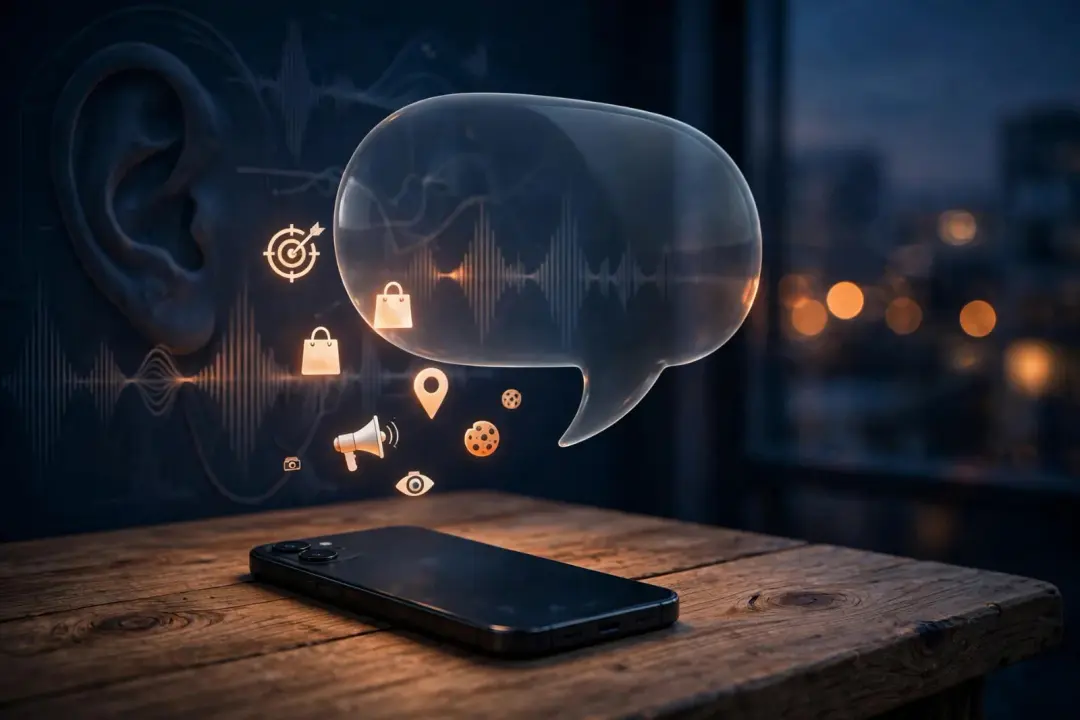
You mention a camping trip over lunch. An hour later, an ad for tents appears on your phone. You talk about getting a dog, and dog food fills your feed the next morning. It feels impossible — like your phone must have been listening. So why do you see ads for things you just talked about? The honest answer is that your phone almost certainly is not secretly recording your conversations. The real explanation is stranger, and it is also easier to do something about.
The Short Answer: Probably Not Listening
In 2018, researchers at Northeastern University ran a study called Panoptispy, examining more than 17,000 Android apps with microphone access. They found no audio leaks at all — no app secretly sent recordings anywhere. No credible investigation since has found a major app recording conversations at scale for ads. Always-on eavesdropping would be a terrible business model: a company would have to record millions of phones continuously, transcribe everything, and hide it from battery use, data use and permission screens — and recording private conversations without consent is illegal in many places. Your phone may record you in specific situations, but the microphone is not the main way advertisers learn about you — because they do not need it.
Why It Feels So Real
If nobody is listening, why does the ad land so precisely? Four things combine to create the illusion.
1. You forget the searches. You talk about tents at lunch — but did you also Google "two-person tent" last week, or linger on a camping video for thirty seconds, or open a friend's link to a tent? You forget the click. You remember the conversation. The ad feels like it came from the talking, when it came from the tapping.
2. Your brain notices the hits and ignores the misses. This is called the frequency illusion (or Baader–Meinhof phenomenon). Once a topic is on your mind, you notice every ad about it — and forget the hundreds of ads about things you never mentioned. You talk about dozens of topics a day; the one that gets an ad is the one you remember.
3. Someone near you searched it. You talk about tents with a friend. Your friend searches for tents on their phone, on the same Wi-Fi network, from the same location. Advertising systems group people by household, location and shared networks — so your friend's search can put tent ads on your screen.
4. Location gives it away. Your phone knows where you are and where you have been. Visit a camping shop on the weekend and an ad for camping gear can follow you for weeks, even if you never bought anything. You talked about the trip because you were already thinking about it — and so was the ad system.
What Advertisers Actually Use Instead
Advertising platforms do not need your voice, because you hand them something better all day: your behaviour. The machinery is public — the platforms document it for their advertisers — and it comes down to a few mechanisms.
- What you browse. Millions of websites and apps carry small pieces of platform code, like the Meta pixel, that report your visits, searches and abandoned shopping baskets back to the ad systems.
- What you search. Typing "best walking shoes" into a search box is a far stronger signal than saying it out loud. A search is a direct statement of intent.
- Where you go. Meta openly lets advertisers target people who live in, recently visited, or often go to a particular place. Your location history is a powerful predictor of what you might buy.
- What you pause on. The time you spend on a video, the posts you linger over, the products you almost buy — all of it feeds your profile.
- Your advertising ID. Your phone carries an advertising identifier, a sort of anonymous label that lets different apps and websites recognise the same person moving between them. Combined with cross-device tracking — your phone, laptop and tablet linked through a shared account — one profile follows you everywhere.
- People like you. Advertisers can target "lookalike" audiences: people whose behaviour resembles that of existing customers. If thousands of people who bought tents also read the same articles you read, you can get the tent ad without ever searching for one.
Put together, these signals let ad systems predict what you will want — often before you have decided yourself. That is the stranger truth: the system does not react to what you said. It guesses what you will do next from data you gave it without noticing.
The "Active Listening" Story That Wasn't
In 2023, it briefly looked as if the listening myth had finally been confirmed. The outlet 404 Media published marketing materials from the American media company Cox Media Group, advertising a service called Active Listening — supposedly ad targeting based on what people said near their phones, TVs and smart speakers, in real time.
Google dropped the company from its partner programme. Meta said it does not use the microphone for ads. Amazon said it had never worked with the programme. Then, in May 2026, the US Federal Trade Commission closed the matter. Its investigation found there had been no listening at all. The company was simply reselling email lists bought from data brokers at a huge markup, and deceiving clients by passing this off as eavesdropping technology. The only company that ever publicly bragged about conversation-based ads turned out to be a fraud — and it was cheating advertisers, not users.
The Exceptions That Keep the Rumour Alive
A few real cases keep the suspicion going, and they are worth knowing about honestly.
Voice assistants do listen — for a wake word. The "Hey Siri" or "Hey Google" listener analyses a rolling few seconds of sound on your device, listening for one acoustic pattern. Google's own documentation says that if no activation is detected, those snippets are not sent or saved anywhere. But a similar-sounding phrase can trigger the assistant by mistake. Apple agreed to pay $95 million to settle a lawsuit claiming Siri activated accidentally and recorded private conversations. Researchers also showed in 2023 that Amazon uses what you say to Alexa itself to work out your interests and target ads — not secret listening, but data you gave the assistant on purpose, used in a way most people did not expect.
How to Make the Ads Less Creepy
You cannot stop ad targeting entirely, but you can cut off most of the signals that make it feel like mind-reading.
- Turn off ad personalisation. On iPhone: Settings → Privacy & Security → Apple Advertising → turn off Personalised Ads. On Android: Settings → Privacy → Ads → delete your advertising ID. On Google: myadcenter.google.com lets you switch off personalised ads.
- Stop apps tracking you across apps. On iPhone, when an app asks "Allow tracking?", tap "Ask App Not to Track". On Android, check Settings → Privacy → Ads.
- Review microphone permissions. Both phones now show a visible indicator when the mic is in use — an orange dot on iPhone, a green dot on Android — and a privacy dashboard lists exactly which apps used the microphone and when. Remove mic access from any app that does not need it.
- Clear your ad history. Google, Meta and TikTok all let you see and delete the interests they have assigned to you, and the off-platform activity they have recorded.
- Use a browser that blocks trackers. Private browsing and tracker-blocking browsers stop much of the Meta pixel and third-party tracking that feeds the system.
- Check your voice assistant's recordings. Both Google and Amazon let you review and delete the voice recordings they hold, and switch off saving them.
Takeaway Checklist
- Your phone is almost certainly not secretly recording your conversations for ads — a study of 17,000+ apps found no audio leaks, and the economics of mass eavesdropping do not add up.
- The ads feel personal because of behaviour, not voice: searches, location, browsing, and the time you spend on content.
- You forget the searches and remember the conversations — the frequency illusion makes coincidences feel like proof.
- The one company that claimed to sell "Active Listening" ads was a fraud — the FTC found in May 2026 that it was reselling data-broker email lists.
- Voice assistants are the real exception: accidental activations happen (Apple paid $95 million over Siri), and what you say to Alexa can shape ads.
- Take control: switch off ad personalisation, delete your advertising ID, check microphone permissions, and review the interests Google and Meta have assigned to you.
Internal links: Why Do Websites Ask You to Accept Cookies? · What Is a VPN?