If you have ever woken up and wondered how a small device knew when you fell asleep, you are asking a fair question. The short answer to how do fitness trackers measure sleep is that they do not measure sleep directly. They measure a handful of signals from your body, then estimate when you were asleep and which stage you were probably in. That explains why trackers can be useful — and why their charts deserve a sceptical eye.
What your tracker is actually measuring
A clinical sleep study, known as polysomnography or PSG, is the reference standard. In a sleep laboratory, sensors on the scalp record brain waves, while other sensors record eye movements, muscle tone, breathing and heart rhythm. A trained scorer works through the night in 30-second slices, labelling each one awake, light, deep or REM sleep. A consumer tracker does none of that: it has no brain-wave sensor, and it sits on your wrist, finger or chest and watches four much simpler signals, then infers the rest.
The four signals, and what each one can and cannot do
| Signal | What it measures | Its limits |
|---|---|---|
| Movement | Motion, via an accelerometer. | Lying still while awake looks like sleeping. |
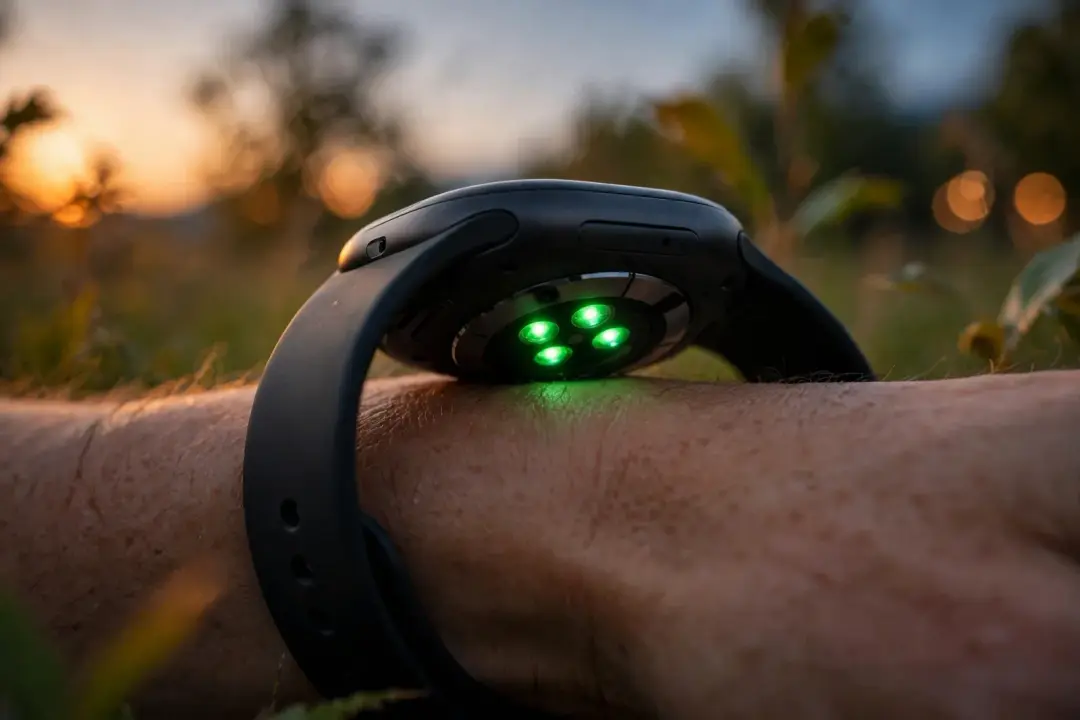
| Heart rate and heart-rate variability | Heart rate, via an optical PPG sensor. | Needs steady skin contact. |
| Blood oxygen (SpO2) | Oxygen saturation, via red and infrared light. | A broad pattern, not a diagnosis. |
| Skin temperature | Small temperature changes through the night. | Supporting evidence only. |
Movement is still the backbone of sleep tracking, even though it is the simplest signal. Early trackers relied on it almost entirely: if you stopped moving, the device assumed you had fallen asleep. Modern devices layer the other signals on top, so a still body with a slowing heart rate looks more like sleep than one with a racing heart. Heart rate does most of the extra work: it tends to slow in deeper sleep, and its rhythm shifts again during REM sleep. The tiny variations between beats, known as heart-rate variability, add another layer, while blood oxygen dips can point to disturbed breathing. No signal measures a stage by itself; together, they give the algorithm something to work with.
How sleep stages are guessed, not measured
When your app shows neat coloured blocks for light, deep and REM sleep, it is showing you estimates, not measurements. The stages are inferred, not measured, and that is why fitness tracker sleep stages should be treated as a rough guide.
Makers train machine-learning algorithms on sleep-laboratory data, where the true stages are known from polysomnography. The algorithm learns which combinations of signals tend to go with which stage, then predicts the most likely stage at home. Our guide to what is a neural network, explained covers that kind of system in plain English.
Because each maker trains its own algorithm and keeps the details private, different devices can reach different conclusions from the same night. A ring and a watch worn together can give different stage splits, and neither is necessarily wrong: they are two estimates from different sensors and algorithms. Our explainer on how do smartwatches actually work walks through the sensors and the processing.
How accurate are they really?
So, are sleep trackers accurate? Lab studies give an honest picture: trackers are good at the broad question and much weaker at the fine detail. That balance is at the heart of sleep tracker accuracy.
When researchers compared trackers against polysomnography, the devices agreed with the laboratory on sleep versus wake for 86–89% of the night, in a 2022 study of 53 adults. They also gave a fair estimate of total sleep time: how long you actually slept, not how long you spent in bed.
The picture changes at the finer level. The split into light, deep and REM sleep matched the laboratory only 50–61% of the time for wrist, ring and strap devices. The stage chart is right about half the time, so one night's exact deep-sleep minutes should not be treated as precise.
Trackers also tend to overestimate sleep on broken nights, because they are weak at spotting time spent awake in bed. If you lie still, unable to sleep, the sensor sees stillness and the algorithm may conclude that you are asleep. Accuracy figures also belong to specific device generations and software versions: a firmware update can change the output of the same device overnight, because the algorithm itself has changed — another reason to watch the pattern over weeks, not one night's numbers.
Sleep apnoea flags are a screening tool, not a diagnosis
Some newer watches flag possible sleep apnoea from accelerometer data. For example, some Apple Watch Series 9, Series 10 and Series 11 models analyse 30 days of data and can raise a flag if the pattern suggests repeated breathing disturbances. This is a screening flag, not a diagnosis — a prompt to speak to a clinician, who can arrange a proper sleep study. A flag does not mean you have sleep apnoea, just as no flag does not prove that you do not. A tracker is good at noticing patterns; it cannot diagnose a sleep disorder. If you suspect you have one — heavy snoring, gasping, exhaustion despite long nights in bed, or falling asleep during the day — see a clinician rather than relying on an app.
How to get the most useful reading from your tracker
- Wear the device snugly. The heart-rate sensor needs steady skin contact; a loose strap gives a patchy reading.
- Keep a consistent sleep schedule. Regular bedtimes make week-to-week comparisons fairer.
- Keep the app and firmware updated. Updates can improve the algorithm.
- Trust trends over weeks more than one night. Watch whether total sleep time drifts up or down over a fortnight.
- Do not let a number decide how you feel. A bad sleep score can itself make you feel worse, so if you wake up rested and the app disagrees, trust your own body.
Takeaway checklist
- Trackers do not measure brain waves. Only polysomnography measures brain activity directly.
- They measure movement, heart rate, blood oxygen and skin temperature, then infer sleep stages.
- Stages are estimated by machine-learning algorithms trained on sleep-laboratory data; makers use different algorithms.
- Trackers agree with the laboratory on sleep versus wake for 86–89% of the night, but their stage split matched it only 50–61% of the time.
- They overestimate sleep on broken nights, because lying still while awake looks much like sleeping.
- Two devices can disagree on the same night, and a firmware update can change the same device's output overnight.
- Wear the device snugly, keep a consistent schedule, keep software updated, and trust trends over weeks.
- Sleep apnoea flags are a screening prompt to see a clinician, not a diagnosis.
- This is general information, not medical advice. If you suspect a sleep disorder, see a clinician.