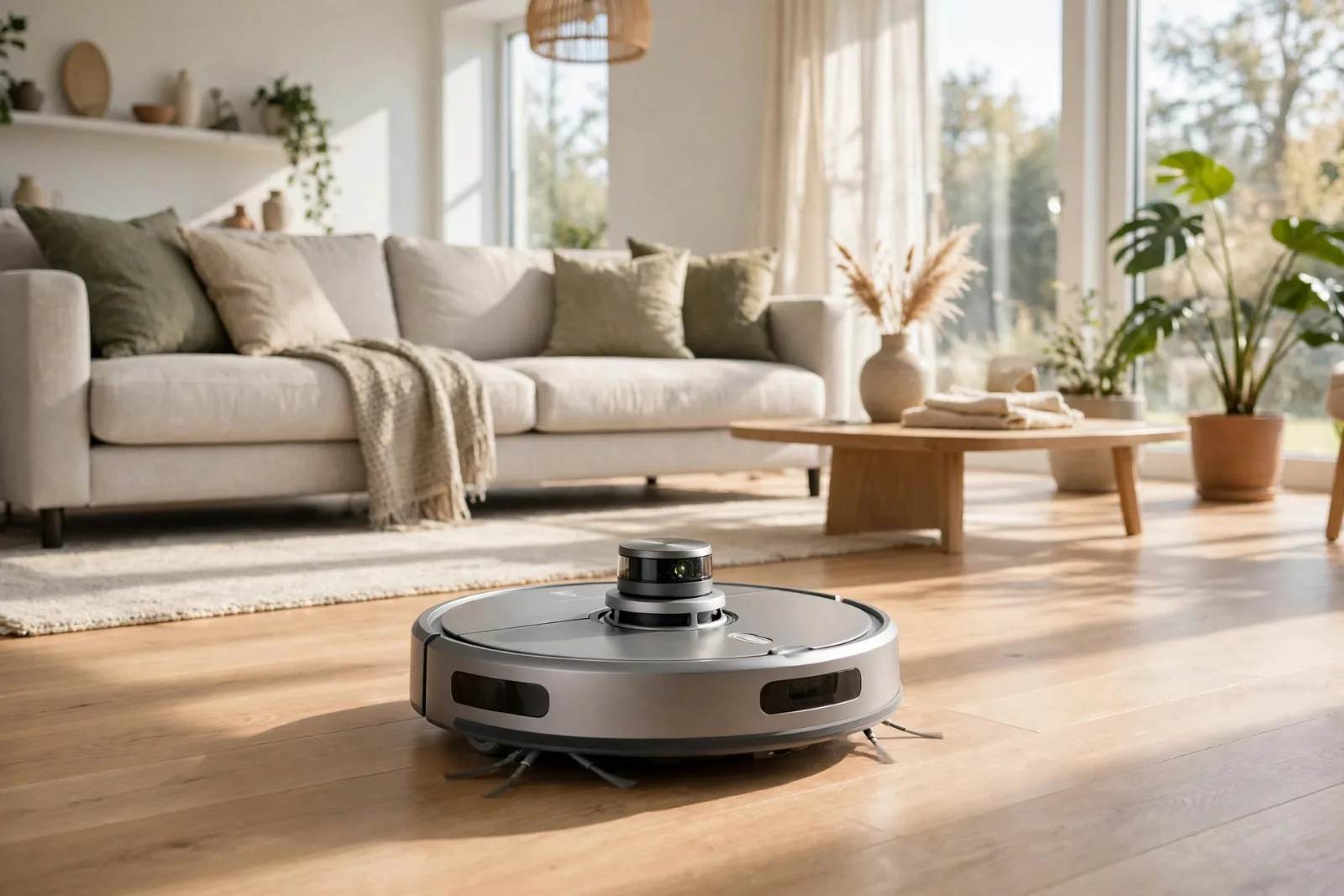
It is a flat disc that wanders your home, disappears under the sofa, avoids the stairs, and returns to its dock when it is done — sometimes emptying itself. A robot vacuum looks like a toy, but it is a small self-driving machine: it maps your rooms, plans a route, senses danger, and cleans as it goes. Here is how it pulls that off.
More than a disc with a brush
Strip away the marketing and a robot vacuum has four jobs: know where it is, know where it has been, pick up dirt, and get home to charge. Everything inside it serves one of those jobs — the spinning turret on top, the cliff sensors underneath, the brushes below, and the little computer tying it all together.
Early robot vacuums from the 2000s did none of this cleverly. They bounced around randomly, like a ball in a pinball machine, and cleaned by luck and repetition. Modern ones build a proper map of your home and clean in neat rows, like mowing a lawn. The difference is the sensors.
How it sees your home: LiDAR, cameras, or bumps
There are three ways a robot vacuum navigates, and the price usually tells you which one you are getting:
- LiDAR (the spinning turret): a laser spins around several times a second, measuring how long the light takes to bounce off your walls and furniture. It builds an accurate map in the dark, works in any light, and is the most reliable method. This is the little tower you see on top of better models.
- Camera-based (vSLAM): a camera on top or front takes pictures as it moves and tracks landmarks — corners, door frames, furniture edges — to work out where it is. It is cheaper than LiDAR but struggles in the dark and can be fooled by blank walls.
- Random bounce (bump sensors): the cheapest models have no map at all. They drive straight until they hit something, turn a random amount, and carry on. Given enough time they cover most of the floor, but they miss spots and waste battery.
The same laser-and-camera thinking drives bigger machines too — see how drones stay stable in the air and how self-driving cars see the world.
SLAM: building a map as it cleans
The clever bit is called SLAM — Simultaneous Localisation and Mapping. As the vacuum moves, it builds a map of your home while also tracking its own position on that map. It is a chicken-and-egg problem — you need a map to know where you are, and you need to know where you are to draw the map — and SLAM solves it by constantly updating both at once.
The result is the floor plan you see in the app: rooms, walls, furniture, and a little dot showing where the robot is right now. Once it has the map, it can plan the most efficient route — straight lines, room by room — instead of wandering. It can also remember the map between cleans, so it can go straight to the kitchen when you ask it to, and so you can draw no-go zones on the map to keep it out of the kids' play area or the dog's water bowl.
The sensors that stop it falling down the stairs
A robot vacuum is covered in sensors whose only job is to keep it alive:
- Cliff sensors underneath use infrared light to check the floor is still there. If the signal vanishes — a stair edge — the robot stops and turns around.
- Bump sensors in the front bumper register a gentle touch, so it can feel its way around chair legs and skirting boards without ramming them.
- Wall sensors keep it tracking along edges, where dust collects.
- Dirt sensors (on some models) detect extra dust passing through and tell the robot to go over that spot again.
- Drop and lift sensors stop the brushes if you pick the robot up mid-clean.
It is the same family of sensing that keeps a drone hovering and a car in its lane — small, cheap sensors, combined by software into something that looks like common sense.
How it actually cleans
Navigation gets it to the dirt; the cleaning system picks it up. Underneath you will usually find:
- A side brush that spins like a whisk, flicking dust out of corners and along edges into the robot's path.
- A main roller brush that agitates carpet fibres and sweeps debris toward the suction inlet.
- Suction, measured in pascals (Pa) — modern models quote several thousand Pa, enough to pull dust from carpet pile, though raw suction matters less than brush design.
- A dustbin with a filter, typically holding a few hundred millilitres — small, which is why the robot empties itself or needs you to empty it after a few runs.
Many models now mop too: a water tank and a damp pad drag behind the vacuum, and fancier ones lift the pad when they detect carpet. The newest docks go further — self-empty stations suck the dustbin clean into a bag, wash the mop pads, and refill the water tank, so you might only touch the machine once a month.
Battery and brains
Most robot vacuums run on a lithium-ion battery giving roughly 90–180 minutes of cleaning, depending on the suction setting and the size of your home. When the battery runs low, the robot returns to its dock, charges, and — if it has a map — resumes exactly where it left off. That is what makes whole-home cleaning possible despite a battery that would never last a full house in one go.
The "brains" are modest by smartphone standards: a small processor running the SLAM map, the route plan, and the Wi-Fi connection to your phone. The app is where you see the map, schedule cleans, set no-go zones, and tell it to clean only the kitchen after dinner.
The three navigation types, compared
| Random bounce | Camera (vSLAM) | LiDAR | |
|---|---|---|---|
| How it navigates | Drives until it hits something, then turns | Tracks visual landmarks with a camera | Spins a laser to measure distances |
| Map | None — cleans by luck | Yes, built from pictures | Yes, accurate to centimetres |
| Works in the dark? | Yes | Poorly | Yes |
| Room-by-room cleaning | No | Yes | Yes |
| Typical price | Cheapest | Mid-range | Mid to high-end |
If you have a small flat with hard floors, a cheap bump-and-go model may be enough. For a big house with carpets and pets, the map is worth paying for — it is the difference between a gadget and a cleaner.
Takeaway checklist
- A robot vacuum is a small self-driving machine — its real job is navigation, not just suction.
- LiDAR models build the best maps by spinning a laser; camera models track landmarks; cheap ones just bounce around.
- SLAM lets it map your home while tracking itself, so it cleans in neat rows and remembers rooms between cleans.
- Cliff sensors stop it falling down stairs, bump sensors feel furniture, and dirt sensors trigger a second pass.
- Self-empty docks are the real convenience upgrade — the robot empties its own bin and washes its own mop pads.
- Battery life is 90–180 minutes, but a good robot recharges and resumes where it left off.