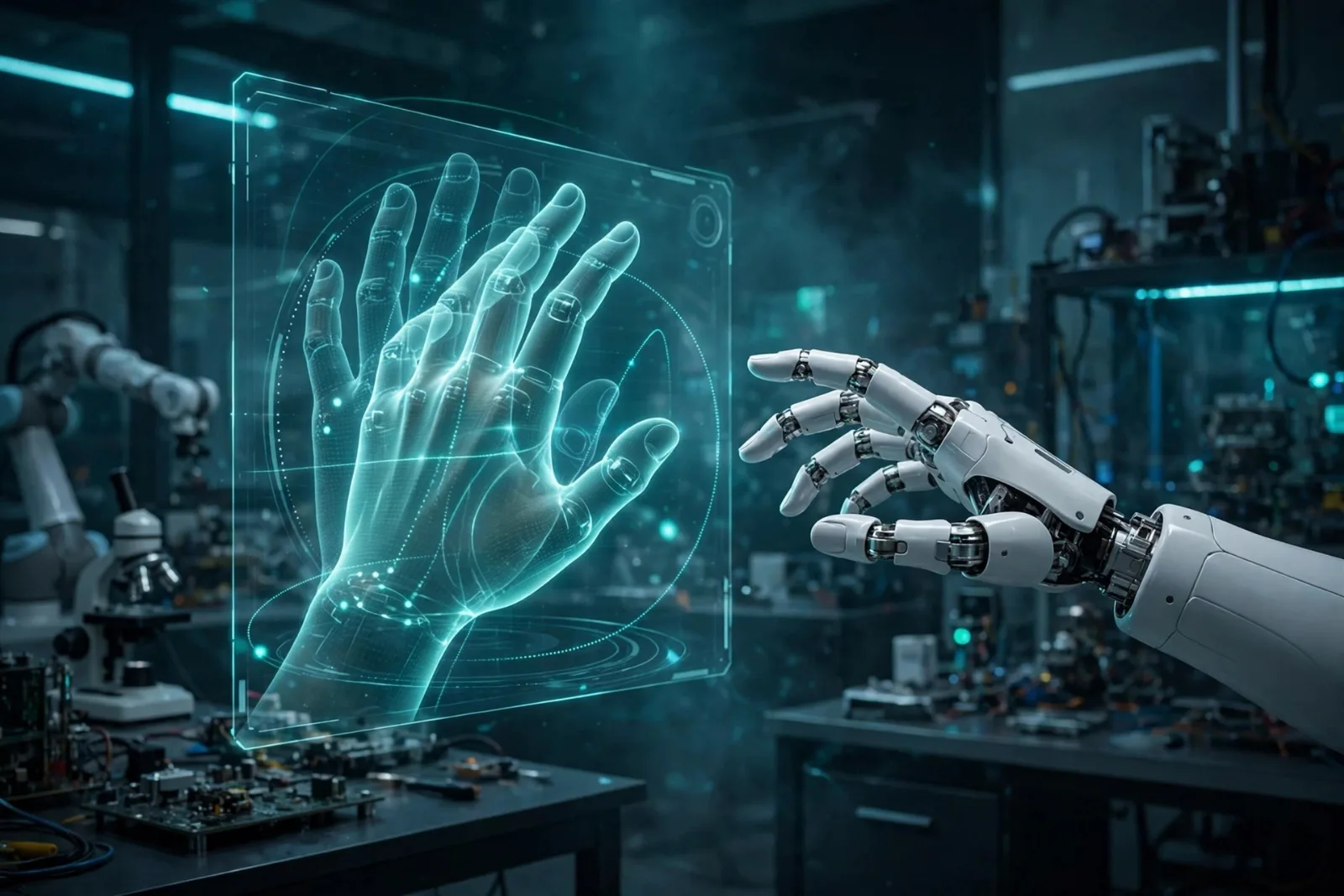
Robots have always had the same problem: every new skill had to be taught by hand. Want a robot to fold a towel? A person had to guide its arm through the motion, over and over, until it learned. Want it to sort parts on a factory line? Same slow process, all over again. On 9 November 2026, at the Conference on Robot Learning (CoRL) in Austin, Texas, NVIDIA unveiled a model designed to break that bottleneck: GR00T 2, a robot foundation model that learns new manipulation skills largely by watching videos of humans doing the job.
What Is GR00T 2?
GR00T 2 — pronounced "groot two" — is what NVIDIA calls an open frontier world action model. That is a mouthful, so let us unpack it. A foundation model is a large AI system trained once on a huge amount of data, then adapted to many different jobs — the same idea behind the language models that power chatbots. A world action model goes one step further: it does not just understand text or images, it predicts what happens next in the physical world and what actions a robot should take.
GR00T 2 is built on NVIDIA Cosmos, the company's family of world models, and uses a 2-billion-parameter transformer based on Cosmos-Predict2.5-2B. It takes in recent camera views, a written instruction ("pick up the cable and plug it in") and the robot's current state, then generates a short chunk of predicted future video together with the motor commands to make it happen — all in a single model.
One pretrained checkpoint covers three very different kinds of robot body: parallel-gripper arms, dexterous multi-fingered hands, and a humanoid robot. That matters, because until now a model trained for one robot usually had to be rebuilt for another.
The Big Idea: Learn From Human Video, Not Robot Demos
The traditional way to train a robot is teleoperation: a human operator drives the robot remotely while it records every movement. It works, but it is slow and expensive — you need the actual robot, the operator, and hours of careful driving for every single task.
GR00T 2 flips the balance. Its pretraining mix includes:
- 402,730 hours of first-person human video — people doing everyday tasks, filmed from a head-mounted camera
- 10,184 hours of handheld gripper demonstrations across 2,897 tasks
- 23,500 hours of robot teleoperation across arms, dexterous hands and Unitree's G1 humanoid
Human video is the key insight. There are billions of hours of people doing things, and almost none of it needs a robot to record. The model learns the shape of a skill — how a hand approaches a handle, how a cable bends when it is pulled — from watching us, then transfers that understanding to a robot body.
NVIDIA is also releasing 100,000 hours of that human data as Human-1M-100K, under a Creative Commons CC BY 4.0 licence that permits commercial and non-commercial use.
How Well Does It Actually Work?
NVIDIA reported results on 50 manipulation tasks that were not in the target robot's training data — the honest test of whether a model generalises, rather than memorising:
- 40 of the 50 tasks were completed at least once with zero demonstrations — no task-specific training at all
- With one demonstration per task, average success rose to 71%
- With five demonstrations, it reached 95%
For context, that one-demonstration jump is the number that matters most in practice. A factory worker showing a robot a new task once, and the robot getting it right seven times out of ten, is a very different world from needing hundreds of guided repetitions.
GR00T 2 also ranks among the top three models across the RoboCasa365, RoboLab, RoboDojo and MolmoSpaces benchmarks, with several leaderboard wins. And a smaller variant, GR00T 2 Turbo, runs a prediction in 124 milliseconds on NVIDIA's Jetson Thor robot computer — fast enough for real-time control.
The Other Half: Practising in Simulation
A robot brain is only half the story. The other half is where it practises, and NVIDIA also used CoRL to push its simulation tools. Isaac Lab 3.0, the open-source robot-learning framework, became generally available on 20 October 2026. Its new release lets AI agents set up training environments quickly, switch between the PhysX and Newton physics engines, and apply reinforcement-learning post-training to foundation models like GR00T.
That matters because simulation is where robots can fail safely and cheaply. A robot can drop a thousand virtual glasses in a simulator before it ever touches a real one. NVIDIA and partners are also introducing new benchmarks for testing robot behaviour in simulation, including DexBench (15 tasks across four industrial scenes) and VABAR (six industrial tasks with standardised variations).
Who Is Already Testing It?
NVIDIA named several early testers, all in evaluation rather than production:
- Nexuni is testing GR00T 2 for robotic laundry handling
- Foxconn is applying it to factory automation for server manufacturing
- Siemens is evaluating it across industrial use cases
- MicroAGI is using a reinforcement-learning post-trained version to perform Ethernet cable swapping with a YAM robotic arm
NVIDIA is working with partners including Ambi Robotics, Bosch Research, Dexmate, Dyna Robotics, FieldAI, Flexion, Skild AI and UC Berkeley to bring the tools to the wider robotics community. And in a separate announcement at the same conference, NVIDIA and UC Berkeley introduced agentic robotics — treating robot control as a coding problem, where AI agents write interpretable code to run physical skills in sequence and recover from errors.
The "Open" Question
NVIDIA calls GR00T 2 open, but there is a caveat worth knowing. The research page says the code will be available in December, and no public release date or licence for the model weights has been announced yet. The 100,000-hour dataset is genuinely open under CC BY 4.0, but the model itself is, for now, open in the sense of "coming soon". That is a pattern worth watching: several recent frontier models have launched with the same gap between announcement and actual release.
Why This Matters
Robotics has long been stuck in a data trap. Language models improved so fast because the internet gave them trillions of words to learn from. Robots had no equivalent — until someone realised that videos of humans doing things are the internet-scale dataset for physical skills. GR00T 2 is the clearest bet yet that watching us is enough to teach machines to work with their hands.
If the numbers hold up outside NVIDIA's own tests — and that is the big "if", since the figures are company-reported — the practical effect is a robot that can be shown a new job once and get on with it. For factories, warehouses and eventually homes, that is the difference between a robot that does one programmed task and a robot that can actually be useful.
| Old approach (teleoperation) | GR00T 2 approach | |
|---|---|---|
| Training data | Robot must perform every task itself | Mostly human video, some robot demos |
| New task setup | Hundreds of guided repetitions | 1–5 demonstrations |
| Works across robot bodies | Usually rebuilt per robot | One checkpoint: arms, hands, humanoid |
| Practise ground | Real world (slow, risky) | Isaac Lab 3.0 simulation + real world |
| Speed (Turbo variant) | — | 124 ms per prediction on Jetson Thor |
Read next: Robots Beyond the Factory Floor · How Self-Driving Cars Work
Takeaway Checklist
- GR00T 2 is a world action model: it predicts future video and robot actions together, from camera views, an instruction and the robot's state.
- It learns from human video: 402,730 hours of first-person human footage, plus gripper demos and teleoperation — the human video is the breakthrough.
- The headline numbers: 40 of 50 unseen tasks completed with no demonstrations; 71% success with one demo; 95% with five.
- Simulation is the training ground: Isaac Lab 3.0 (generally available 20 October 2026) lets robots rehearse in virtual worlds before touching real objects.
- "Open" has an asterisk: the 100,000-hour dataset is openly licensed, but model code arrives in December and no weights release date has been announced.
- It is early days: Foxconn, Siemens and Nexuni are testing, not deploying — real-world reliability is still unproven.