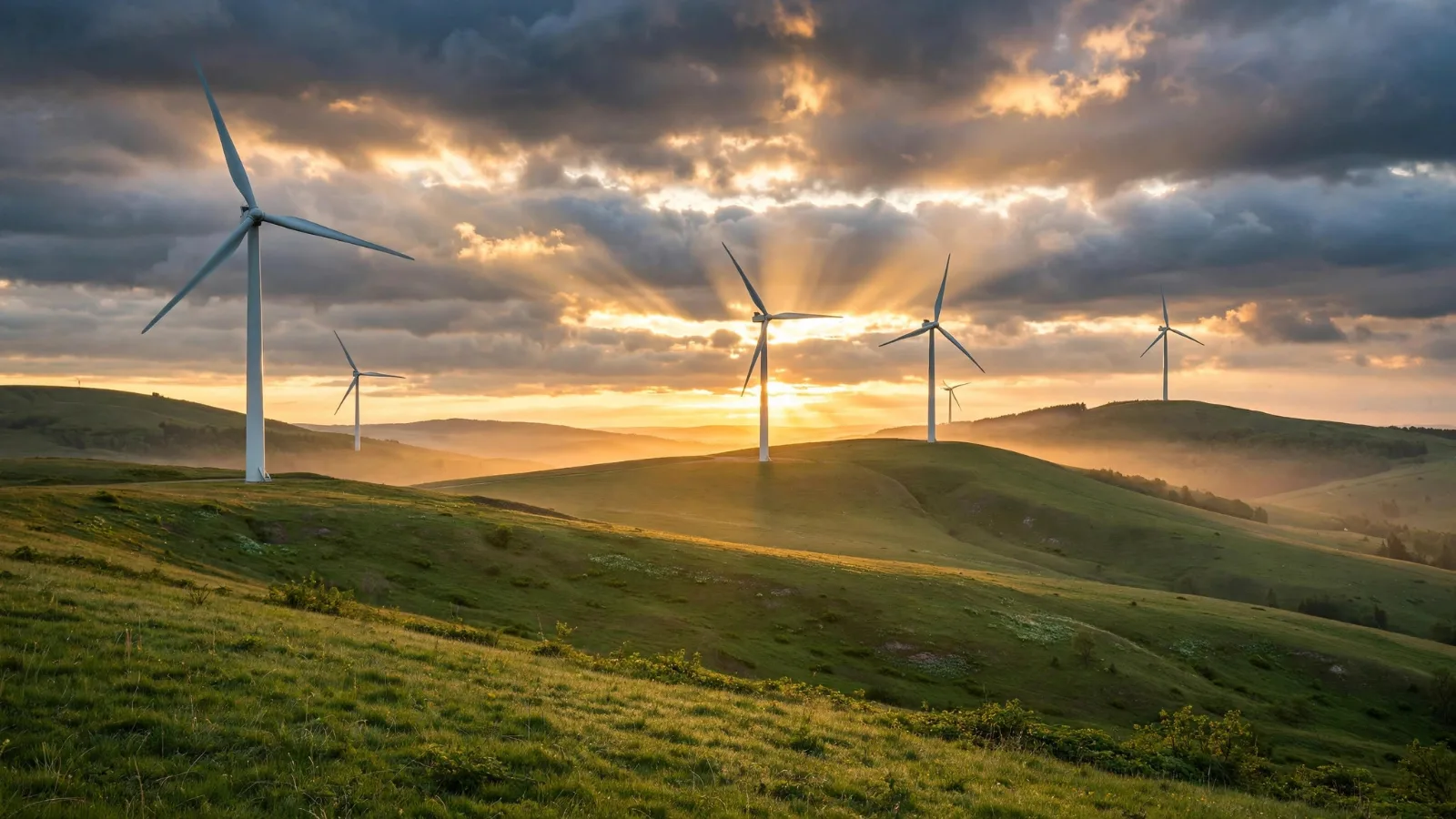
A modern wind turbine is one of the largest machines humans build: the biggest offshore models stand taller than the Eiffel Tower, with blades longer than a football pitch. Yet the idea inside is ancient — windmills have been grinding grain since at least the 9th century. The modern version just does the same trick with far better physics. The short version: wind pushes the blades, the blades spin a shaft, the shaft drives a generator, and the generator makes electricity. Now the longer, more interesting version.
The blades are wings, not sails
This is the most misunderstood part. Turbine blades do not work like sails catching the wind — they work like airplane wings.
Each blade is shaped as an airfoil. When wind flows past it, the air moves faster over one side than the other, creating lift — a force that pulls the blade sideways. Because the blades are mounted at a slight angle on a rotating hub, that lift becomes rotation. The blades are angled so that the wind pushes them around the circle, not through it.
This is why turbines spin even when they seem to face "away" from the wind, and why the blades have that distinctive twisted shape: each part of the blade meets the wind at the perfect angle.
From slow spin to fast electricity: the drivetrain
The rotor (blades + hub) turns at a lazy 5 to 15 revolutions per minute — slow enough that you can follow a single blade with your eyes. But generators need to spin much faster. So the turbine contains a chain:
- Rotor catches the wind and turns the low-speed shaft.
- The low-speed shaft feeds into a gearbox, which multiplies the speed roughly 100 times — up to about 1,500 rpm.
- The high-speed shaft spins the generator, which uses magnets and copper coils to convert motion into electricity (the same electromagnetic principle as every power station on Earth).
(Some newer turbines skip the gearbox entirely with direct-drive generators — fewer moving parts, less maintenance, but bigger, heavier generators. Offshore turbines increasingly favour this design.)
The turbine has brains, not just blades
A wind turbine is constantly managing itself to survive and produce. Three systems do the work:
- Yaw drive — motors in the top of the tower rotate the whole nacelle (the box behind the blades) so the rotor always faces into the wind. Sensors track wind direction continuously.
- Pitch control — each blade can twist along its own length. In gentle wind the blades bite hard; in strong wind they feather (turn edge-on) to avoid overload.
- Cut-in and cut-out speeds — turbines start generating at about 3 m/s (a light breeze). They reach full power around 12–15 m/s. And at about 25 m/s (storm conditions) they stop entirely — feathering the blades and applying brakes. A turbine that spins too fast destroys itself, so the bravest thing it does is quit.
That is why turbines sometimes stand still on a windy day: they are either protecting themselves, waiting for a fault to clear, or the grid has asked them to pause.
Why you can't capture all the wind: the Betz limit
Here is a beautiful piece of physics. In 1919, German physicist Albert Betz proved that no turbine can capture more than 59.3% of the wind's energy — the Betz limit.
Why? Because to keep the wind flowing through, the air must leave the turbine still moving. If you extracted 100% of the energy, the air would stop dead behind the blades — and then no more wind could flow in. Physics demands a toll: the wind must keep some of its energy to get out of the way.
Real turbines get about 45–50% of the wind's energy at their best — remarkably close to the theoretical ceiling. The remaining losses come from blade drag, turbulence at the tips, and mechanical friction.
Capacity factor: why the nameplate lies
A 5-megawatt turbine does not produce 5 MW all the time. The capacity factor — actual yearly output divided by the theoretical maximum — tells the honest story:
- Onshore: typically 25–40% (the US fleet averages about 37%). Wind is variable, and good sites are taken.
- Offshore: 40–60% or more. The wind at sea is stronger and steadier.
A low capacity factor is not a failure — it is the deal you make with a free, intermittent fuel. Grid planners simply install more turbines to compensate, and renewable energy grids are designed around it. (Compare nuclear plants, which run at ~90% — steady but far more expensive to build.)
The scale of wind in 2026
| Onshore | Offshore | |
|---|---|---|
| Typical size | 2–5 MW per turbine | 8–15+ MW per turbine |
| Capacity factor | 25–40% | 40–60%+ |
| Build cost | Cheaper per MW | Roughly 2–3× onshore per MW |
| Best for | Cheap, fast deployment on land | Huge machines, steady sea winds |
Globally, the industry has reached staggering scale: about 1,173 GW of wind capacity was installed worldwide by April 2025, with 117 GW added in 2024 alone — China alone holds over 521 GW. Wind now supplies roughly 8–10% of the world's electricity, and the average new turbine installed in 2024 was rated at 5.5 MW, up 9% on the year before. The trend is clear: fewer, bigger, taller turbines in steadier wind.
For more on this, see our explainer on fusion energy.
Takeaway checklist
- ✅ Turbine blades work by lift, like airplane wings — not like sails catching the wind.
- ✅ The rotor's slow spin is multiplied ~100× by a gearbox (or skipped entirely in direct-drive designs) to drive the generator.
- ✅ Yaw, pitch, and cut-in/cut-out systems constantly manage the turbine — it stops itself in storms (~25 m/s) to survive.
- ✅ The Betz limit (59.3%) caps how much wind energy any turbine can capture; real machines reach ~45–50%.
- ✅ Capacity factor is the honest measure: ~25–40% onshore, 40–60%+ offshore — the deal you make with free, variable fuel.
- ✅ Wind is now a giant: ~1,173 GW installed globally, supplying roughly a tenth of the world's electricity — and the machines keep getting bigger.