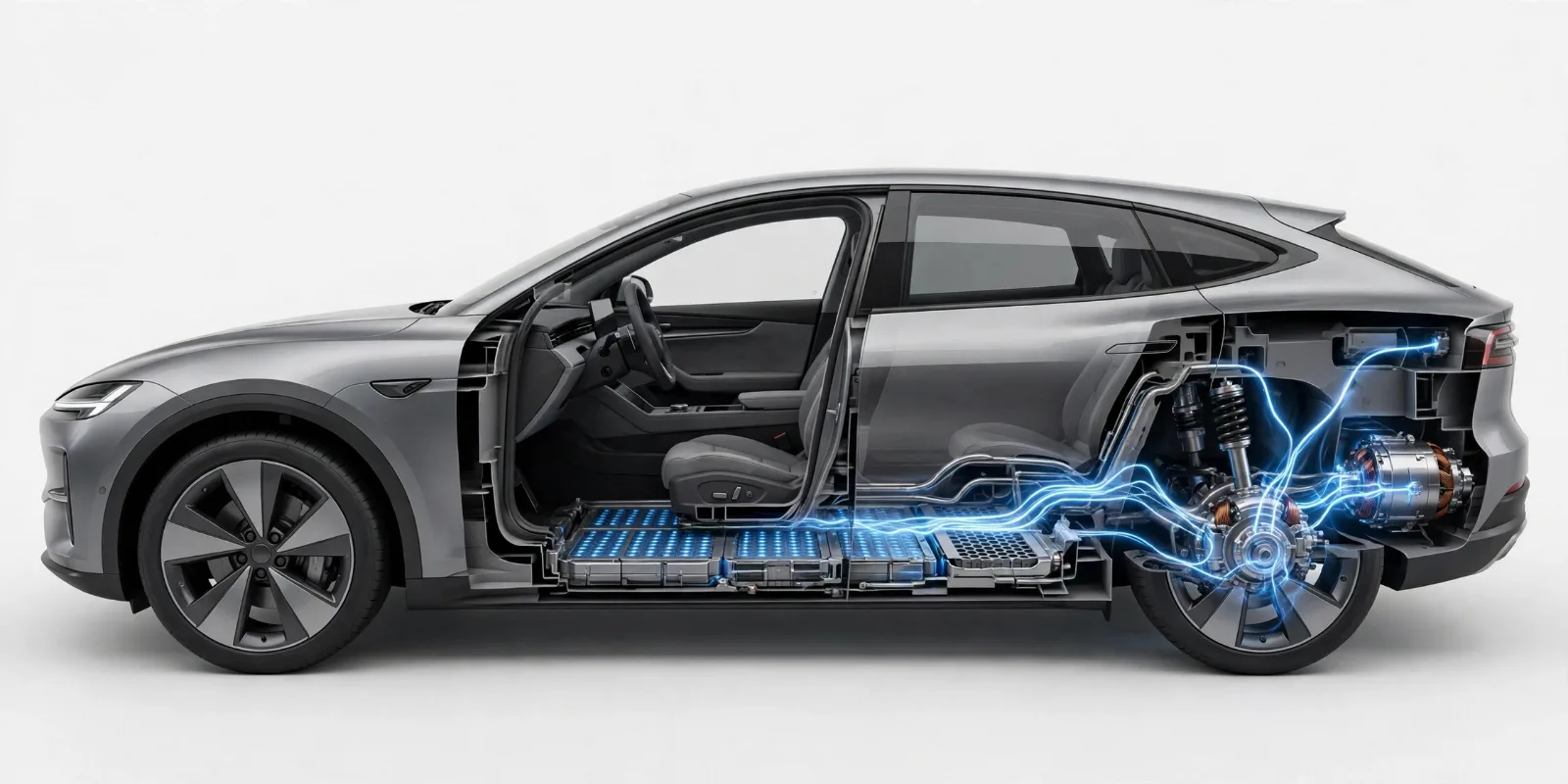
Pop the bonnet of an electric car and you will not find an engine. No pistons, no spark plugs, no exhaust pipe, no gearbox full of gears. Instead there is a big flat battery under the floor, one or two electric motors, and a lot of software. It looks simpler — and it is — but the simplicity hides some clever engineering. Here is how it all works.
The three big parts
Every electric car (EV) is built around three things:
- The battery pack — stores the energy, like a giant phone battery.
- The electric motor — turns that energy into motion.
- The power electronics and software — the brain that moves energy between the two, and decides when to charge, discharge, or recover it.
There is no fuel tank, no combustion, and no multi-gear transmission. Press the accelerator and the software tells the motor how much power to draw from the battery. That is the whole driving experience, more or less — and it is why EVs feel so smooth and instant.
The battery: a giant phone battery
The battery is the most expensive part of the car, usually a flat pack of lithium-ion cells bolted under the floor. A typical family EV carries roughly 40–80 kWh (kilowatt-hours) of capacity — enough for around 200–300 miles of driving, depending on the car and the weather. Cold weather shrinks that range noticeably, as we explain in why electric cars lose range in winter.
The cells are the same basic chemistry as your phone battery, just thousands of them wired together. They are managed by a battery management system (BMS) — a computer that watches every cell's voltage and temperature, balances the charge between them, and protects the pack from overheating or overcharging. The pack is liquid-cooled in most modern EVs, with coolant channels running between the cells. For the chemistry behind it all, see lithium-ion batteries explained.
The motor: magnets, not explosions
A petrol engine makes power by exploding fuel hundreds of times a minute. An electric motor makes power with magnets and electricity. Most EVs use one of two designs:
- Permanent magnet motors — magnets on the rotor are pulled around by a rotating magnetic field in the stator. Efficient and compact; the most common choice today.
- Induction motors — the magnetic field induces a current in the rotor, which creates its own magnetism. No rare-earth magnets needed, which is why some makers prefer them.
Either way, the result is the same: the motor spins the moment current flows, and it produces full torque from zero speed. That is why EVs launch so hard from a standstill — there is no waiting for revs to build, no turbo lag, no gear to find. A single electric motor can spin from 0 to over 15,000 rpm, which brings us to the next surprise.
No gearbox, no gears to change
A petrol car needs five or six gears because its engine only works well in a narrow band of speeds. An electric motor works well across almost its whole speed range, so most EVs have a single fixed gear — a simple reduction gear that slows the motor's spin down to wheel speed. One gear, no clutch, no shifting, no stalling.
That is also why EVs are so quiet. The drivetrain has far fewer moving parts than a petrol car's — dozens instead of hundreds — and nothing explodes, so there is almost no vibration. What you hear at speed is mostly wind and tyre noise.
The brake that charges the battery
Here is the cleverest part. When you lift off the accelerator in an EV, the motor runs in reverse as a generator. The wheels spin the motor, the motor generates electricity, and that electricity flows back into the battery. This is regenerative braking, and it is why EVs can recover energy every time you slow down.
In practice it feels like the car is braking itself when you lift off — many drivers use "one-pedal driving" and barely touch the brake pedal in town. The friction brakes are still there for hard stops, but they last far longer because they do so little work. Regen is most effective in stop-start traffic; on a motorway cruise at steady speed, there is little braking to recover from.
Charging: slow at home, fast on the road
An EV charges in two very different ways:
- AC charging (home or work): alternating current from the grid goes through the car's onboard charger, which converts it to DC for the battery. Typically 7 kW at home — a full charge overnight.
- DC fast charging (public rapid chargers): direct current goes straight into the battery, bypassing the onboard charger. Modern EVs can take 100–350 kW, adding roughly 100 miles of range in 15–20 minutes on the fastest chargers.
Charging speed is not constant: batteries charge fastest when they are between about 10% and 80% full, then slow down sharply to protect the cells. That is why road-trip advice is always "charge to 80% and go" rather than waiting for 100%.
EV vs petrol: the honest comparison
| Electric car | Petrol car | |
|---|---|---|
| Energy conversion | Over 77% of grid energy reaches the wheels (US Dept. of Energy) | Only 12–30% of fuel energy reaches the wheels |
| Moving parts | Dozens in the drivetrain | Hundreds, including the engine itself |
| Refuelling | At home overnight, or 15–30 min at a fast charger | 5 minutes at a petrol station |
| Running cost | Cheaper per mile in most countries | Fuel + oil + more servicing |
| Weakness | Range drops in cold weather; charging takes longer than filling a tank | Emissions, noise, and a lot more maintenance |
The efficiency gap is the real story: an electric motor wastes far less energy as heat than a combustion engine, which throws most of its fuel's energy away through the exhaust and the radiator.
Takeaway checklist
- An EV is a battery, a motor and software — no engine, no exhaust, no multi-gear gearbox.
- The battery is a giant lithium-ion pack under the floor, managed by a computer that watches every cell.
- Electric motors give full torque from zero speed, which is why EVs accelerate instantly — and why they need only one gear.
- Regenerative braking turns the motor into a generator, recovering energy every time you slow down.
- Charging is slowest at the extremes — fastest between 10% and 80%, so road trips work best with short, frequent top-ups.
- The big advantage is efficiency: over 77% of the energy reaches the wheels, versus 12–30% for a petrol car.