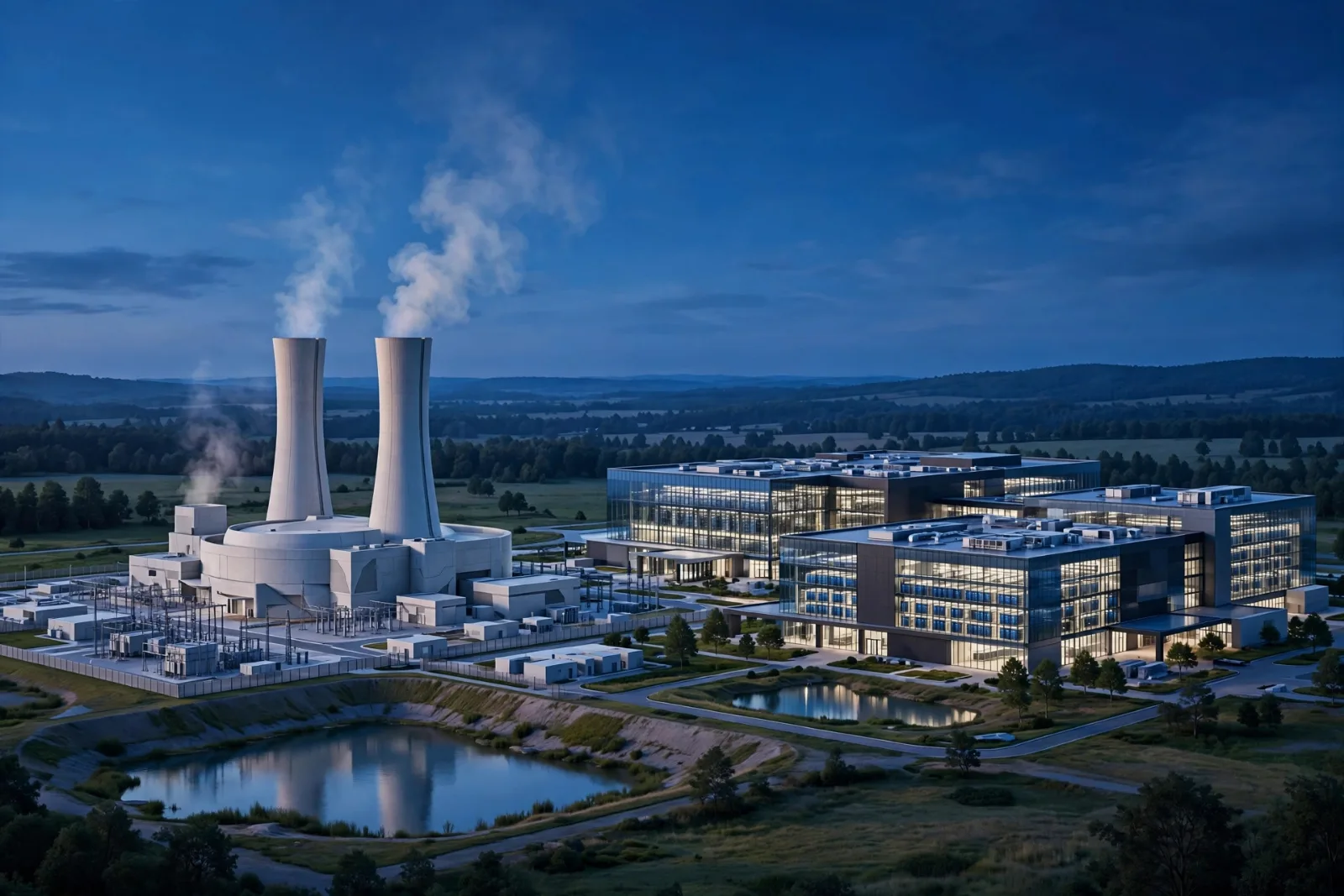
In 2026, the world's largest technology companies became the world's most aggressive buyers of nuclear power. Microsoft, Amazon, Google and Meta have signed deals worth tens of billions of dollars to secure atomic energy for their AI data centres. The technology at the centre of most of these deals has a short name you'll be hearing for the next decade: SMRs — small modular reactors.
Here's what they are, why Big Tech wants them, and why the sceptics aren't convinced.
What a small modular reactor actually is
An SMR is a nuclear fission reactor — it splits uranium atoms to release heat, which boils water into steam to spin a turbine, exactly like a conventional nuclear plant. The difference is in the delivery:
- Small: the International Atomic Energy Agency defines SMRs as reactors producing under 300 megawatts of electricity (MWe) — roughly a tenth of a large conventional reactor.
- Modular: the reactor is designed to be built in a factory and shipped to the site in pieces, rather than constructed from scratch outdoors over a decade. Need more power? Add more modules.
That factory approach is the whole pitch. Recent large nuclear plants in the West have run years late and billions over budget — the two new reactors at Georgia's Vogtle plant, for example, finished roughly seven years behind schedule at a cost of about $35 billion. SMRs promise to replace mega-project risk with assembly-line repetition.
SMRs also lean on passive safety: the reactor is designed so that if something goes wrong, physics — gravity, natural circulation of coolant, materials that expand as they heat — shuts the reaction down without any power supply or human intervention. No backup generators that can flood, no operators who must act in minutes.
The four reactor types you should know
Not all SMRs are the same machine. The main families competing in 2026:
| Type | How it works | Leading example |
|---|---|---|
| Light-water SMR | Scaled-down version of today's reactors; water cools the core | NuScale VOYGR (77 MWe per module) — the only SMR with full US design certification |
| Sodium fast reactor | Liquid sodium coolant; can run hotter and recycle fuel | TerraPower Natrium (345 MWe) — founded by Bill Gates; construction permit issued March 2026, building started April 2026 in Kemmerer, Wyoming |
| High-temperature gas reactor | Helium-cooled; extremely high temperatures, useful for industry too | X-energy Xe-100 — Amazon-backed |
| Molten salt reactor | Liquid fluoride salt coolant; runs at atmospheric pressure | Kairos Power KP-FHR — Google-backed |
Each trades off between proven technology (light-water is what nearly all today's plants use) and promised advantages (the newer designs run hotter, which means more efficient electricity — and useful heat for industry).
Why Big Tech suddenly wants nuclear
AI data centres are ferociously power-hungry. A single large AI training campus can draw as much electricity as a small city, and tech companies burned through an estimated $480 billion in AI infrastructure spending in 2026 alone, according to industry analysis. Wind and solar are cheap but intermittent; batteries at data-centre scale are still wildly expensive. Nuclear runs 24/7 at full power — what the industry calls "firm" power — and emits no carbon. For companies with net-zero pledges and an AI arms race to fuel, that combination is irresistible.
The deals, as tracked by analysts in 2026, come to roughly 10 gigawatts of committed capacity:
| Company | Deal | Earliest power |
|---|---|---|
| Microsoft | 20-year deal for the full output of the restarted Three Mile Island Unit 1 (renamed Crane Clean Energy Center), 835 MW — an existing plant, not an SMR | Second half of 2027 |
| Amazon | 1.9 GW power agreement from the Susquehanna nuclear plant in Pennsylvania, plus a major stake in X-energy for up to 12 Xe-100 SMRs | Existing plant now; SMRs in the 2030s |
| Up to 500 MW from Kairos Power's molten-salt SMRs — the first US corporate SMR fleet deal | Around 2030 | |
| Meta | Up to 6.6 GW across TerraPower (as many as 8 Natrium reactors), Oklo's Aurora reactors and utility deals | 2032–2035 |
Microsoft will likely get its nuclear power first — precisely because it chose to restart an existing reactor rather than wait for a new one to be built. Construction of TerraPower's first Natrium plant began in April 2026 after the US Nuclear Regulatory Commission issued a construction permit in March.
If you want to understand where all this electricity is going, read our tour of the data centres powering the AI boom.
The sceptics' case
The hype deserves a hard look, because not a single one of these reactors is powering a data centre yet. The Bulletin of the Atomic Scientists argued in July 2026 that AI firms are spending lavishly on data centres but not enough to bring new nuclear online at scale. The honest timeline:
- Nothing commercial is operating. TerraPower has started construction; Kairos has broken ground on demonstration reactors; NuScale holds the only certified design but saw its flagship Utah project cancelled in 2023 when costs rose and customers pulled out.
- Fuel is a bottleneck. Many advanced SMRs need HALEU — high-assay low-enriched uranium — and the commercial supply chain for it barely exists outside Russia and China. The US is only now building domestic capacity.
- Regulators and steel move slowly. Nuclear-grade forgings, transformer lead times and trained workforces are all in short supply.
- The money is real, the reactors aren't. Tens of billions in signed deals buys options and headlines; the first corporate SMR electrons are still years away.
SMRs are a bet that the third or fourth reactor off the factory line will be cheap — but you have to survive building the first and second. That is exactly where previous nuclear renaissances have died.
What SMRs mean for the future of energy
Strip away the AI angle and SMRs are interesting for three bigger reasons. First, their size fits places a gigawatt plant never could: remote mining operations, island nations, industrial sites that want power and heat together. Second, factory production could — if the economics work — make nuclear competitive in countries that could never afford a $15 billion mega-project. Third, they arrive alongside a genuine shift in public and political attitudes: nuclear is increasingly counted as clean energy in policy, from Brussels to Washington.
Fusion gets the headlines about the far future — see our explainer on fusion energy — but fission SMRs are the nuclear bet actually being built right now.
Your takeaway checklist
- SMRs are fission reactors under 300 MWe, designed to be factory-built in modules and cooled by passive safety.
- Big Tech's nuclear shopping spree — roughly 10 GW across Microsoft, Amazon, Google and Meta — is driven by AI data centres that need 24/7 carbon-free power.
- The deals mix old and new: Microsoft restarted an existing reactor (power by late 2027); Google, Amazon and Meta are betting on SMRs that don't exist yet (2030s).
- TerraPower's Natrium in Wyoming is the furthest along — construction permit in March 2026, building started April 2026.
- The sceptics have a point: no SMR powers a data centre today, fuel supply is a bottleneck, and NuScale's cancelled Utah project shows the economics aren't proven.
- Watch the second and third builds, not the announcements — that's where SMRs will prove whether the factory model actually beats the mega-project curse.