Microsoft's Maia 300 AI Chip, Explained
On October 12, 2026, Microsoft pulled the curtain back on Maia 300 — its third-generation, self-designed AI accelerator chip. The headline is simple but striking: Microsoft, the world's biggest buyer of AI chips, is now building its own — and it says this one will run the AI behind Copilot, GitHub Copilot, and Azure more efficiently than the Nvidia and AMD chips it currently rents by the thousands. Let's break down what Maia 300 actually is, why inference (not training) is the battleground, and what it means for the future of AI.
What is Maia 300?
Maia 300 is a custom-built AI accelerator — a processor designed for one job: running AI workloads quickly and efficiently. It is the third chip in Microsoft's Maia line. The original Maia 100 appeared in 2023, and Maia 200 arrived in January 2026 and is already handling production workloads today.
The new chip follows the same playbook as custom silicon from Google (TPU), Amazon (Trainium), and even OpenAI, which recently debuted its own in-house chip called Jalapeno. The idea: instead of buying general-purpose GPUs from Nvidia or AMD, design chips tuned exactly for the workloads you run.
Microsoft calls Maia 300 the "primary AI inference system" for its products and services — meaning the chip is meant to handle the day-to-day job of answering AI requests, not the one-time job of teaching models in the first place.
Training vs. inference: the crucial difference
To understand Maia 300, you need to know two words: training and inference.
- Training is teaching an AI model. It takes enormous computing power, runs once (or occasionally), and is where Nvidia's most powerful GPUs currently rule.
- Inference is running a trained model — every time you ask ChatGPT or Copilot a question, that's inference. It happens billions of times a day, so even small efficiency gains add up to enormous savings.
Here's the key strategic detail: Microsoft is targeting inference, not training. It still plans to buy Nvidia's and AMD's latest chips for training workloads (Microsoft even expects to be among the first to deploy Nvidia's upcoming Vera Rubin platform). But inference is where Microsoft spends most of its compute budget — so that's where owning the chip pays off.
- Training = learning once, with brute force
- Inference = answering billions of times, where efficiency wins
- Maia 300 is built for inference: cheaper, leaner answers at giant scale
The specs that matter
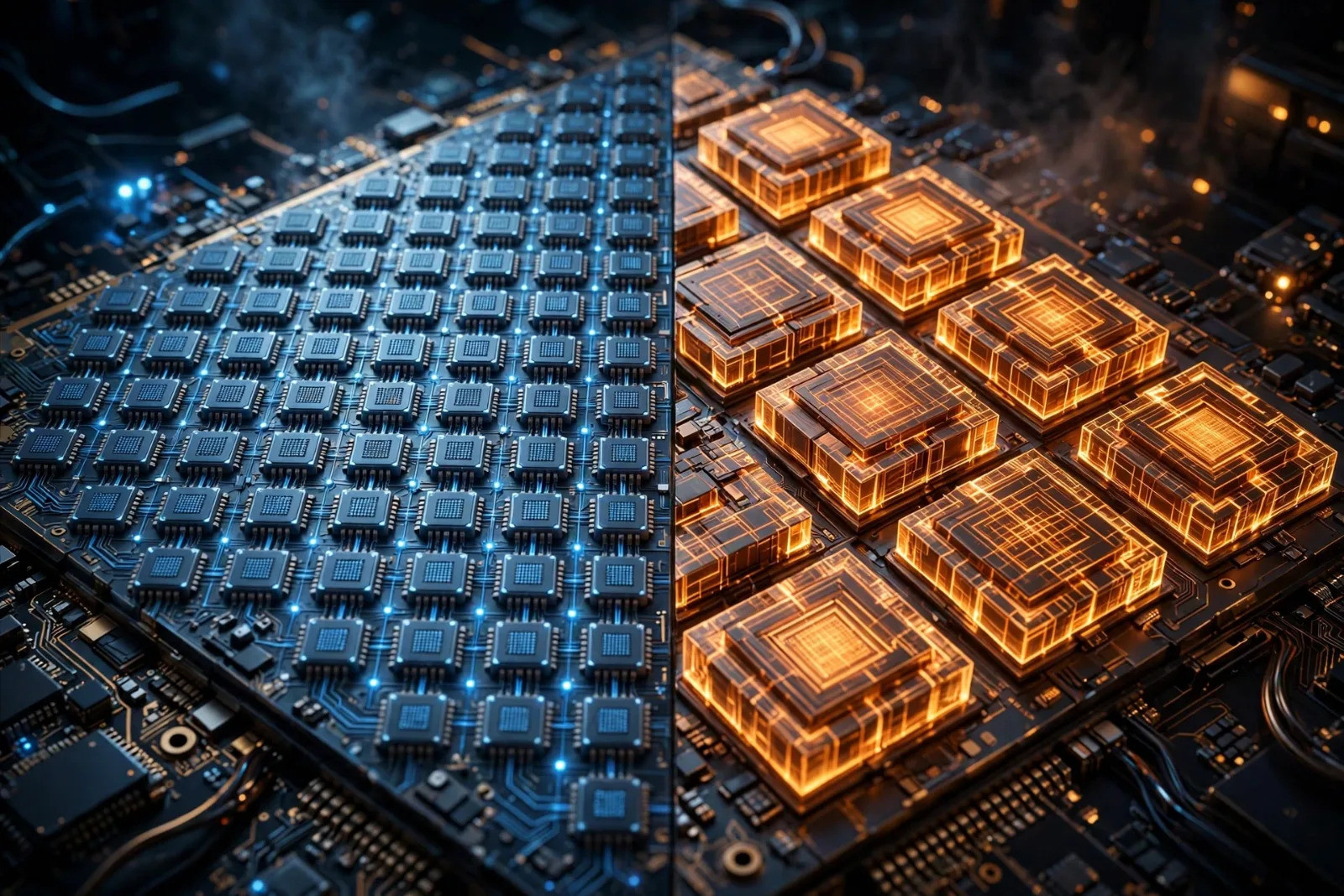
Maia 300 is built on TSMC's advanced N2P process — the same 2-nanometer-class technology behind the latest smartphone chips — using a multi-chiplet design. That means instead of one giant piece of silicon, the chip packages several smaller dies (compute, memory, and input/output), each manufactured with the process best suited to it.
Here are the headline numbers, all as stated by Microsoft:
- Compute performance: up to 13.8 PFLOPS at FP4 precision and 6.9 PFLOPS at FP8 (lower precision means more AI math per second)
- Memory: 288 GB of HBM4 high-bandwidth memory across eight stacks, with 18 TB/s of memory bandwidth — huge memory matters because AI models must hold their "knowledge" in memory to answer quickly
- Power: a 950-watt chip rating (up from 750 watts on Maia 200)
- Scale: 96 accelerators per rack, scaling up to clusters of 12,000 accelerators
The two efficiency claims are the real headline:
- 40% more tokens per megawatt than leading GPU-based systems, according to Scott Guthrie, executive vice president of Microsoft's cloud group — a token being a chunk of AI output (words, parts of images)
- Up to 7x the rack-scale token throughput of the previous Maia 200 in a full 96-accelerator configuration
One honest caveat: these are Microsoft's own figures, not independently verified benchmarks. The chip won't actually reach production workloads until 2027, so the real-world numbers are still a year away.
How the generations compare
| Maia 100 | Maia 200 | Maia 300 | |
|---|---|---|---|
| Announced | 2023 | January 2026 | October 2026 |
| Process | 5 nm | 3 nm-class | TSMC N2P (2 nm-class) |
| Memory | HBM3 | 216 GB HBM3E (7 TB/s) | 288 GB HBM4 (18 TB/s) |
| Power rating | ~500 W | 750 W | 950 W |
| Accelerators per rack | 48 | 48 | 96 |
| Role | First experiment | In production (Copilot, GitHub Copilot, Foundry) | "Primary inference system," rolling out 2027 |
The jump from Maia 200 to Maia 300 is dramatic: more memory, far more bandwidth, twice as many chips per rack — and roughly 2.7x the HBM per rack. Microsoft's goal is clear: move as much of its AI serving as possible onto its own silicon.
Why everyone suddenly builds their own chips
Maia 300 is part of a much bigger shift. Hyperscalers — the giants running cloud computing — spend tens of billions of dollars on AI chips every year, and the bulk of that spending flows to one company: Nvidia, which reportedly gets over half of its quarterly revenue from cloud giants.
Building your own chip changes the math:
- Cost control — no markup on hardware you buy forever
- Efficiency tuning — a chip designed for your models beats a general-purpose one
- Supply independence — no waiting in line for someone else's production slots
- Strategic leverage — even buying less from Nvidia means negotiating better prices on what you still buy
Microsoft announced plans for gigawatt-scale Maia deployments starting in 2027 — a gigawatt of computing power typically means AI chips in the millions. Google is targeting production of 3 million of its TPU chips this year and over 5 million next year. This is an arms race measured in power plants, not just processors.
The market noticed: after the Maia 300 announcement, Nvidia's and AMD's stocks dipped — a reminder that investors see every hyperscaler chip as a slice of revenue potentially lost.
What this means for you (probably nothing, indirectly)
Unlike Nvidia's GPUs or Intel's CPUs, you will never buy a Maia 300. These chips are not for sale or rent — Microsoft uses them exclusively to run its own services, just as Google's TPUs and Amazon's Trainium chips serve their makers first.
But you will feel the effects indirectly:
- Cheaper AI services — more efficient inference means lower cost per query, which could keep Copilot and Azure AI prices in check
- Faster AI responses — chips tuned for latency-sensitive conversations mean snappier replies
- More AI everywhere — when inference gets cheaper, companies can afford to put AI into more products
For the full picture of where these chips live, see our explainer on how the data centers powering AI actually work.
The bigger picture: the inference economy
Here's the story behind the story. The first wave of the AI boom was about training — who could build the biggest model. That wave belonged to Nvidia. The second wave, happening now, is about inference — who can serve AI to billions of people cheapest and fastest.
Inference is where AI becomes a utility like electricity. And utilities are built on ruthless efficiency: 40% more output per megawatt isn't a benchmark flex — it's the difference between profitable AI services and burning money. Microsoft, Google, Amazon, Meta, OpenAI, and Anthropic all now design their own chips for exactly this reason.
The semiconductor industry is also reshaping around it: Maia 300's memory demands alone mean more business for memory giants like Samsung and SK hynix, which make the HBM chips stacked inside. If you want the background on why chips have become the world's most strategic product, our semiconductors explainer covers it.
What's next
Microsoft plans to share more Maia 300 details at its Ignite conference in San Francisco next month. Production deployment begins in 2027, alongside what Microsoft calls multi-gigawatt deployments — essentially, entire data centers purpose-built around Maia hardware.
What to watch:
- Real benchmarks — will independent testing confirm Microsoft's 40% efficiency claim?
- Adoption inside Microsoft — how fast do Copilot and Azure workloads actually migrate off Nvidia?
- The response — Nvidia's Vera Rubin and AMD's Helios platforms are coming, and Nvidia has never surrendered a market quietly
- OpenAI's Jalapeno — Microsoft's closest AI partner is building its own chip too; the relationship between partners-turned-rivals is getting interesting
One thing is certain: the era of one company making all the AI chips is ending. The future of AI is being built on custom silicon — and Maia 300 is Microsoft's biggest bet yet that designing the chip is just as important as training the model.
Takeaway checklist
- What happened: Microsoft unveiled Maia 300, its third in-house AI chip, on October 12, 2026 — production rollout starts 2027
- What it is: A custom accelerator built for AI inference (answering requests), not training (teaching models)
- Why it matters: Microsoft claims 40% more tokens per megawatt than leading GPU systems — efficiency that cuts the cost of running AI at scale
- Key specs: TSMC 2nm-class process, 13.8 PFLOPS (FP4), 288 GB HBM4 memory, 18 TB/s bandwidth, 96 accelerators per rack
- The strategy: Less dependence on Nvidia and AMD, more control over costs for Copilot, GitHub Copilot, and Azure
- You can't buy one: Maia chips run Microsoft's internal services only — but cheaper inference could mean cheaper, faster AI services for everyone
- The trend: Every major AI player (Google, Amazon, Meta, OpenAI) is now designing its own chips — inference is the new battleground
- Watch for: Independent benchmarks, Microsoft's Ignite conference next month, and how fast workloads migrate off Nvidia