Let's put one number on the table: 107.4 trillion won. That's roughly $80 billion. It's the operating profit Samsung Electronics says it made in a single quarter — July through September 2026 — according to guidance released on October 8, 2026.
For perspective:
| Quarter | Operating profit |
|---|---|
| Q3 2026 (guided) | 107.4 trillion won (~$80B) |
| Q2 2026 | 89.49 trillion won |
| Q3 2025 | 12.17 trillion won |
That's nearly a nine-fold jump year over year — a 783% increase. It's Samsung's fourth straight quarter of record profit, and the first time any tech company in history has cleared 100 trillion won (about $75 billion) in a single quarter. Revenue was guided at 195 trillion won, up 127% from a year earlier.
And here's the twist: it has almost nothing to do with phones or TVs. The money came from something most people never think about — memory chips.
Wait — memory chips? The things in my laptop?
Exactly those, but not the way you think. Your laptop has a few gigabytes of RAM. An AI data center has millions of gigabytes, and it needs a special, expensive kind.
Here's the simple version of what happened:
- AI companies are building data centers at a furious pace. Every chatbot, image generator, and AI assistant runs on giant clusters of GPUs (mostly Nvidia's).
- GPUs are useless without memory. Each GPU needs ultra-fast memory sitting right next to it, feeding it data during AI training. That memory is called HBM — high-bandwidth memory.
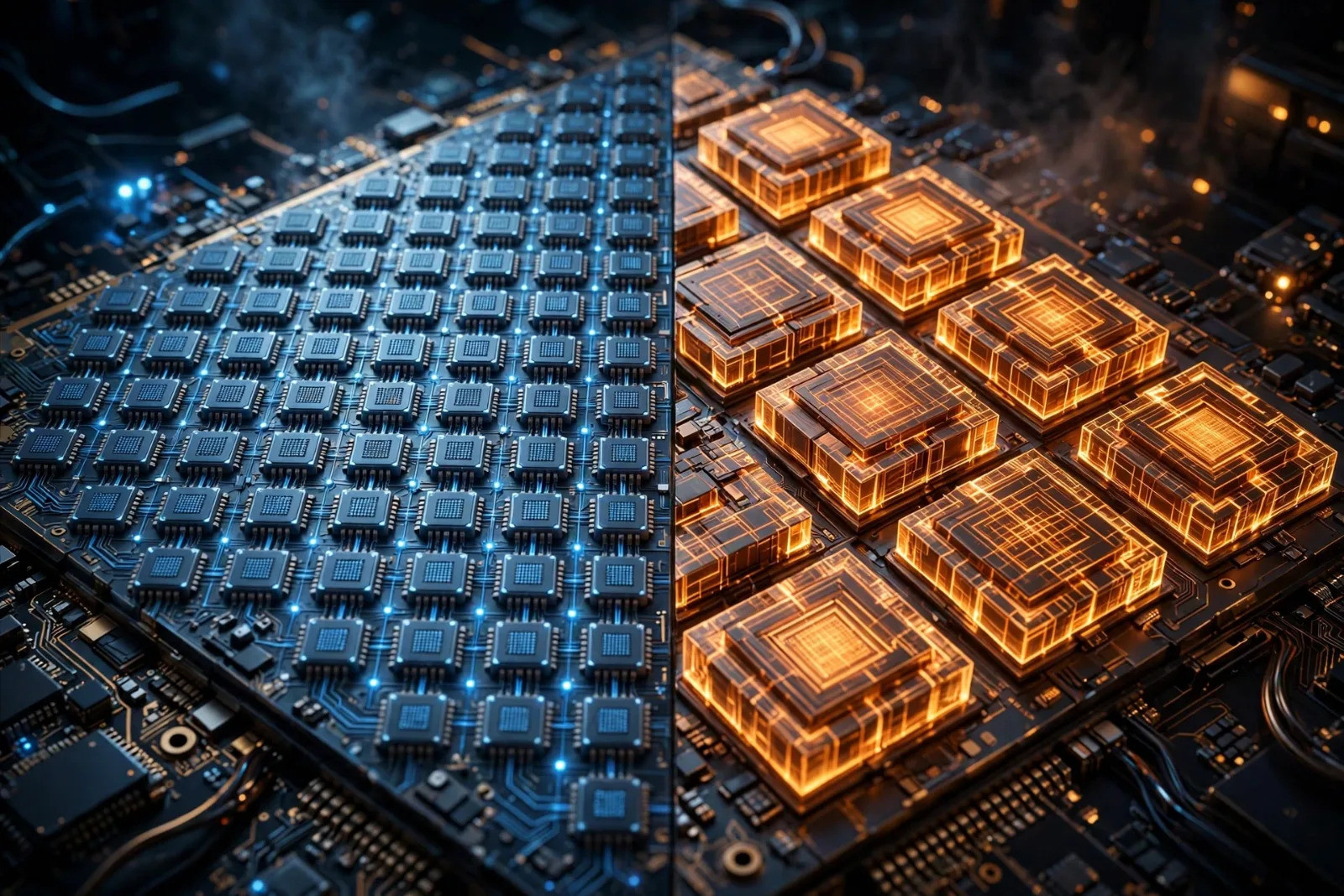
- HBM is hard to make. It's built by stacking memory chips vertically, like a microscopic skyscraper. It takes three times the factory wafer capacity of regular memory to produce.
- Demand exploded past supply. When demand outruns supply, prices shoot up. Memory prices soared — and Samsung, the world's largest memory maker, collected the difference.
Analysts now estimate Samsung's DRAM profit margins above 80%. Two years ago, when memory prices were still falling, that number would have sounded absurd.
Why HBM is the real star
Not all memory is equal. The AI boom runs on three kinds:
- HBM (high-bandwidth memory): stacked chips placed next to GPUs. The scarcest, most profitable product in semiconductors right now. This is doing most of the work in Samsung's quarter.
- DRAM: the standard working memory in servers and PCs. Prices up sharply across the board.
- NAND: flash storage (SSDs, phones). Its own cycle, also tightening.
Think of it this way: if AI data centers are gold mines, HBM is the pickaxe — and Samsung owns the pickaxe factory.
Samsung and rival Micron both expect the supply-demand imbalance to last into 2028. Building new chip factories takes years, so there's no quick fix.
What this means for you (yes, really)
Record chip profits sound abstract. They aren't. The same price surge making Samsung rich is making your next gadgets more expensive:
- Smartphones cost more to build. Memory is a major component cost. A South Korean media report says Samsung's own mobile division has begun cutting smartphone production for Q4 2026 by up to 30% — because at current chip prices, its phones reportedly barely make a profit at all.
- Laptops, consoles, and SSDs face the same component inflation.
- Cloud and AI services may get pricier as data-center operators pass costs along.
The AI boom giveth (smarter assistants) and the AI boom taketh away (pricier hardware).
Will it last? The honest risks
A 783% profit jump invites a fair question: is this a bubble? Here's the balanced picture:
Reasons it could continue:
- Data-center construction is still accelerating, not slowing.
- New chip factories take 2–3 years to build — supply can't catch up quickly.
- Both Samsung and Micron guide tightness into 2028.
Reasons to be cautious:
- Chinese competitors are expanding memory production and could undercut prices.
- If AI spending slows, demand could cool faster than supply adjusts.
- A stronger Korean won shrinks Samsung's reported profits even if chip prices hold.
- Investors already smell the peak: despite the record, Samsung's shares fell about 2% on the news, because some analysts had hoped for 108–110 trillion won, and the stock's buyback program was ending the same day.
The full Q3 report lands on October 29, when Samsung will break out divisional results — that's when we'll see exactly how much of the $80 billion came from chips versus everything else.
The takeaway checklist
- 107.4 trillion won (~$80B) operating profit guided for Q3 2026 — 9x last year's 12.17 trillion.
- First 100T+ won quarter by any tech company, ever. Fourth straight record.
- The driver is AI memory demand: HBM and DRAM shortages → soaring prices → 80%+ margins.
- HBM takes 3x the wafer capacity of regular DRAM — supply can't scale fast.
- Tightness expected into 2028 (Samsung, Micron).
- Your gadgets get pricier: Samsung reportedly cutting phone production up to 30% as chips eat the profit.
- Risks: China, AI-spending slowdown, currency. Full results October 29.
One quarter. Eighty billion dollars. And it all comes down to the most boring-sounding product in tech — memory — becoming the most valuable. The AI revolution isn't just about software. It's about silicon, and right now, silicon is everything.
New to chips? Start with Semiconductors Explained — the plain-English guide to the tiny slabs of silicon running the modern world.
That memory ends up inside the huge data centers powering AI.