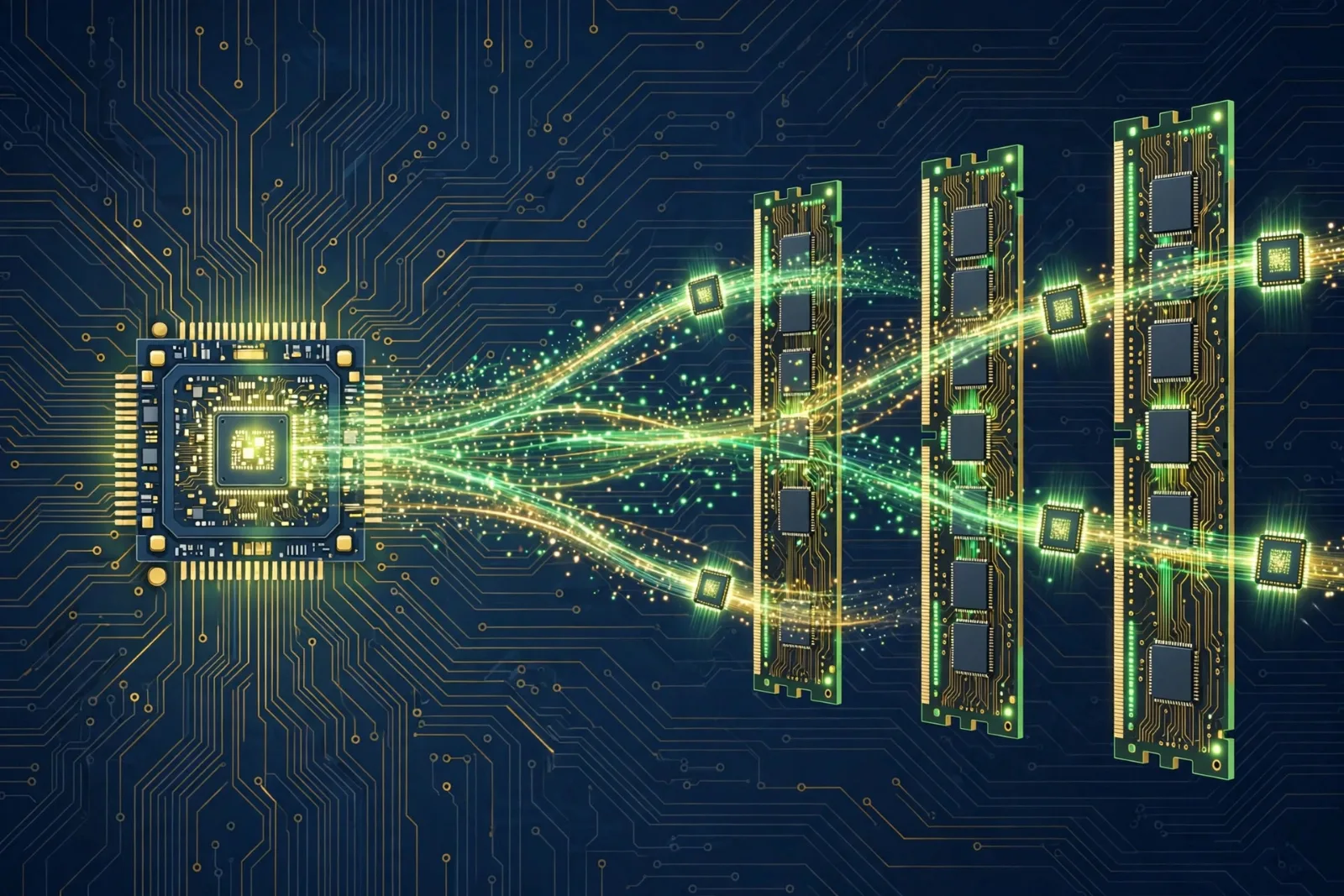
Every photo you take, every song you stream, every message you send — inside your computer, all of it is just 0s and 1s. Two digits. Nothing else. No letters, no decimal points, no colours. Just a very long string of on and off.
It sounds absurdly limiting. So why did the most powerful machines ever built settle on the simplest possible counting system — and why, after 80 years of progress, has nothing replaced it?
The short answer
Computers are built from transistors, tiny electronic switches that can be either on or off. One state is called 1, the other is called 0, and a single on-or-off value is called a bit. Because the hardware itself only has two states, the language of computing is binary: everything a computer stores or processes is a pattern of bits.
Two states are not a limitation computers suffer from. They are the reason computers are reliable.
Why two states beat ten
Humans count in tens because we have ten fingers. Early computers actually tried decimal — the ENIAC, one of the first general-purpose computers, used ten-state vacuum tubes. It was a nightmare. Each tube had to distinguish ten different voltage levels, and a tiny wobble in voltage could turn a 7 into an 8.
A transistor only has to answer one question: is current flowing, yes or no? That is easy to detect even when the signal is noisy, the chip is hot, or the voltage droops slightly. There is a huge margin between "clearly on" and "clearly off", so errors are rare. A ten-state switch would need ten clean levels, and the gaps between them would be small enough for noise to cause constant mistakes.
The mathematician Gottfried Wilhelm Leibniz described the binary system back in 1703, and the logician George Boole showed in 1854 how true/false logic could do arithmetic. When engineers started building electronic computers in the 1940s, binary was waiting for them: a system invented centuries earlier that matched exactly what a switch can do.
Bits, bytes, and how much 8 bits can hold
One bit holds two possible values: 0 or 1. That is not much. But bits combine fast:
- 1 bit — 2 values
- 4 bits — 16 values (enough for one hexadecimal digit)
- 8 bits (1 byte) — 256 values (enough for one character, or a shade of red)
- 16 bits — 65,536 values
- 32 bits — over 4 billion values
Each extra bit doubles the possibilities. Eight bits give you 256 combinations — exactly enough to cover every letter, number and punctuation mark in basic English, which is why the ASCII standard assigned each character a number from 0 to 127. The capital letter A is 65 in ASCII, which in binary is 01000001. The letter a is 97, or 01100001. Your keyboard is just a device that turns key presses into these numbers.
From bits to words, pictures, and sound
Once you can store numbers, everything else is a matter of agreement about what the numbers mean. Those numbers live in memory while the computer works on them — see how RAM actually works for the memory side of the story:
- Text: each character is a number (ASCII, and today its much bigger successor Unicode, which covers over 150,000 characters from every writing system on Earth).
- Pictures: an image is a grid of pixels, and each pixel is three numbers — how much red, green and blue light it should show. A single pixel in a normal photo is 24 bits: 8 for red, 8 for green, 8 for blue, giving 16.7 million possible colours.
- Sound: a microphone measures the air pressure of a sound wave thousands of times a second (typically 44,100 times a second for CD-quality audio) and stores each measurement as a number. Play the numbers back in order, and you hear the sound again.
- Video: just pictures, 24 to 60 of them per second, each one a grid of numbered pixels.
None of this requires the computer to "understand" letters or colours. It just stores numbers and follows rules about what to do with them.
The logic underneath: AND, OR, NOT
Arithmetic on bits is done with three simple operations, straight from Boole's logic:
- AND — outputs 1 only if both inputs are 1
- OR — outputs 1 if either input is 1
- NOT — flips 1 to 0 and 0 to 1
Every calculation a computer performs — adding two numbers, comparing a password, deciding whether to show you an ad — is built from these three operations, wired together in circuits called logic gates. Adding 2 + 3, for instance, is a chain of AND, OR and NOT gates working on the binary forms of 2 (10) and 3 (11) to produce 5 (101). A modern processor contains billions of transistors arranged into these gates, all switching billions of times a second — we explain the full picture in how CPUs actually work.
Why not use more than two states?
Engineers have tried. There are experimental ternary (three-state) computers, and quantum computers use qubits that can hold a blend of 0 and 1. But for everyday computing, binary keeps winning for three reasons:
- Reliability. Two states have the widest possible margin for error. More states mean smaller margins and more mistakes.
- Simplicity. Transistors are the cheapest, most reliable switches ever made, and they are naturally binary.
- Momentum. Eighty years of hardware, software and standards are built on bits. Replacing them would mean rebuilding everything.
Quantum computing is the real exception — but it is not a replacement for your laptop. It is a specialist tool for specific problems, and even quantum computers are controlled by ordinary binary machines.
The scale of it today
A single modern chip is hard to picture. Apple's M4 chip, released in 2024, packs 28 billion transistors onto a piece of silicon smaller than a postage stamp. Each one is a tiny switch, flipping on and off billions of times a second, and every flip is a bit changing value.
And yet the idea is unchanged since the 1940s: on, off, on, off. Every email, every video call, every AI model — all of it is patterns of 0s and 1s, manipulated by logic gates, at a speed no human could ever follow.
Binary vs decimal: the comparison
| Binary (base 2) | Decimal (base 10) | |
|---|---|---|
| Digits | 0, 1 | 0–9 |
| Invented for | Switches and logic | Human fingers |
| Error margin | Huge — on vs off | Small — ten levels to confuse |
| Hardware | One transistor per bit | Ten-state switch per digit |
| Example | 1010 = ten | 10 = ten |
| Where it rules | Every computer ever sold | Everyday human maths |
Takeaway checklist
- A bit is one on/off value — 0 or 1 — stored in a transistor, a tiny electronic switch.
- Two states are more reliable than ten: a switch only has to tell "on" from "off", so noise rarely causes errors.
- 8 bits make a byte, which holds 256 values — enough for one character or one shade of a colour.
- Letters are numbers: A is 65 in ASCII, written as 01000001 in binary.
- Pictures are grids of numbers (red, green, blue per pixel); sound is a list of measurements taken 44,100 times a second.
- All computation is AND, OR and NOT — three simple logic operations, wired into billions of transistors.
- Binary survives because it is reliable, simple, and everything is built on it — even quantum computers are steered by binary machines.
For more on this, see our explainer on 3D printers.
For more on this, see our explainer on restarting.