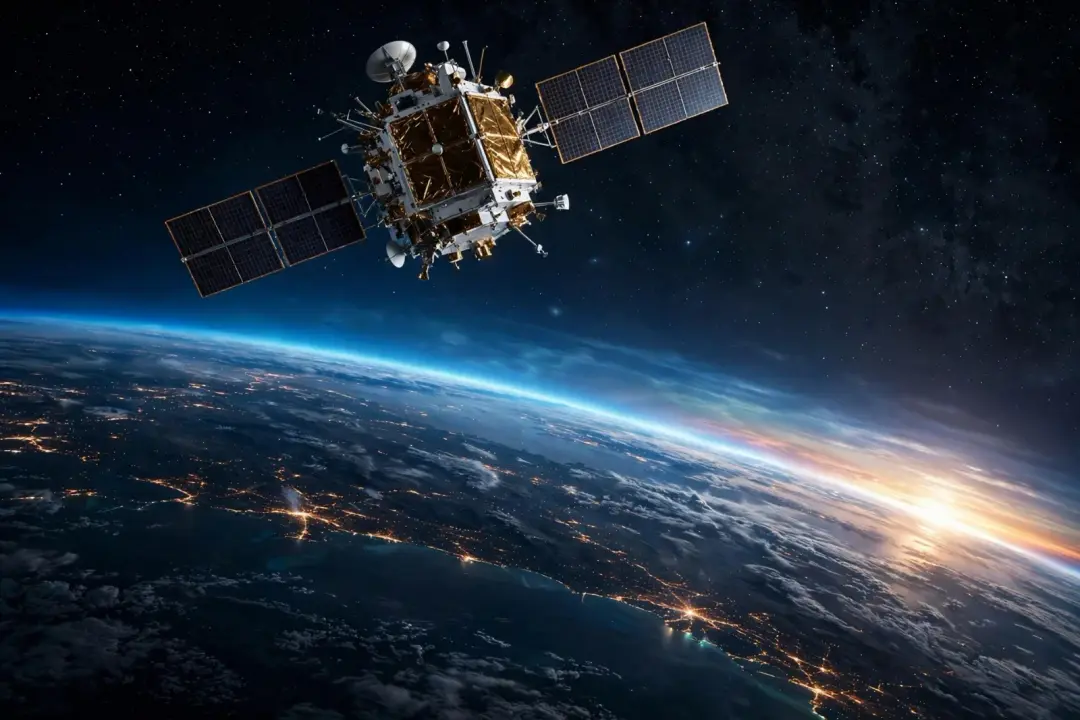
How do satellites stay in orbit? A satellite weighing several tonnes hangs above your head for years, with no engine running and nothing holding it up. It does not float, it is not beyond gravity, and it is not glued to the sky. The real answer is stranger and simpler: satellites are falling all the time — they just keep missing the ground.
The short answer: a fall that never lands
An orbit is not a place where gravity stops. It is a continuous fall, combined with enough sideways speed that the fall never ends. Gravity pulls the satellite toward Earth's centre, while the satellite's enormous sideways speed carries it forward. The two combine into a curved path that bends around the planet instead of into it.
Think of it this way: if you drop a ball, it falls straight down. If you throw it forward, it arcs and lands further away. Throw it fast enough, and the ground curves away beneath it at exactly the same rate as it falls — so it keeps falling, forever, without ever getting closer to the ground. That is an orbit.
Newton's cannonball
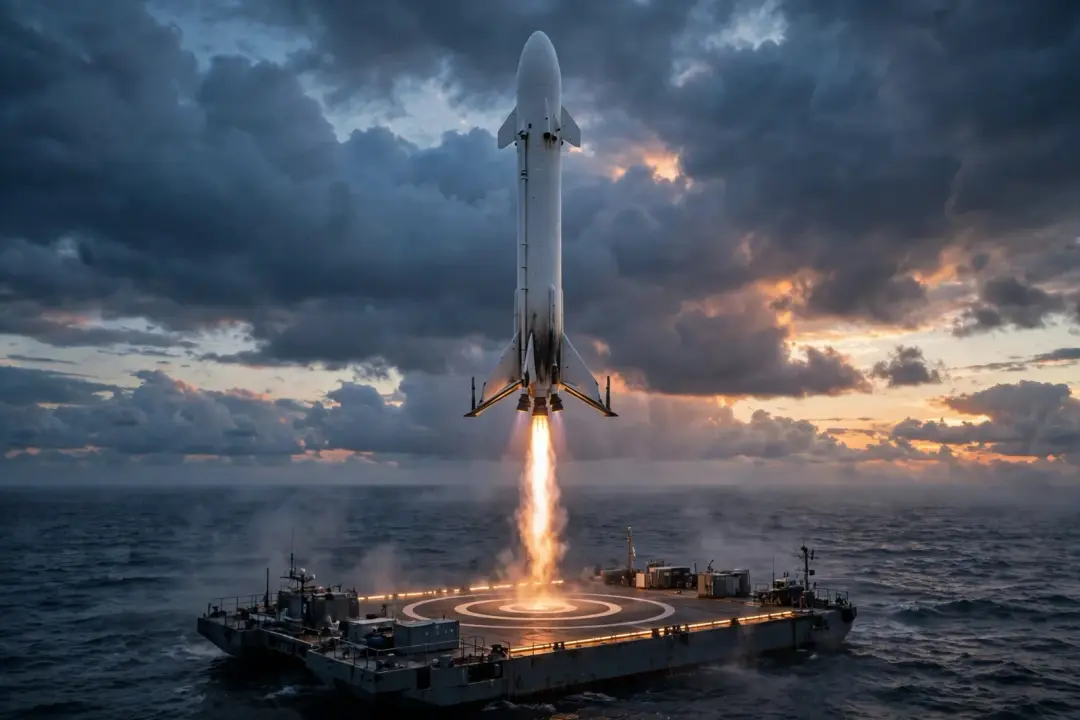
This idea goes back to Isaac Newton. In a famous thought experiment from 1687, he imagined a cannon on top of a very high mountain, firing cannonballs horizontally. A slow shot arcs down and lands nearby. A faster shot travels further before hitting the ground. Fire it fast enough — about 8 kilometres per second — and the cannonball falls toward Earth but always misses it, because Earth's surface curves away beneath it at the same rate. The cannonball would circle the planet and come back to where it started.
Every satellite in orbit is Newton's cannonball, fired at exactly the right speed. The only difference is that a rocket, not a cannon, does the firing.
Orbital velocity: the magic number depends on height
The speed a satellite needs is called its orbital velocity, and it changes with altitude. The higher the orbit, the weaker gravity's pull — and the slower the satellite needs to go. The speed does not depend on the satellite's mass at all: a 10-tonne station and a 1-kilogram cubesat need the same speed at the same height.
| Orbit | Approximate altitude | Orbital velocity | One lap takes |
|---|---|---|---|
| Low Earth orbit (e.g. the ISS) | ~400 km | about 7.7 km/s (about 27,600 km/h) | ~92 minutes |
| Medium Earth orbit (e.g. GPS satellites) | ~20,200 km | ~3.9 km/s | ~12 hours |
| Geostationary orbit | ~35,786 km | ~3.1 km/s | 24 hours |
The formula behind these numbers is simple: orbital velocity is the square root of Earth's gravitational pull divided by the distance from Earth's centre. At 400 km up, that works out to about 7.7 km/s — roughly 27,600 km/h, or about 23 times the speed of sound.
Geostationary orbit is a special case. At exactly 35,786 km above the equator, a satellite's orbital period matches Earth's rotation — about 24 hours — so it appears to hover over the same spot on the ground. That is why TV and weather satellites live there: a dish on your roof can point at one fixed place in the sky.
Why astronauts float if gravity is still there
One of the most common misunderstandings about space is that there is no gravity up there. There is — plenty of it. At the International Space Station's altitude of about 400 km, gravity is still around 88% as strong as it is on the ground.
Astronauts float for the same reason the station stays up: everything inside it is falling together, along the same curved path. It feels like weightlessness because there is nothing pushing back — the same feeling you get for a split second at the top of a roller coaster drop, stretched out for months.
What can go wrong
An orbit is a balance, and the balance can break in three ways:
- Too slow: if a satellite loses speed, gravity wins and it spirals down into the atmosphere, where it burns up. This is how old satellites are deliberately retired.
- Too fast: above about 11.2 km/s at Earth's surface — the escape velocity — a spacecraft breaks free of Earth's gravity entirely and heads off into space. That is what interplanetary probes do on purpose.
- Drag: low Earth orbit is not a perfect vacuum. There is still a whisper of atmosphere at 400 km, and it slowly brakes satellites down. The ISS loses a little altitude every day and needs occasional engine boosts — called reboosts — to stay up. Dead satellites with no fuel eventually fall back on their own.
Space debris makes this worse: thousands of dead satellites and fragments share these orbits, and at 7.7 km/s even a paint fleck can do real damage. That is why tracking debris has become a serious job in its own right.
Not all orbits are circles
Most satellites follow near-circular orbits, but orbits can also be ellipses. On an elliptical orbit, speed is not constant: the satellite moves fastest at its closest point to Earth (called perigee) and slowest at its farthest point (apogee), because gravity pulls harder up close. Earth itself does the same thing around the Sun — it moves slightly faster in January, when it is closest, than in July.
The rule that ties it all together is Kepler's third law: the higher the orbit, the longer one lap takes. That is why the ISS circles Earth 16 times a day while a geostationary satellite takes a full day to do it once.
Takeaway checklist
- Satellites never stop falling — they move sideways fast enough to keep missing the ground.
- The magic speed is orbital velocity: about 7.7 km/s at 400 km, slower the higher you go.
- Gravity is still strong in orbit — about 88% of surface gravity at the ISS. Astronauts float because they are falling together with the station.
- Geostationary orbit (35,786 km) is the one height where a satellite appears fixed over one spot on Earth.
- Orbits decay: thin air drags low satellites down, which is why the ISS needs regular reboosts.
- Too fast means escape: above 11.2 km/s, a spacecraft leaves Earth behind for good.
Next time you see a satellite glide silently across the night sky, remember what you are watching: an object in permanent free fall, moving so fast that the Earth keeps curving away beneath it. For how those satellites beam internet down to you, see Satellite Internet, Explained, and for what happens when too many dead satellites share the same orbits, read Space Debris and the Kessler Syndrome, Explained.