How do space telescopes work? Nobody looks through them. A space telescope is a giant light collector in orbit: mirrors gather faint light from distant objects, instruments sort that light by colour, detectors record it as numbers, and those numbers are radioed back to Earth — where they become the images that fill the news. Here is the whole journey, from a photon leaving a distant galaxy to the picture on your screen.
Why put a telescope in space at all?
Earth's atmosphere is the problem. It does three things astronomers hate:
- It blocks most light. The atmosphere lets visible light and radio waves through, but it absorbs gamma rays, X-rays, most ultraviolet light and much infrared light. To study the universe in those wavelengths, a telescope has to get above the air.
- It blurs what remains. Turbulent pockets of air bend starlight in constantly changing ways — the reason stars twinkle. From the ground, even a perfect telescope sees a shimmering image.
- It never gets truly dark. The sky itself glows faintly, which limits how faint an object a ground telescope can detect. In space the sky is pitch black, so a long exposure can reveal objects far fainter than anything visible from Earth.
A space telescope escapes all three problems at once. It can also observe continuously — no daylight, no weather, no clouds.
The three jobs every space telescope does
Whatever wavelength it studies, every space observatory shares the same three-part design:
- A telescope to gather the light and bring it to a focus — usually large curved mirrors, since lenses would be too heavy and fragile at these sizes.
- Filters or instruments to sort the light by wavelength — a spectrograph, for example, splits light into a rainbow that reveals what a star or galaxy is made of.
- A detector to record the result — a much more sensitive cousin of the sensor in a digital camera.
The bigger the mirror, the more light it collects, and the fainter and more distant the objects it can see. That single rule drives the design of every great space telescope.
Hubble: the telescope that fixed its own eyesight
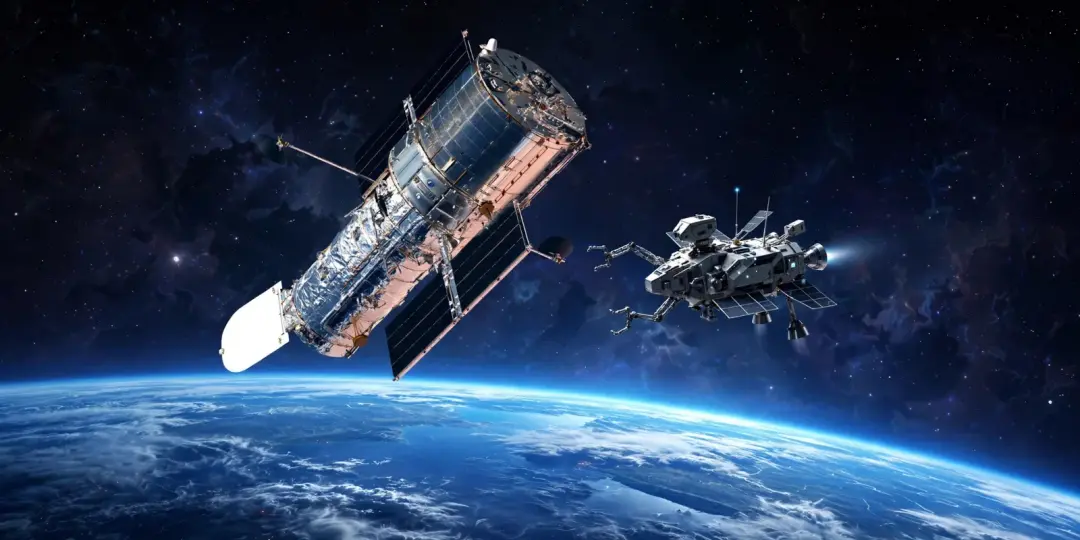
The Hubble Space Telescope launched in April 1990 aboard the Space Shuttle Discovery and has worked in low Earth orbit, about 540 kilometres above the surface, for more than 35 years — one of the longest-serving scientific instruments ever built. Its 2.4-metre primary mirror collects visible, ultraviolet and near-infrared light.
Hubble's start was nearly a disaster. Its first images were blurry because the primary mirror had been ground to the wrong shape — a flaw of just 2.2 micrometres that caused severe spherical aberration. In December 1993, astronauts on the first servicing mission installed corrective optics, and Hubble immediately began producing images of unprecedented sharpness. It has been serviced and upgraded five times in total.
Hubble can resolve objects just 0.05 arcseconds across — roughly like seeing two fireflies less than 10 feet apart in Tokyo from Washington, DC. In December 1995 it stared at a single tiny, apparently empty patch of sky for ten days and produced the Hubble Deep Field: thousands of galaxies in a speck of sky, some shining from just 400 million years after the Big Bang. It also measured the expansion rate of the universe precisely enough to earn its principal investigators a Nobel Prize. NASA expects Hubble to keep working into the 2030s — and a few years ago it even planned a rescue mission to keep it flying, which we covered in our explainer on NASA's plan to save Hubble.
Webb: built to see the first light
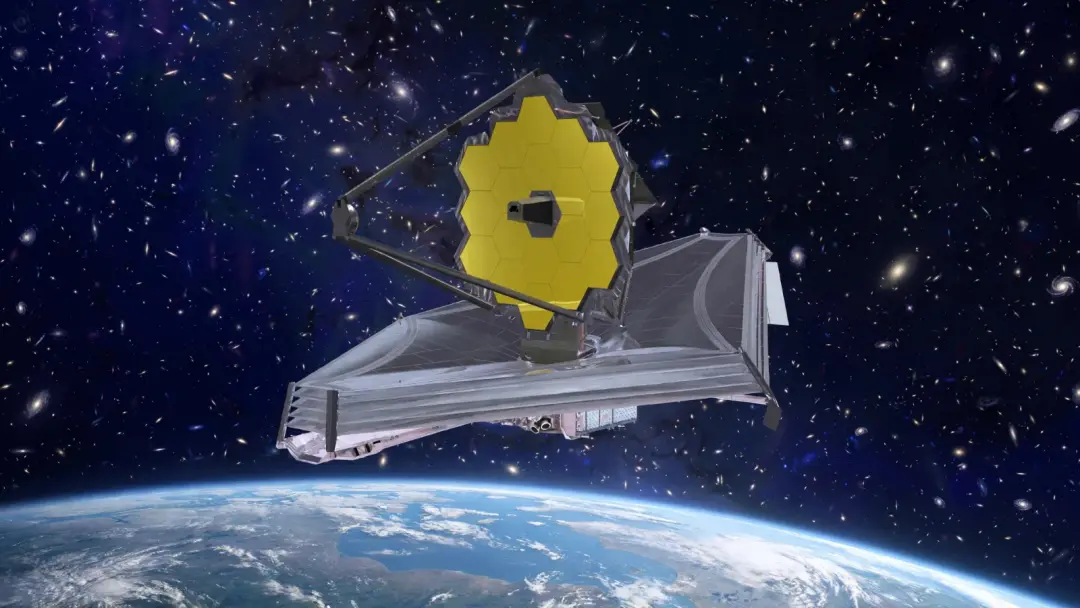
The James Webb Space Telescope, launched on 25 December 2021, is Hubble's successor — and it works differently. Where Hubble looks mostly at visible light, Webb looks at infrared, because the light from the first galaxies has been stretched by the expansion of the universe into the infrared by the time it reaches us. This stretching is called redshift.
- Mirror: 6.5 metres across, made of 18 hexagonal segments of gold-coated beryllium — about six times the collecting area of Hubble's mirror.
- Home: the second Lagrange point (L2), 1.5 million kilometres from Earth, where the Sun, Earth and Moon all stay behind it.
- Sunshield: a tennis-court-sized shield (about 21 × 14 metres) that blocks heat from the Sun.
- Temperature: Webb's instruments must stay extremely cold, because anything warm glows in infrared — including the telescope itself. Its mid-infrared instrument is cooled to around 7 Kelvin (–266°C), just a few degrees above absolute zero.
Because it sees in infrared, Webb can look through dust clouds that hide young stars, study the atmospheres of planets around other stars, and observe galaxies as they were more than 13 billion years ago. It is, in the most literal sense, a time machine: the farther away an object is, the longer its light has travelled, and the further back in time we see.
Hubble vs Webb, side by side
| Hubble | Webb | |
|---|---|---|
| Launched | April 1990 | December 2021 |
| Primary mirror | 2.4 m, single piece | 6.5 m, 18 segments |
| Main light | Visible, ultraviolet, near-infrared | Infrared |
| Orbit | Low Earth orbit, ~540 km | Lagrange point L2, 1.5 million km |
| Temperature | Near room temperature | As cold as ~7 K (–266°C) |
| Famous for | Deep Field images, expansion of the universe | First galaxies, exoplanet atmospheres |
The two telescopes complement each other rather than compete: Hubble still does work Webb cannot, especially in ultraviolet light, which Webb does not observe at all.
How the pictures get to your screen
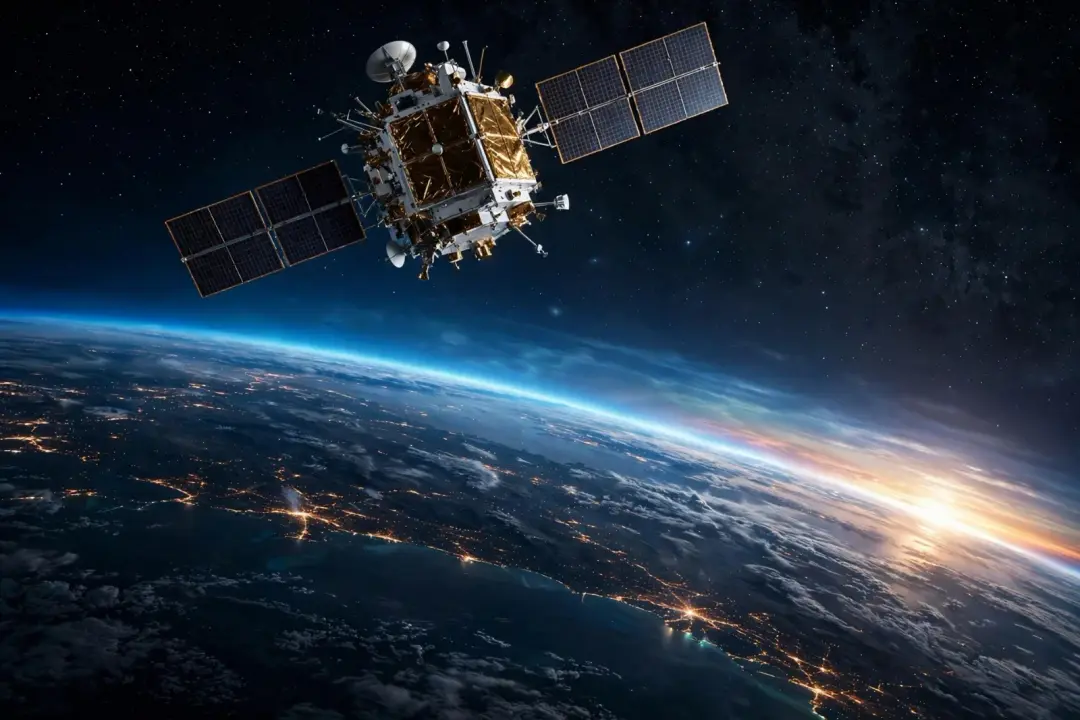
A space telescope has no film and no eyepiece. Its detectors record brightness through different filters, one exposure at a time, and the data is radioed down to ground stations — much like the satellites we explained in our guide to how satellites stay in orbit.
The colour in the famous images is added afterwards. Detectors record only brightness, so astronomers combine exposures taken through different filters and map them to visible colours — often assigning colours to wavelengths the human eye cannot see at all. The result is a scientifically honest picture: the shapes, structures and brightness are real, even if the colours are a translation.
Not all space telescopes use mirrors the same way. X-ray telescopes such as Chandra use barrel-shaped mirrors that X-rays skim at shallow angles, like stones skipping across water. Gamma-ray telescopes do not focus light at all; they track the particles the rays create when they hit a detector.
What comes next
NASA's next great observatory, the Nancy Grace Roman Space Telescope, launched on 30 August 2026 aboard a SpaceX Falcon Heavy and is now cruising to the same L2 point Webb occupies. With a 2.4-metre mirror — the same size as Hubble's — and a field of view roughly 100 times wider than Hubble's, Roman is built to survey huge swathes of sky at once and map dark energy and exoplanets. Meanwhile, Hubble and Webb keep working together, and astronomers are already designing the telescopes that will follow them.
Takeaway checklist
- Why space: Earth's atmosphere blocks most light and blurs the rest — space telescopes escape both problems.
- Three jobs: collect light with a mirror, sort it with instruments, record it with a detector.
- Hubble: launched 1990, 2.4 m mirror, 540 km up; a 1993 repair fixed its flawed mirror; famous for the Deep Field.
- Webb: launched 2021, 6.5 m gold mirror at L2, 1.5 million km away, cooled to near absolute zero to see infrared.
- Time machines: the farther the light travelled, the further back in time we see — Webb looks back over 13 billion years.
- Colour is added later: detectors record brightness; the famous colours are mapped from invisible wavelengths.
- Different light, different mirrors: X-ray telescopes use grazing-angle mirrors; gamma-ray telescopes track particles instead.