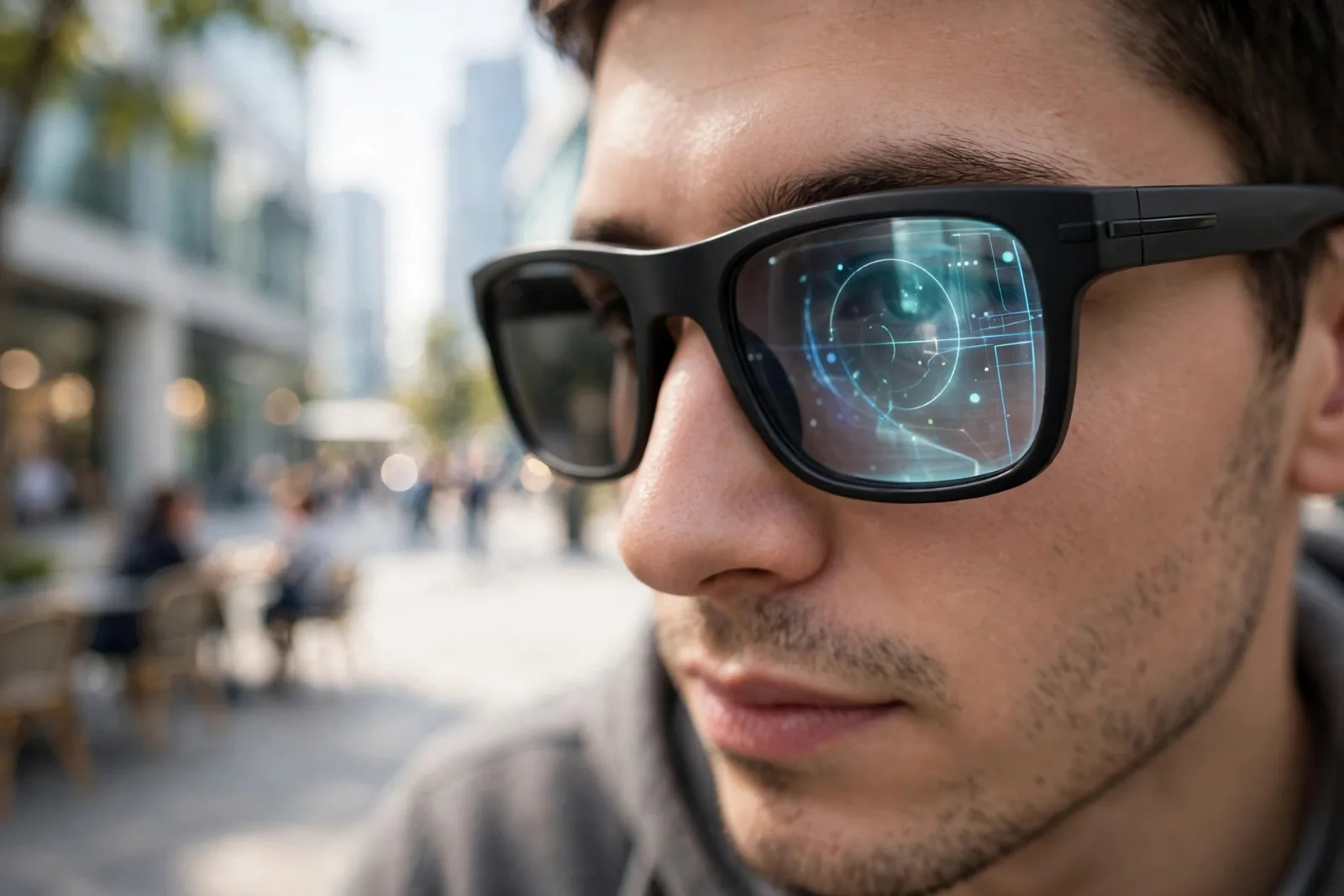
Put on a pair of smart glasses and a small screen appears in front of your eye — directions floating over the road, a message you can read without touching your phone, a foreign street sign translated in real time. There is no screen you can see from the outside. The image is beamed into the lens itself, and you control it by twitching your thumb. Here is how the three tricks inside the frame actually work.
First, what are smart glasses?
There are two kinds, and the difference matters more than the brand name:
- Camera glasses have a camera, microphones, speakers and an AI assistant, but no display. Meta's Ray-Ban Meta Gen 2 costs $299 (Gen 3 is $349). They take photos, record video, answer questions about what you are looking at — and everything they show you, they say out loud.
- Display glasses add a screen inside the lens. Meta's Ray-Ban Display costs $799 and launched in September 2025. The RayNeo X3 Pro ($1,099) and Even Realities G2 Air ($599) are its main rivals. Reports say Meta sold more than 7 million pairs of its camera glasses in 2025 — the display version is the attempt to turn that hit into something more.
Both kinds look like ordinary glasses. That is the whole point: unlike a VR headset, they are meant to be worn all day, in public, without anyone staring.
The waveguide: a screen hidden inside the lens
The cleverest part is the display, and it works nothing like your phone screen. There is no panel in front of your eye. Instead, three parts cooperate:
- A micro-projector sits in the temple arm, about the size of a grain of rice. It creates a tiny, very bright full-colour image.
- The lens is the screen. The projector beams the image into the edge of the lens, where it bounces along inside the glass through total internal reflection — the same physics that keeps light inside a fibre-optic cable.
- A waveguide pulls the light out. Microscopic gratings or tiny partial mirrors embedded in the lens bend the bouncing light outwards, directly into your eye. You see the image floating in front of you; someone looking at you sees almost nothing, because less than 1% of the light leaks outwards.
The numbers show how early this technology still is. The Ray-Ban Display shows 600 × 600 pixels in the lower-right corner of the right lens only, across a 20-degree field of view — a small window in your peripheral vision, not a cinema screen. But it is bright: up to 5,000 nits, roughly five times brighter than a phone, so it stays readable in direct sunlight. It refreshes at 90 Hz and packs 42 pixels per degree, which is why text looks sharp despite the tiny window.
Binocular rivals such as the RayNeo X3 Pro put a display in both lenses for true 3D depth, but they pay for it: 76 grams, and under two hours of heavy use. Meta chose one eye, 69 grams, and about six hours of mixed use.
The wristband that reads your muscles
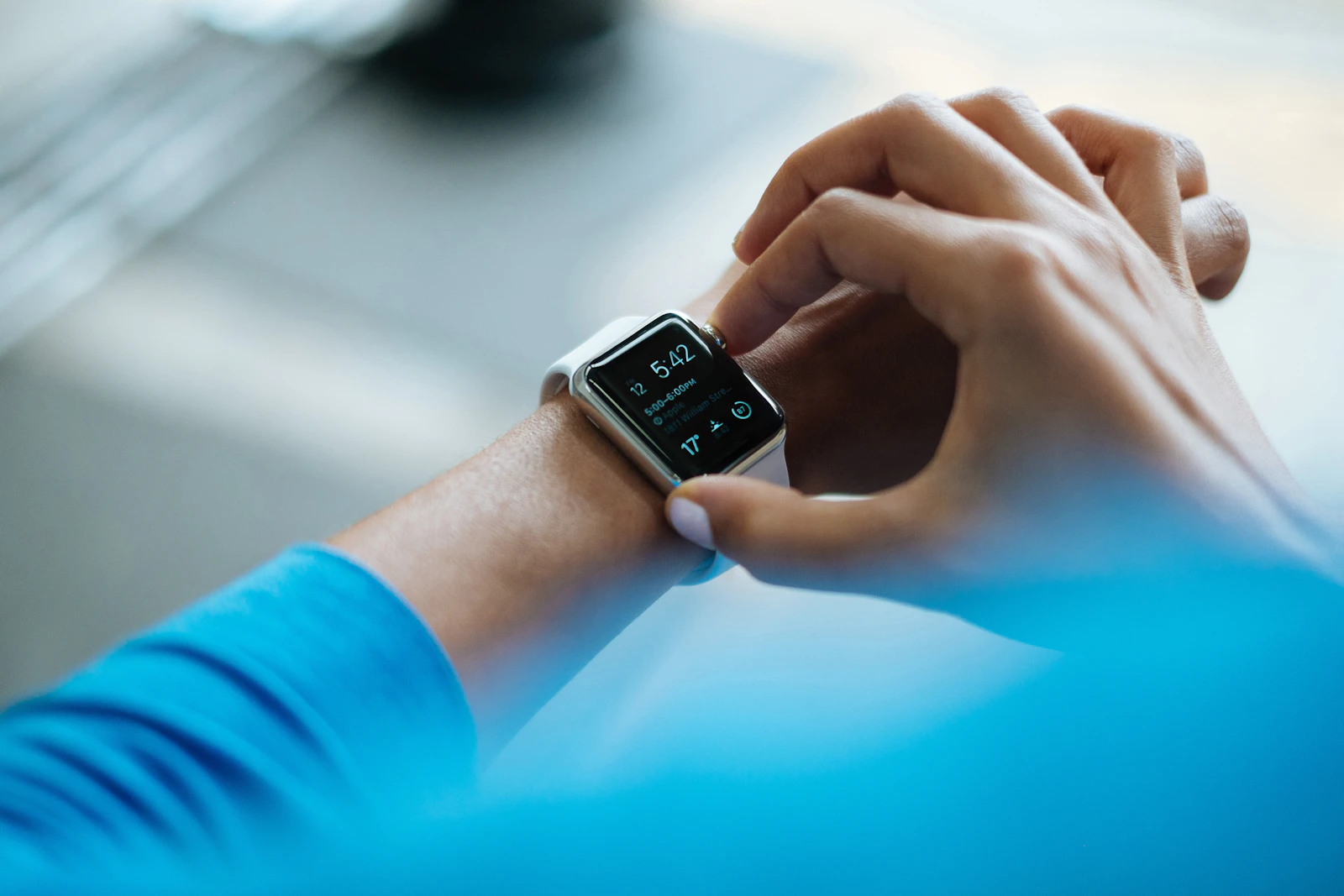
A screen you cannot touch needs a different kind of control, and Meta's answer is a wristband. The Neural Band (included with the Ray-Ban Display) has eight dry electrodes pressed against your wrist. When you pinch your thumb and index finger together, the muscles in your forearm fire a tiny electrical signal — surface electromyography, or sEMG — and the band reads it.
- The band detects a pinch in about 14 milliseconds, fast enough to feel instant.
- It can tell different gestures apart: a pinch to select, a swipe of the thumb to scroll, even tracing letters in the air to type.
- It weighs 18.5 grams and runs for about 18 hours on a charge — far longer than the glasses themselves.
Why a wristband instead of buttons on the frame? Because tapping your glasses in public looks odd and announces that you are using a computer. A thumb pinch is nearly invisible. Voice control is the backup: you can simply ask Meta AI, and the glasses answer through tiny open-ear speakers built into the temples.
The camera, the AI and the phone in your pocket
The glasses themselves are deliberately dumb. The real computing happens on your phone:
- A 12MP camera in the frame takes photos and 3K video. The AI sees what you see, so you can ask what a plant is, what a sign says, or where you left your keys.
- A Snapdragon AR1+ Gen 2 chip in the glasses handles the display, the camera and the wireless link, while your phone runs the Meta AI app and does the heavy thinking.
- Tiny speakers sit above your ears and microphones pick up your voice, so calls and music work without earbuds.
This split is why the glasses can weigh 69 grams instead of 200. But it also means they are useless without a charged phone nearby and a data connection.
The hard trade-offs
Smart glasses are impressive, but four limits decide whether they are worth buying yet:
- Battery. Meta claims up to 6 hours, but with the display active the real figure is closer to 3–5 hours. The charging case tops them up, but they are not all-day devices yet.
- A tiny window. A 20-degree field of view shows notifications and directions well. It cannot show a video, a map you can study, or anything immersive — a VR headset's 110-degree view is a different world.
- Weight and price. At 69 grams they are roughly double the weight of ordinary glasses, and $799 becomes $999 with prescription lenses.
- Privacy. A camera on your face makes other people nervous, even with the small white LED that lights up while recording. Expect awkward conversations.
Display glasses vs camera glasses vs VR headset
| Camera glasses | Display glasses | VR headset | |
|---|---|---|---|
| Screen | None (audio only) | Small, in one lens | Huge, both eyes |
| Weight | ~45 g | ~69 g | ~500 g |
| Battery | 5–8 hours | 3–6 hours | 2–3 hours |
| Best for | Photos, AI questions | Notifications, directions | Games, immersive video |
| Price from | $299 | $799 | ~$500 |
Takeaway checklist
- Smart glasses come in two kinds: camera-only glasses ($299) that talk to you, and display glasses ($799) that also show you things.
- The display is a waveguide: a micro-projector beams an image into the lens, light bounces inside the glass, and tiny mirrors bend it out into your eye.
- The screen is small but bright: 600 × 600 pixels, a 20-degree window, up to 5,000 nits so it works in sunlight.
- Control comes from your wrist: the Neural Band reads muscle signals (sEMG) and detects a thumb pinch in about 14 milliseconds.
- Your phone does the thinking: the glasses hold the camera and display; the Meta AI app on your phone does the heavy work.
- The limits are battery, field of view, weight and price — this is still early-adopter technology, not a phone replacement.
Internal links: How OLED Displays Work · How Do VR Headsets Actually Work?
For the bigger picture, see our guide to wearable technology.
For more on this, see our explainer on HomePod.