How Noise-Cancelling Headphones Actually Work
You've felt it — you put on a pair of noise-cancelling headphones in an airport, and the roar of the crowd melts away like someone turned down the world's volume knob. But how does a piece of plastic do that? The answer involves a physics trick, tiny microphones that listen to the noise around you, and sound waves that fight sound waves. Let's break it down in plain English.
There Are Two Kinds of Silence: Passive and Active
Before we get to the fancy electronics, it's important to know that every pair of noise-cancelling headphones uses two layers of quiet, not one.
Passive noise isolation is the simple one. It's what happens when you stick your fingers in your ears: a physical barrier blocks sound. Over-ear headphones do this with cushioned earcups that seal around your ears, and earbuds do it with silicone tips that plug the ear canal. Good passive isolation blocks mid and high-frequency sounds well — chatter, clinking dishes, the hiss of an air conditioner.
Active noise cancellation (ANC) is the electronic layer built on top. It uses power, microphones, and a processor to actively erase noise that gets past the physical seal — especially low-frequency droning sounds like airplane engines, train rumble, and office HVAC hum.
Here's how they compare:
| Feature | Passive isolation | Active noise cancellation (ANC) | Transparency mode |
|---|---|---|---|
| What it is | Physical seal blocking sound | Electronics that erase noise with anti-noise | Electronics that pipe outside sound IN |
| Best at blocking | Mid/high sounds (voices, clatter) | Low-frequency drone (engines, fans, traffic hum) | Blocks nothing — lets you hear your surroundings |
| Needs battery? | No | Yes | Yes |
| Typical reduction | 10–15 dB from the seal | ~20–30 dB total (with the seal) | N/A |
| Weak spot | Low bass sounds leak through | Sudden sharp sounds (a clap, a horn) | Hearing your own voice naturally |
A decibel (dB) is just a measure of loudness, and the scale is logarithmic — a 10 dB drop sounds roughly half as loud. So when a manufacturer claims ~20–30 dB of noise reduction, that's a very noticeable drop, turning a roaring cabin into a manageable hum.
The Physics Trick: Destructive Interference
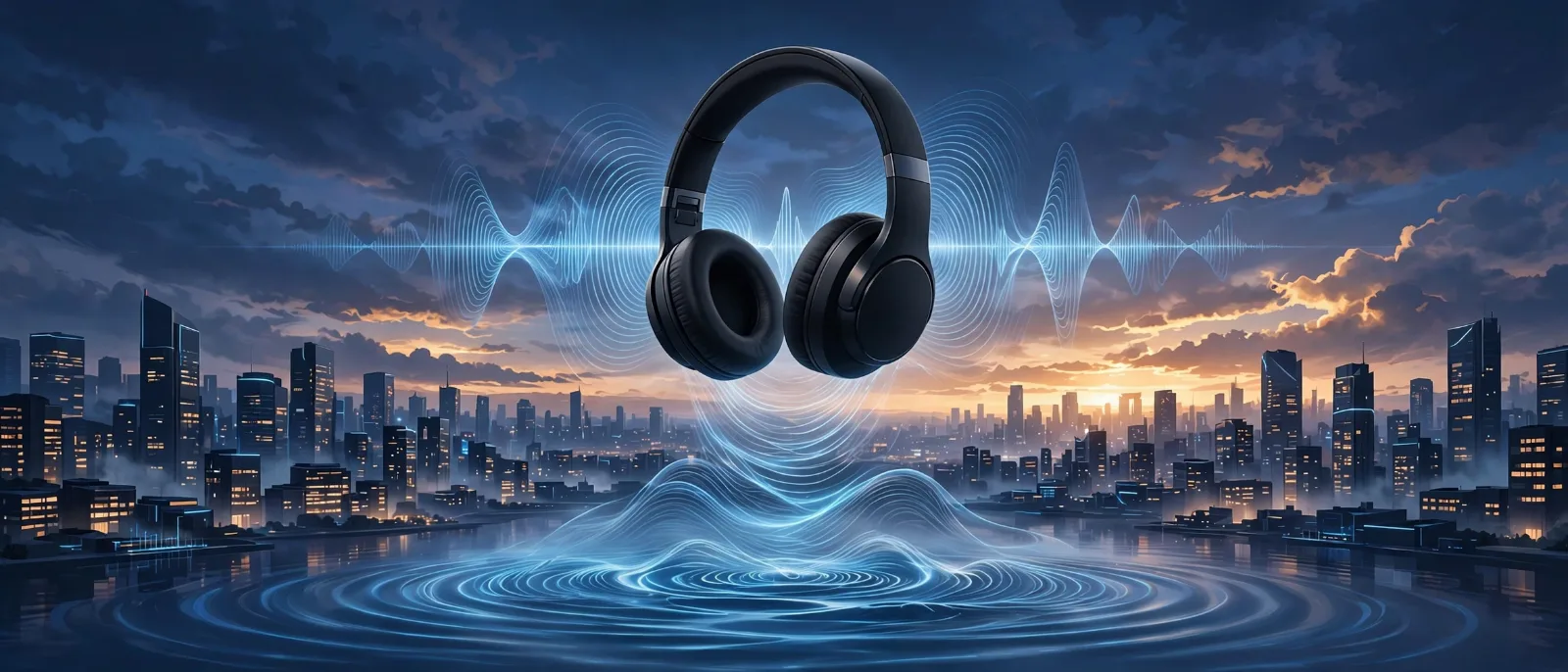
Here's the magic trick at the heart of ANC, and it's surprisingly simple: two identical sound waves that are exactly out of step with each other cancel out.
Imagine two water waves in a pool. If the peak of one wave meets the peak of another, they add up into a bigger wave — that's constructive interference. But if the peak of one wave meets the valley of the other, they flatten each other out — that's destructive interference. Sound works the same way.
ANC headphones exploit this in real time:
- Microphones on the headphones constantly listen to the noise around you — the drone of an airplane engine, for example.
- A tiny digital signal processor (DSP) analyses that noise and instantly creates an "anti-noise" sound wave: the exact mirror image of the incoming sound (peaks where the noise has valleys, valleys where it has peaks).
- The speaker plays that anti-noise into your ear at the same moment the real noise arrives.
The two waves collide in your ear and cancel each other out. You hear silence — or at least, much less noise.
For this to work, the timing has to be perfect. Sound travels fast, so the processor has only a few thousandths of a second to hear the noise, flip it, and play the anti-noise. That's why ANC is best at low-frequency, predictable sounds — a steady engine hum is easy to predict and mirror. A sudden sound, like a dropped tray or a car horn, happens too fast for the system to react to, which is why ANC can't block those.
Feedforward vs Feedback vs Hybrid ANC
Not all ANC systems are built the same way. Manufacturers use three microphone layouts, and the difference matters:
- Feedforward ANC — the microphone sits on the outside of the earcup. It hears the noise before it reaches your ear, giving the processor a head start. It's great for mid-range frequencies but can be fooled by wind, which blasts directly into the outside mic.
- Feedback ANC — the microphone sits on the inside of the earcup, near your ear. It hears what you're actually hearing and corrects mistakes in real time. It's more accurate but has to react to noise that's already arrived, so it works best on lower frequencies.
- Hybrid ANC — uses both: outside mics for an early warning, inside mics for fine-tuning. Most flagship headphones today (and many mid-range ones) use hybrid ANC because it combines the strengths of both. It handles a wider range of frequencies and adapts better when the earcup seal isn't perfect — like when you wear glasses.
Transparency and Adaptive ANC: The Smart Modes
Early ANC headphones had one setting: silence. Modern ones give you a dial:
Transparency mode (also called ambient mode) flips the script: instead of cancelling outside sound, the microphones pick it up and play it into your ears alongside your music. It's perfect for hearing a train announcement, ordering coffee, or just walking near traffic without taking your headphones off. The best implementations sound surprisingly natural — like you're not wearing headphones at all.
Adaptive ANC goes a step further. The headphones measure your surroundings and adjust the noise cancellation automatically. Loud street? Maximum cancellation. Quiet room? Back it off to save battery and avoid that faint "pressure" feeling some people notice with strong ANC. Some models even adjust in real time for wind, or tweak the cancellation to your ear shape and the exact seal of your earcups.
The Codec Question: Why Bluetooth Quality Matters
One catch with wireless ANC headphones: your music travels over Bluetooth, and Bluetooth squeezes audio down to fit. The algorithm doing the squeezing is called a codec, and it affects sound quality — especially if you care about detail. The phone and the headphones must both support a codec for it to kick in; otherwise they fall back to the basic one.
- SBC (~328 kbps) — the universal baseline. Every Bluetooth device supports it, but it's the lowest common denominator in quality.
- AAC (~256 kbps) — Apple's default. On iPhones it's the only choice, and it sounds good there because Apple tunes it well. On Android, AAC performance varies.
- aptX (~352 kbps) — Qualcomm's codec for Android. Low latency is its strength, which makes it great for video and gaming. aptX HD (576 kbps) and aptX Adaptive (up to 420 kbps, variable) are the upgraded versions.
- LDAC (up to 990 kbps) — Sony's codec, the highest-quality mainstream option. It can carry near-hi-res audio (24-bit/96 kHz), but needs a strong connection and works only on Android and select devices — never on iPhones.
A word of honest perspective: if you mostly stream music from Spotify or Apple Music, the difference between codecs is subtle — your stream's own compression often matters more. Codecs matter most for listeners with high-quality music files who are really paying attention. For more on how the chips and hardware inside gadgets actually do their jobs, see Semiconductors Explained and how wireless tech keeps improving in How 5G Changes Connectivity.
Battery, Charging, and Practical Limits
ANC is hungry for power — those microphones and processors run constantly. Most modern wireless ANC headphones deliver 25–40 hours of playback with ANC on, and a 10-minute quick charge typically buys several more hours. True wireless earbuds last less per charge (usually 5–8 hours, with the charging case extending that to 20–30 hours total).
A few honest limits worth knowing:
- ANC can't block sudden sounds. It needs a predictable, steady wave to mirror. Conversations, clapping, and horns still come through — transparency mode is there for a reason.
- Some people feel ear pressure. Strong ANC creates a subtle sensation of pressure or fullness in the ears. Lowering the ANC level or switching to a lighter mode usually fixes it.
- Fit matters more than marketing. For earbuds, the right tip size is everything — a poor seal lets noise (and bass) leak out no matter how good the ANC chip is. For more on how ear-worn tech interacts with your body, check out Wearable Technology and Health.
- ANC headphones need power to cancel. When the battery dies, ANC dies with it — though most still play music passively over a cable.
A Short History: From Cockpits to Commutes
ANC didn't start with commuters. The idea was born when Bose founder Amar Bose tried airline headphones on a flight and was disappointed by the engine noise drowning out his music. Bose developed the first commercially available noise-cancelling headset for pilots in 1989 — the Bose Aviation Headset — protecting pilots' hearing and letting them hear radio communications clearly.
The technology stayed in cockpits and military vehicles for a decade until Bose brought it to consumers with the QuietComfort line in 2000. Those early models were wired and expensive, but they proved everyday listeners wanted the same quiet pilots had. Wireless ANC headphones, which took off in the 2010s, are simply that same anti-noise idea — plus Bluetooth, batteries, and smarter chips — shrunk into a travel-friendly package.
Takeaway checklist
Buying:
- Choose hybrid ANC if you want the strongest all-round noise cancellation
- Try the fit before buying (earbuds: test all included tip sizes; over-ears: check the seal with glasses on)
- Match the codec to your phone — LDAC/aptX matter on Android; iPhones max out at AAC anyway
- Check battery life with ANC turned on (not the "ANC off" figure), plus quick-charge specs
- Look for transparency mode if you walk in traffic or commute by train
Using:
- Keep firmware updated — ANC algorithms often improve with software updates
- Clean ear tips and earcups regularly; dirt ruins the acoustic seal
- Use transparency mode near roads — safety first, silence second
- If you feel ear pressure, lower the ANC level instead of turning it off completely
- Store earbuds in their case — it charges them and protects the microphones from dust