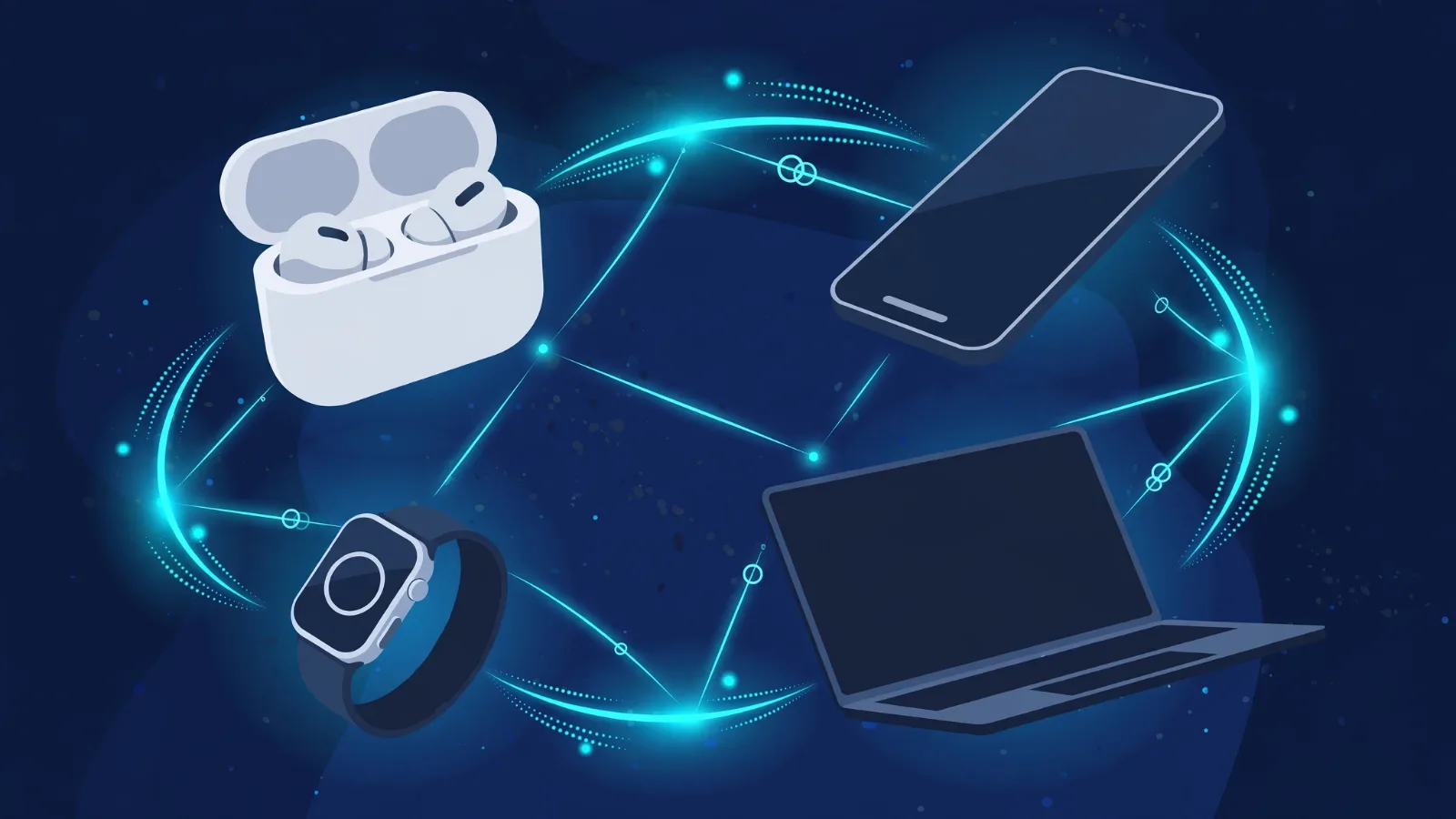
Your earbuds, car stereo, smartwatch, and door lock all speak the same wireless language — and it's named after a Viking king with a bad tooth. Every day, billions of Bluetooth connections are made without anyone thinking about the tiny radio dance happening in their pocket. Here's what that dance actually is.
Named after a 10th-century king
The name is a literal translation of the nickname of Harald Gormsson, a 10th-century Danish king remembered for uniting warring factions in Scandinavia. In 1997, engineers from Ericsson and Intel were building a common short-range wireless standard and needed a placeholder name. Intel engineer Jim Kardach, who had been reading about Vikings, suggested "Bluetooth": just as the king united territories, this standard would unite the PC and phone industries.
The codename was never meant to be permanent, but it spread through the industry and stuck. Even the logo carries the story: it is a bind rune — the runes for H and B, the king's initials, overlaid into one mark. The Bluetooth SIG (Special Interest Group) was founded in 1998, and the first specification arrived in 1999.
The radio: tiny waves, fast hopping
Bluetooth is a short-range radio technology. It operates in the 2.4 GHz ISM band — the same unlicensed frequency neighborhood as Wi-Fi and microwave ovens. Because that band is crowded, Bluetooth avoids interference with a trick called frequency-hopping spread spectrum.
A Classic Bluetooth radio divides the band into 79 channels and jumps between them up to 1,600 times per second, following a pseudo-random pattern shared by the two connected devices. Each channel is used for only a fraction of a millisecond, so a burst of interference on one frequency barely touches the conversation. Modern Bluetooth hops adaptively, learning which channels Wi-Fi is sitting on and skipping them — part of how the two manage to coexist in the same phone without constantly tripping over each other (see our how Wi-Fi actually works for the other side of that story).
Pairing and bonding, in plain English
For two devices to connect, they must agree they're talking to each other. Three stages:
- Discovery. Headphones go into "pairing mode" and broadcast "I'm here" signals; your phone lists what it finds.
- Pairing. You tap the device name. The two exchange a handshake and agree on an encryption key.
- Bonding. That key is saved, so the devices reconnect automatically next time — no tapping required.
Modern Bluetooth uses strong encryption once paired. The most practical security habit is keeping device firmware updated, since updates patch the rare vulnerabilities researchers find. Turning pairing mode off when you don't need it is also sensible.
Two flavors: Classic and Low Energy
Bluetooth is two related technologies sharing a name:
- Bluetooth Classic — the original: a steady, relatively fast connection (up to about 3 Mbps) for streams of data — music to headphones, calls to car systems, file transfers. It uses more power.
- Bluetooth Low Energy (BLE) — designed for tiny sips of data: a fitness band sending your step count, a temperature sensor, a luggage tag. It sleeps most of the time, which is why a coin-cell sensor can run for a year.
Your phone has both and picks automatically. A smartwatch may use Classic for music but BLE for syncing health data — one reason it doesn't drain its battery in hours (wearable technology and health).
Versions: what the numbers mean
Both devices negotiate the best they share. Here's what each release added:
| Version | Released | Headline improvement | What it means for you |
|---|---|---|---|
| 5.0 | 2016 | 2× speed and 4× range for Low Energy | Better range for trackers and smart-home gadgets |
| 5.1 | 2019 | Direction finding | Devices can estimate a signal's direction — better item tracking |
| 5.2 | 2020 | New audio channels; foundation for LE Audio | Groundwork for a new generation of wireless audio |
| 5.3 | 2021 | Efficiency and reliability tweaks | Small battery and stability improvements |
| 5.4 | 2023 | Periodic Advertising with Responses | One beacon can serve thousands of electronic shelf labels — mostly industrial |
| 6.0 | 2024 | Channel Sounding | True distance awareness — find lost items with centimeter-level accuracy |
Channel Sounding measures distance between two devices by timing radio signals across multiple channels, aiming for accuracy around ±20 cm over a theoretical distance of about 150 metres. Once both devices support Bluetooth 6.0, Find-My-style apps could point you to a lost bag with real precision — and digital car keys could know exactly how far away your phone is.
LE Audio and Auracast: the audio upgrade
For decades, Bluetooth audio meant one phone streaming to one headset. LE Audio, whose specification was completed by the Bluetooth SIG in July 2022, changes the architecture with a more efficient codec (LC3) and new audio channels.
The headline feature is Auracast, announced in June 2022: broadcast audio. One source can transmit to an unlimited number of nearby receivers. Picture a gym where every TV offers a broadcast you can tune into with your own earbuds, or airport announcements playing directly in your headphones. Hearing-aid makers adopted it first, and consumer products have been arriving since.
Codecs: why your music sounds the way it does
Bluetooth can't carry raw studio audio, so music is compressed by a codec before transmission, and both devices negotiate the best one they share:
- SBC — the mandatory baseline every device supports. Decent but least efficient (up to about 345 kbps; many devices run lower).
- AAC — what iPhones use (~256 kbps). A safe default on Android too.
- aptX / aptX HD — Qualcomm's codecs (~352 kbps and ~576 kbps), popular on Android headphones.
- LDAC — Sony's high-bitrate codec (up to 990 kbps), aimed at hi-res listening; hungrier for battery and pickier about connection strength.
- LC3 — the mandatory codec for LE Audio. It matches or beats SBC's quality at roughly half the bit rate, meaning better sound and longer battery life.
The catch: the codec only matters where both ends support it. An iPhone will only ever speak AAC or SBC to your earbuds, no matter what the box promises. Higher bitrates also drain batteries faster — a real cost for wireless audio (lithium-ion batteries explained).
Range and profiles: the fine print
Most everyday devices are Class 2 radios with a typical range of about 10 metres in open air. Walls, bodies, and interference shrink that; Class 1 devices can reach up to about 100 metres in theory.
Profiles are the rulebooks defining what a connection can do:
- A2DP — streaming stereo audio (your music)
- HFP/HSP — hands-free calling (car kits, headsets)
- HID — keyboards, mice, game controllers
- AVRCP — remote control (play/pause/skip from your watch)
If a device won't connect, check it supports the right profile — that's step one.
Multipoint: two devices, one pair of ears
Multipoint lets one headset stay connected to two sources at once — say, your laptop and your phone. Watch a video on the laptop; when a call comes in, audio switches automatically. If you juggle devices, it's worth checking for before you buy.
Takeaway checklist
- Bluetooth is a 2.4 GHz radio that hops between 79 channels 1,600 times per second to dodge interference.
- Classic is for streams (music, calls); BLE is for tiny, battery-sipping bursts (sensors, trackers).
- Pairing exchanges an encryption key once; bonding saves it for automatic reconnections.
- Version 5.0 (2016) boosted BLE speed and range; 6.0 (2024) added Channel Sounding for precise device-finding.
- LE Audio (finalized 2022) brings the efficient LC3 codec and Auracast broadcast audio.
- Codecs only matter where both devices agree: SBC is universal, AAC is the Apple default, LDAC tops out near 990 kbps, LC3 is the efficient newcomer.
- Typical Class 2 range is about 10 metres; walls and interference reduce it.
- Look for multipoint if you switch between phone and laptop — and keep firmware updated for security.