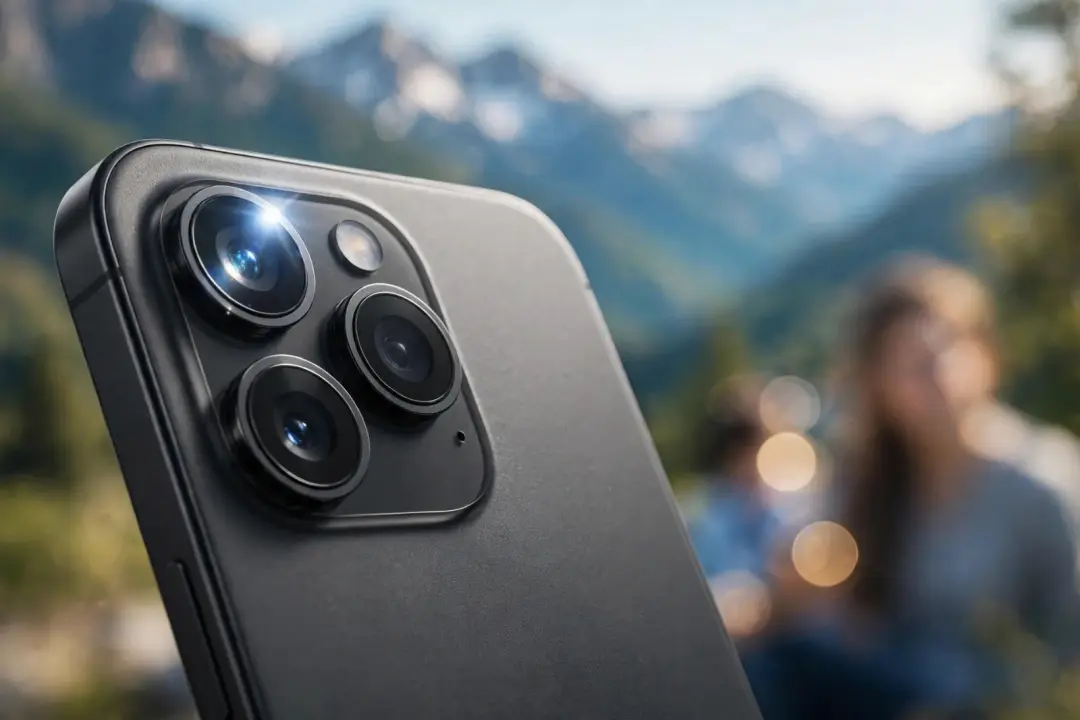
Look at the back of any modern phone and you will see two, three or even four camera lenses staring back at you. It is easy to assume they are mostly decoration, or a marketing trick to make the phone look more advanced. So why do phones have multiple cameras? The answer comes down to physics: a phone is too thin for a proper zoom lens, so manufacturers give it several small cameras instead — each one built for a different kind of photo.
The Physics Problem: Phones Are Too Thin
A traditional camera zooms by physically moving glass elements inside a long lens barrel. A phone is about 8 millimetres thick. There is simply no room for that. So instead of one lens that changes shape, a phone carries several fixed lenses, each at a different focal length, and switches between them — or blends their images together — as you zoom.
Think of it like a set of fixed-lens cameras packed into one pocket device. Each module has its own lens, image sensor, aperture, autofocus system and stabilisation. The phone constantly decides which camera to use, and often combines data from more than one to produce the final photo.
What Each Camera Does
Most triple-camera phones — such as the iPhone 16 Pro, Google Pixel 7 Pro, Samsung Galaxy S25 or OnePlus 13 — carry the same three core modules. Here is what each one is for.
| Camera | Typical focal length | Field of view | Best for |
|---|---|---|---|
| Main (wide) | 23–28 mm | Normal | Everyday photos, low light |
| Ultrawide | 13–16 mm | Very wide | Landscapes, architecture, groups, small rooms |
| Telephoto | 50–77 mm | Narrow | Portraits, distant subjects, concerts |
| Periscope telephoto | 85–120 mm or more | Very narrow | Far subjects, wildlife, sports |
| Macro / depth | Varies | Very close / sensing | Close-ups, portrait blur |
The main camera: the workhorse
The main camera is the one your phone uses for general photography, and it is usually the most powerful module: the largest sensor, the best lens, and the widest aperture. Because its sensor collects the most light, it also gives the best results in dim rooms and at night. When you tap the shutter without thinking about it, this is almost always the camera doing the work.
The ultrawide camera: more of the world
The ultrawide camera captures a much wider field of view than the main camera. It is the one to reach for when you cannot physically step back: a landscape, a tall building, a big group of friends, or a small room where the main camera cannot fit everything in. The trade-off is a smaller sensor and more distortion at the edges, so ultrawide photos are usually a little softer than main-camera shots.
The telephoto camera: bringing things closer
A telephoto camera has a narrower field of view, which makes distant subjects appear larger in the frame — without relying on digital cropping. It is the best choice for portraits (the narrower view flatters faces), distant subjects, sports and concerts. The key difference from digital zoom: a telephoto changes the optical field of view before light reaches the sensor, so it preserves detail that cropping would throw away.
The periscope telephoto: zoom that folds
For really long reach — 5x, 10x and beyond — even a telephoto lens is too long to fit straight into a phone. The solution is the periscope camera: the light enters the phone, hits a prism or mirror, and travels sideways along the inside of the phone to the sensor. This folded path fits a long focal length into a thin body. Some 2026 flagships pair a large main sensor with one or two periscope telephotos reaching 100 mm or more, and some now offer continuous zoom across part of that range.
How the Cameras Work Together
The clever part is not the number of lenses — it is how the phone combines them. Modern phones rely heavily on computational photography: software that merges images and data from several cameras into one finished photo.
- Portrait mode uses two or more cameras (or a depth sensor) to measure how far away everything is, then separates the subject from the background and blurs the background to mimic a professional camera.
- Night mode takes several frames in quick succession — sometimes from more than one camera — and stacks them to pull detail out of the dark.
- Zoom in between lenses is filled in by software: at 2x zoom, the phone may crop the main camera's high-resolution sensor rather than switching to the telephoto at all.
- Silent switching happens more than you think. In low light, or when you focus very close, a phone set to telephoto may quietly use a cropped image from the main camera instead — because the main camera gathers more light and produces a cleaner result.
That is why the photo you take is often not the output of a single camera, but a blend of several, decided in a fraction of a second.
Optical Zoom vs Digital Zoom
This is the distinction that matters most when you are pinching to zoom. Optical zoom uses a different lens to change the field of view before the light hits the sensor — the detail is real. Digital zoom enlarges the image by cropping and processing the pixels you already have — the detail is invented by software, and quality drops fast.
A phone with a 3x telephoto gives you true optical zoom at 3x. At 10x, the same phone may be combining the periscope lens with heavy digital cropping. Knowing which lens your phone actually has tells you where the quality stops: the photo is sharpest at each camera's native zoom level (1x, 0.5x, 3x, 5x), and softest in the gaps between them.
Does More Cameras Mean Better Photos?
Not necessarily — and this is the part the marketing skips. A phone with four cameras is not automatically better than a phone with two. Sensor size, lens quality, stabilisation, autofocus and software processing all shape the final image as much as the number of lenses does.
What extra cameras do give you is range: more ways to respond to a scene. A single excellent main camera can take a beautiful photo, but it cannot fit a whole mountain range into the frame, and it cannot make a distant bird fill the frame. Multiple cameras turn the phone into a pocket kit of fixed lenses, with the software doing the job of choosing between them.
The honest test when buying a phone is not "how many cameras does it have?" but "how good is the main camera, and does the telephoto reach far enough for what I shoot?" For most people, a strong main camera and one good telephoto matter far more than a fourth or fifth lens.
Takeaway Checklist
- Phones are too thin for a zoom lens, so they carry several fixed cameras at different focal lengths instead.
- Main camera (23–28 mm) is the workhorse — largest sensor, best in low light, used for most photos.
- Ultrawide (13–16 mm) fits landscapes, groups and small rooms into the frame, with some edge distortion.
- Telephoto (50–77 mm) brings distant subjects closer optically — ideal for portraits and concerts.
- Periscope telephoto (85–120 mm+) folds light sideways inside the phone for long-range zoom.
- Computational photography blends the cameras: portrait blur, night mode and zoom all combine data from several modules.
- Optical zoom is real detail; digital zoom is cropping — photos are sharpest at each lens's native zoom level.
- More cameras ≠ better photos — sensor size, lens quality and software matter just as much.
Internal links: How Camera Image Sensors Work · Why Do Phone Photos Sometimes Look Better Than a DSLR's?