How do AirTags work? The short answer: a tiny disc in your bag quietly shouts "I'm here" over Bluetooth, and any nearby iPhone that hears it — even a stranger's — anonymously passes the message on to you. No GPS, no mobile signal, no monthly fee. Here is the full explanation, in plain English.
The Short Answer
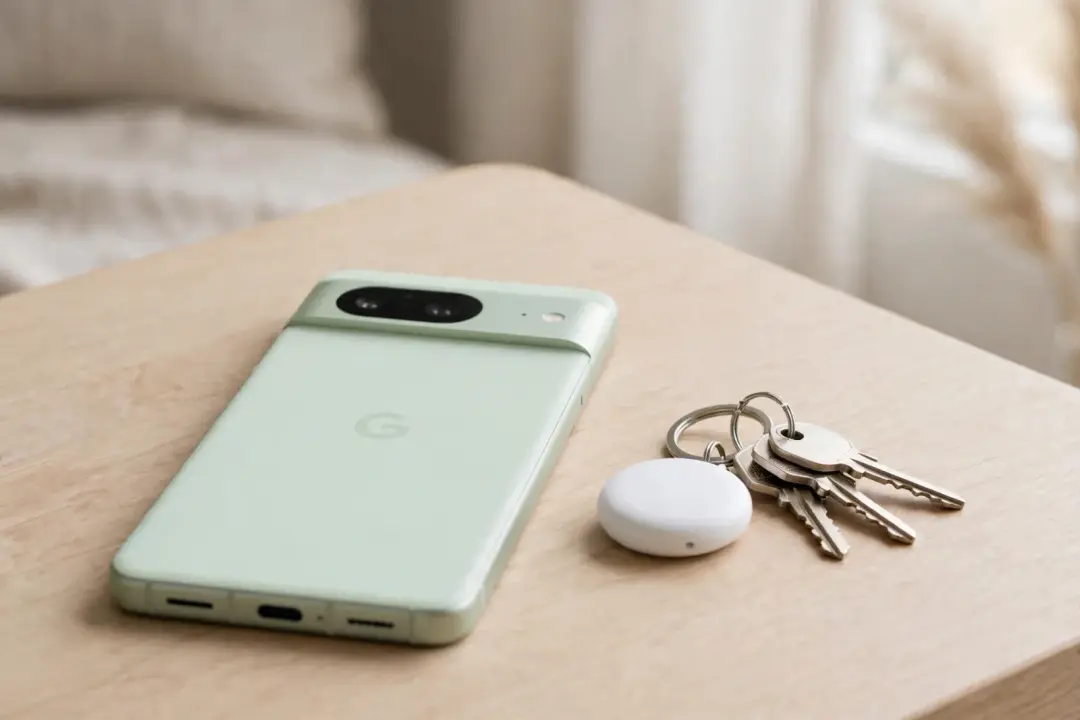
An AirTag is a small, coin-sized tracker from Apple, launched in April 2021. You attach one to your keys, wallet, backpack or luggage, and if you lose the item, you open the Find My app on your iPhone and see its location on a map. A single AirTag costs $29, and a pack of four costs $99.
What makes it clever is that the AirTag itself has no GPS and no internet connection. It cannot find itself. Instead, it borrows the world's largest tracking network — the hundreds of millions of iPhones, iPads and Macs already in people's pockets — to report where it is. That is the trick the rest of this article unpacks.
Three Ways an AirTag Finds Your Stuff
An AirTag locates your belongings in three different ways, depending on how far away they are:
1. Nearby: play a sound
If your keys are somewhere in the house, you do not need a map — you need a beep. From the Find My app you can make the AirTag's built-in speaker play a loud sound, or just say "Hey Siri, where are my keys?" This works over a direct Bluetooth connection to your own iPhone, at a range of roughly 30 feet (about 10 metres) indoors.
2. Close by: Precision Finding
If you are in the same room or garden but still cannot see the item, iPhone 11 and later models offer Precision Finding. The AirTag contains Apple's U1 ultra-wideband chip, which measures the time radio waves take to travel between your phone and the tag, working out the distance and direction with remarkable accuracy. Your iPhone combines that with data from its accelerometer, gyroscope, camera and ARKit to show you an on-screen arrow and distance — "3 metres to your left" — with haptic, visual and audible feedback guiding you in. Think of it as a metal detector for your keys.
3. Far away: the Find My network
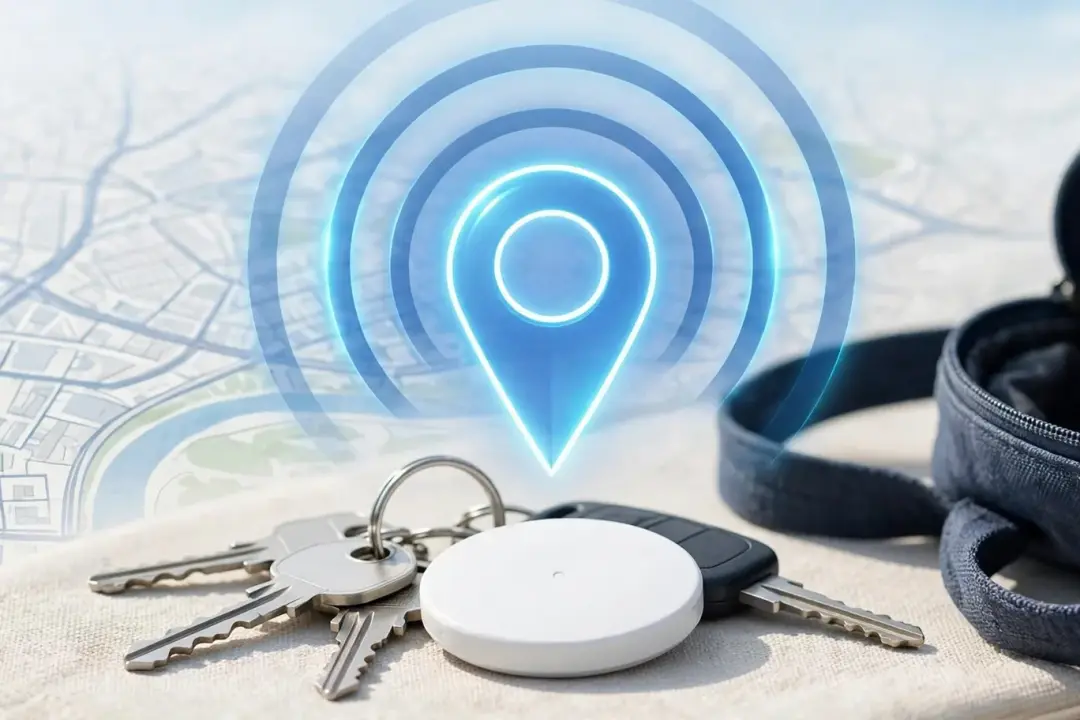
This is the magic part. If your bag is in another city — or another country — the AirTag sends out a secure Bluetooth signal every few minutes. Any iPhone, iPad or Mac in Apple's Find My network that wanders within Bluetooth range picks up that signal and, completely anonymously, relays the phone's location to Apple's servers. Your Find My app then shows the AirTag on a map. The stranger's phone never knows it helped, you never learn whose phone it was, and Apple cannot see where your AirTag is either — the whole relay is encrypted end to end.
How the Find My Network Actually Works
| Situation | How it works | What you see |
|---|---|---|
| Item in the same room | Direct Bluetooth to your iPhone | Play a sound; Precision Finding arrow |
| Item a street away | Nearby strangers' iPhones relay the signal | Location on a map, updated when a device passes by |
| Item in another country | The global Find My network (hundreds of millions of devices) | Location on a map, as long as any Apple device passes within range |
| Nobody has passed by yet | The last known location stays on the map | The last place it was seen, and the time |
Two details matter. The AirTag's Bluetooth signal is deliberately weak and infrequent, which is why the battery lasts about a year. And the AirTag stores no location history — you see where it is, not where it has travelled.
Battery, Price and Durability
- Battery: a standard CR2032 coin cell, the kind sold in supermarkets for a few dollars. Apple says it lasts over a year with everyday use — roughly four "play sound" events and one Precision Finding event per day. To replace it, flip the AirTag to the polished metal side, press down and twist. The Find My app warns you when the battery is running low.
- Price: $29 for one, $99 for four. You will also need an accessory to attach it to anything — Apple sells loops and key rings, and there are countless third-party holders, since the disc itself has no hole.
- Durability: AirTags are rated IP67, meaning they survive dust and being submerged in about a metre of water for 30 minutes.
- Range: the AirTag's own Bluetooth reach is only about 30 feet indoors and about 100 feet outdoors. Beyond that, everything depends on the Find My network. In a busy city, that is no limit at all; in a remote area with few iPhones around, updates will be slower and rarer.
What AirTags Can't Do
Honest limits matter as much as the features:
- They are not real-time GPS trackers. The location updates only when an Apple device passes nearby. If your bag is sitting in an empty field, the map shows its last known spot.
- They do not work with Android for finding your own items — setup and tracking need an iPhone (Android phones can only detect an unknown AirTag travelling with them, and tap a lost one with NFC to see its owner's message).
- They cannot tell you a route or a history. No breadcrumb trail, no live movement, no alert the moment it moves.
- They are not a theft-recovery tool. Apple designed AirTags to find lost things, not to track stolen ones — which is why the anti-stalking features below exist, and why police generally advise against chasing a stolen item yourself.
The Anti-Stalking Safeguards
Because a tiny tracker could be misused to follow a person, Apple built in protections — and they are the reason AirTags beep and warn:
- Unknown AirTag alerts: if an AirTag that is not yours starts moving with you, your iPhone will warn you — "AirTag Found Moving With You" — and show you how to find it and disable it.
- Separation beep: an AirTag that has been away from its owner for a while will start playing a sound on its own, so it cannot sit silently in someone's bag or car.
- Lost Mode: if you mark your AirTag as lost, anyone who finds it can tap it with an NFC-capable phone and see a message you wrote, including a phone number to reach you.
- One owner only: each AirTag can be registered to a single Apple ID, but you can now share its location with up to six people — useful for family luggage or a shared set of keys.
Takeaway Checklist
- An AirTag has no GPS and no internet — it borrows nearby iPhones to report its location.
- Three ways to find it: play a sound nearby, Precision Finding with the U1 chip close by, and the global Find My network far away.
- Battery: CR2032 coin cell, about a year, user-replaceable. Price: $29 each, $99 for four.
- Range: about 30 feet by Bluetooth alone — effectively worldwide through the Find My network, as long as an Apple device passes by.
- Limits: no live tracking, no location history, and it is a lost-item finder, not a theft-recovery device.
- Safety: unknown-AirTag alerts and separation beeps exist to stop misuse — if your phone warns you about a tag, take it seriously.
Related reading: How GPS Works, Explained: From Satellites to Your Phone and How Bluetooth Works.