Every ten years or so, mobile networks get a new generation. 3G brought the mobile internet. 4G brought video streaming. 5G brought low-latency connections for everything from gaming to factories. Now the next one is already being designed — and what is 6G, exactly, is a question worth answering before the marketing starts.
6G is the sixth generation of mobile network technology, the planned successor to 5G. It does not exist yet as a service you can buy. But the blueprint is already written, the trials have begun, and the launch date is no longer a guess: the first commercial 6G networks are expected around 2029–2030.
What 6G actually is
In 2023, the International Telecommunication Union (ITU) — the same United Nations body that set the ground rules for 5G — finalised an official framework for 6G, formally called IMT-2030. That framework spells out six core usage scenarios that 6G is actually being built to deliver:
- Immersive communication — lag-free virtual reality, augmented reality and holographic media that feel seamless.
- Integrated sensing and communication (ISAC) — the network itself becomes a sensor, detecting objects, motion and location while it carries data.
- Massive communication — connecting huge numbers of devices at once, the backbone of smart cities and the Internet of Things.
- Hyper-reliable and low-latency communication — near-instant, rock-solid links for remote surgery, self-driving cars and factory automation.
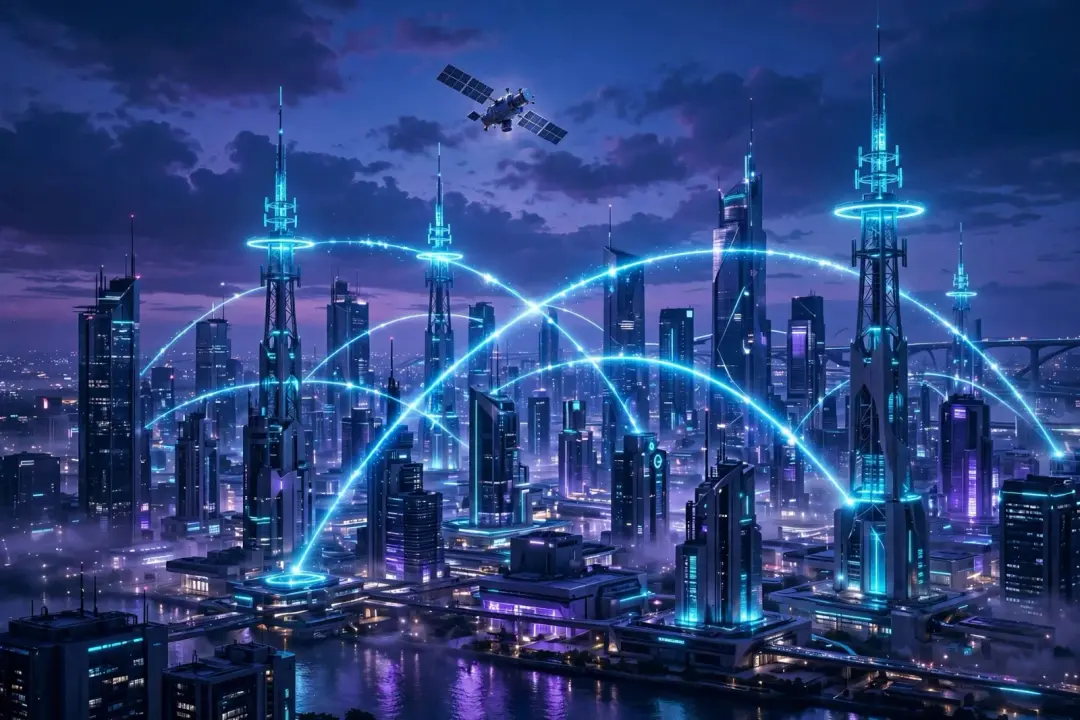
- Ubiquitous connectivity — extending coverage to rural and remote areas, often via satellites, to close the digital divide.
- AI-and-communication — artificial intelligence baked into the network itself, so it can manage and optimise itself in real time.
In other words, 6G is not just "5G but faster". It is a network that senses, thinks and covers places today's networks cannot reach.
6G vs 5G: how different will it be?
The exact specifications are still being hammered out in standards meetings, but the direction is clear. Here is how the two generations compare on the numbers researchers are aiming for:
| Feature | 5G | 6G (target) |
|---|---|---|
| Peak data speed | Up to 20 Gbps | Up to 1 Tbps (1,000 Gbps) |
| Latency | Around 1 millisecond | Around 0.1 milliseconds |
| Spectrum | Up to 100 GHz | New bands above 100 GHz, into the terahertz range |
| Special trick | Network slicing | The network itself senses and uses AI |
| Commercial launch | 2019 | Around 2029–2030 |
The speed leap comes mostly from spectrum. 5G airwaves top out at around 100 GHz, so 6G has to jump into the terahertz (THz) range — frequencies between 100 GHz and 3 THz, where enormous unused swaths of spectrum sit waiting. The trade-off is physics: higher frequencies carry more data but travel shorter distances and are blocked more easily by walls and rain. That is why 6G will also use new mid-band spectrum (7–15 GHz) and reconfigurable intelligent surfaces — special materials that reflect and steer signals around obstacles.
When will 6G launch?
The timeline is now fairly settled, because the standards process runs on a fixed schedule:
- 2023: the ITU finalised the IMT-2030 framework, defining what 6G must do.
- Late 2025: China completed the first phase of its 6G trials, reporting more than 300 technical advances.
- 2028: South Korea plans to launch a 6G service, and Qualcomm says pre-commercial 6G devices could arrive as early as 2028.
- 2029: 3GPP — the body that writes the mobile standards — is expected to publish Release 21, the first 6G standard.
- 2029–2030: commercial 6G networks, devices and services are expected to become available globally.
One test gives a sense of how far along the research is: in September 2023, LG successfully transmitted data at 6 Gbit/s over 500 metres outdoors using 6G-era frequencies. That is a lab result, not a phone in your pocket — but it shows the technology is real, not a slide deck.
What 6G could actually change
The honest answer is that nobody knows which 6G uses will matter most. Every generation has surprised its creators: 4G was built for faster browsing and ended up enabling ride-hailing and mobile video; 5G was sold on speed and found its real value in factories and private networks. With that warning in mind, here are the uses researchers are betting on:
- Holographic calls and meetings — full 3D video of a person in the room with you, which needs far more bandwidth than today's networks can carry.
- Remote surgery and real-time robotics — where a tenth of a millisecond of delay is the difference between safe and dangerous.
- Digital twins — live, exact virtual copies of factories, cities or even the human body, updated constantly by sensors.
- The network as a radar — because 6G signals bounce off objects, the network itself could detect a person falling, a car approaching a blind corner, or a drone entering restricted airspace.
- Coverage everywhere — satellites built into the standard, so remote areas get the same network as cities.
What 6G will not do
A new "G" does not fix everything, and the hype cycle is already starting:
- It will not replace Wi-Fi or fibre. Short-range, high-frequency signals are terrible at going through walls. Your home broadband is not going anywhere.
- It will not arrive overnight. Even after launch, coverage will build slowly, city by city — just as 5G did. Early 6G phones will spend most of their time on 5G anyway.
- It will not be free. New spectrum, new towers and new phones all cost money, and the first 6G devices will be expensive flagships.
- It will not make your current phone faster. 6G needs new hardware. Your 5G phone will never become a 6G phone with a software update.
Takeaway checklist
- What is 6G? The sixth generation of mobile networks, successor to 5G, built on the ITU's IMT-2030 framework from 2023.
- Target speeds reach 1 Tbps — around 50 times faster than 5G's peak — using terahertz spectrum above 100 GHz.
- It is more than speed: the network itself will sense its surroundings and use AI to manage itself.
- Launch is expected around 2029–2030, with the first 3GPP standard (Release 21) due in 2029 and early devices possibly in 2028.
- Biggest uses: holographic calls, remote surgery, digital twins, the network as a sensor, and satellite-backed coverage everywhere.
- What it won't do: replace Wi-Fi or fibre, arrive everywhere at once, or speed up your current phone.