Your smartwatch knows your heart rate, counts your steps, and tracks your sleep — all from a device smaller than a matchbox, without drawing a single drop of blood. No magic is involved: just a handful of tiny sensors and a lot of clever maths.
The watch does not directly measure most of the numbers it shows you. Its sensors measure raw things — light, movement, electrical signals — and software turns them into the numbers on your screen.
Heart rate: the green light trick
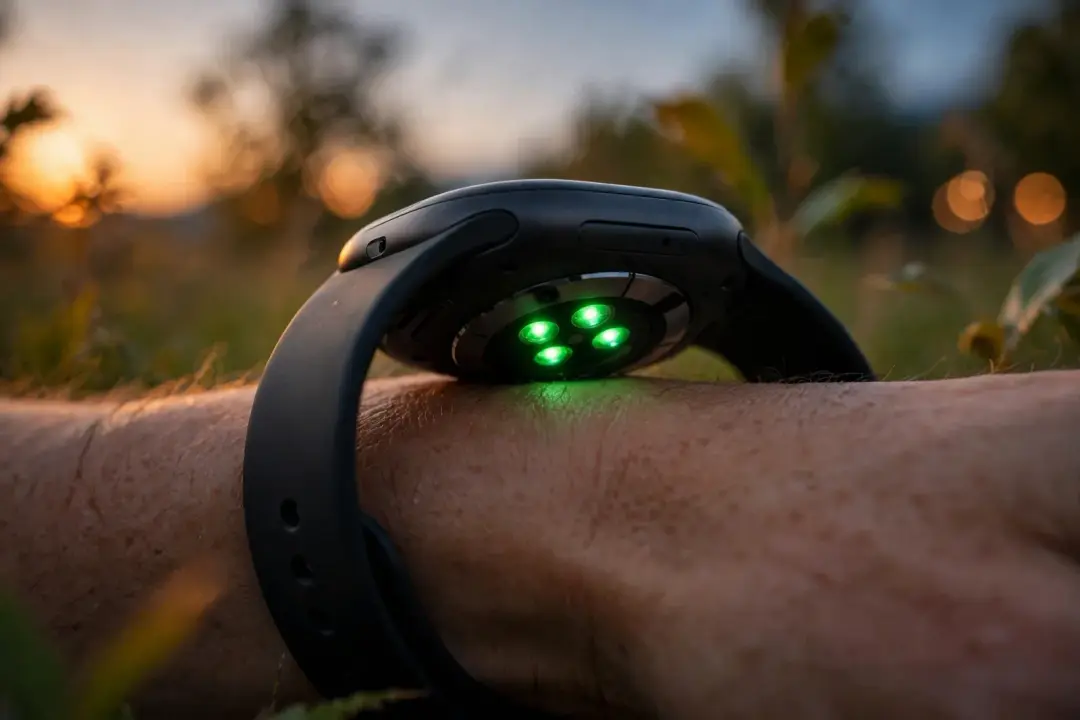
Flip your watch over and you will see green lights flashing against your skin. This is the heart-rate sensor, and it works using a technique called photoplethysmography (PPG).
Your blood is red because the haemoglobin in it absorbs green light very strongly. With every heartbeat, a wave of blood surges through the tiny vessels in your wrist: more blood means more green light absorbed and less reflected, and between beats the opposite happens.
The sensor is simply green LEDs (around 520–570 nanometres) plus a photodiode that measures the returning light. Each dip in the reflected light is one heartbeat, and the watch counts those dips to get your beats per minute. The same signal also gives you heart rate variability (HRV) — the tiny variations in timing between beats, a marker of stress and recovery.
One catch: the sensor cannot tell your pulse from your arm moving, so watches cross-check the light signal against motion data — and readings get less reliable when you are sprinting.
Blood oxygen: red and infrared light
The SpO2 reading estimates the percentage of your haemoglobin carrying oxygen. For most healthy adults, the normal range is 95–100% at sea level.
It uses the same PPG idea as heart rate, but with different colours of light: oxygenated haemoglobin absorbs more infrared light (around 940 nanometres), while deoxygenated haemoglobin absorbs more red light (around 660 nanometres). The watch shines both colours into your wrist, measures how much of each bounces back, and compares the two. The ratio becomes the percentage on your screen.
Two honest caveats: this is an estimate, not a medical measurement — wrist SpO2 readings typically land within 2–3 percentage points of a clinical fingertip device, and a loose strap, cold hands, or movement can make it worse. And it is for general wellness only: it cannot diagnose breathing problems or sleep apnoea.
ECG: reading your heart's electricity
The ECG feature works completely differently. Your heart is not just a pump — it is also an electrical organ, and every beat starts with a tiny electrical signal that travels through your body to your skin. The watch records it with two metal electrodes: one on the back of the watch against your wrist, and one on the crown or side button, which you touch with a finger from your opposite hand. That touch completes a circuit from one arm, across your chest, to the other, and the watch measures the tiny voltage difference for 30 seconds.
In clinical terms this is a single-lead ECG (Lead I) — one viewpoint on your heart's electrical activity, where a hospital machine uses twelve. The software classifies the rhythm, mainly looking for atrial fibrillation (AFib), a common irregular heartbeat, and watches with this feature have regulatory clearance specifically for AFib detection.
But a single-lead ECG cannot detect a heart attack, a blocked artery, or most structural heart problems. It answers one narrow question — is the rhythm regular? — and only records when you ask it to.
Motion sensors: the accelerometer and gyroscope
Step counting, sleep tracking, and fall detection all start with two motion sensors, together called an inertial measurement unit (IMU).
The accelerometer measures linear acceleration — how fast your wrist speeds up or slows down — along three axes. Inside it is a MEMS chip, a silicon structure whose tiny parts shift by a hair's width when you move, read about 50 times per second.
When you walk, your body bounces up and down in a regular rhythm and your arm swings with it. The software looks for that repeating pattern and counts each cycle as a step — but it has to be clever about it, since the same sensor also fires when you stir a pot or brush your teeth.
The gyroscope measures rotation — how quickly your wrist twists or turns. Paired with the accelerometer, it helps the watch tell a real step from a random arm gesture and detect a sudden fall. Sleep tracking works the same way: stillness plus a steady, dropping heart rate tells the watch you are probably asleep.
For the bigger picture, see our guide to wearable technology.
GPS and the hidden extras
Your watch uses GPS, the same satellite system as your phone, for outdoor runs and rides: it listens for satellite radio signals and works out its position by timing how long each took to arrive. We explain the full story in How GPS Works, Explained.
Most watches also pack in quiet extras — an altimeter, a compass, and a skin temperature sensor — whose power comes from being combined, a technique called sensor fusion.
Sensor comparison at a glance
| Sensor | What it measures | How it works | What it is used for |
|---|---|---|---|
| PPG (optical) | Blood volume changes | Green LED + photodiode | Heart rate, HRV |
| SpO2 sensor | Blood oxygen saturation | Red + infrared LEDs | Oxygen level estimate |
| ECG electrodes | Heart's electrical signal | Two metal contacts, 30-second reading | Rhythm check, AFib detection |
| Accelerometer | Linear movement | MEMS chip, 3 axes | Steps, sleep, fall detection |
| Gyroscope | Rotation | MEMS vibrating element | Orientation, activity type |
| GPS | Position | Satellite radio signals | Distance, pace, routes |
Where smartwatches get it wrong
Knowing how the sensors work also explains their limits:
- Loose fit ruins optical readings. If light leaks in from the sides, the sensors get a noisy signal — wear the watch snug, a finger's width above your wrist bone.
- Movement is the enemy. Optical sensors struggle during intense exercise, so chest straps are still more accurate for serious athletes.
- Nothing here is a diagnosis. Wrist sensors are wellness tools. A strange reading is a reason to talk to a doctor.
Takeaway checklist
- Your watch sees light, movement, and electricity — not health directly. Every number on screen is the software's best interpretation of raw sensor data.
- Heart rate comes from green LEDs measuring blood pulsing under your skin (PPG).
- Blood oxygen comes from comparing red and infrared light — an estimate, with 95–100% the normal range.
- ECG reads your heart's electrical signal through two electrodes over 30 seconds, and spots irregular rhythm (AFib), not heart attacks.
- Steps and sleep come from the accelerometer and gyroscope detecting movement patterns, cross-checked with heart rate.
- Fit matters most. A snug strap just above the wrist bone is the easiest way to get better readings from every sensor.
Next time your watch buzzes with a heart-rate alert, you will know what happened inside that little box: light bounced off your blood, a chip felt your arm swing, and a lot of maths turned it all into a number.