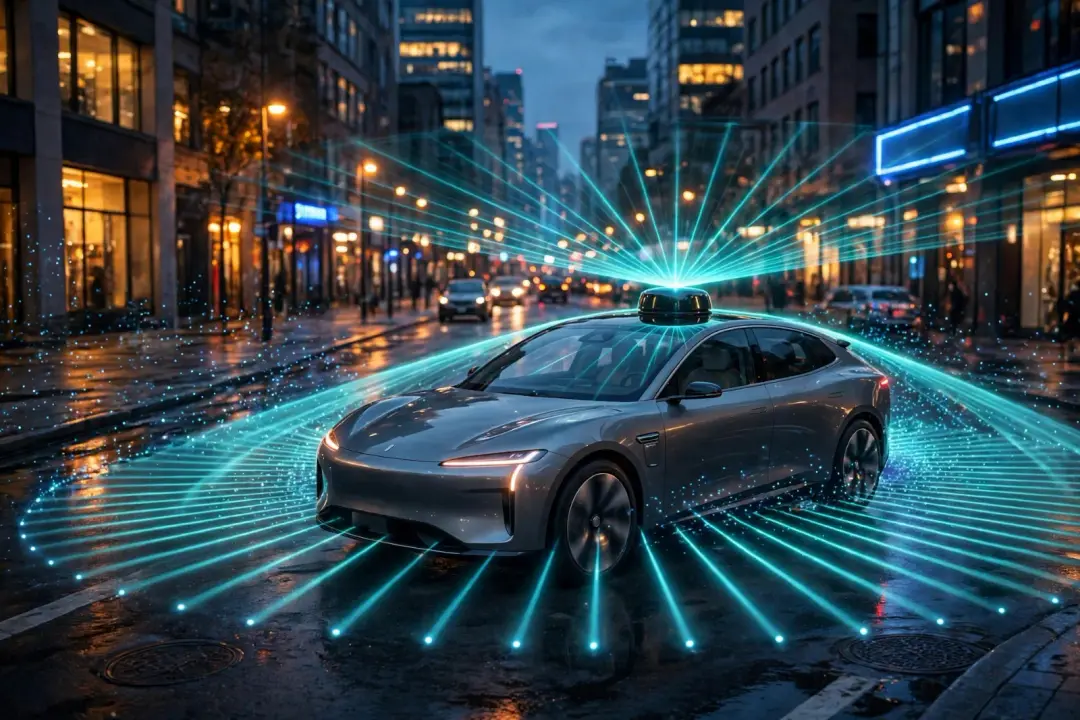
In 2026, you can open an app in fifteen American cities and a car with an empty driver's seat will pull up. No one is steering — at least, no human is. How do self-driving cars work? The short answer is a loop that repeats many times every second: sense, decide, act. The car senses the world with lasers, radar and cameras, an AI decides what to do, and the car steers, brakes and accelerates. Here is each part of that loop, the six levels of automation, and who is on the road.
How Do Self-Driving Cars Work? The Sense–Decide–Act Loop
A self-driving car is a rolling robot. Everything it does fits into three steps:
- Sense. Sensors build a live 3D model of the world around the car — vehicles, pedestrians, cyclists, lane markings and traffic lights.
- Decide. Onboard AI interprets that model, predicts what everything will do next, and plans a safe path.
- Act. The plan becomes steering, throttle and braking — then the loop repeats, dozens of times per second.
No single sensor can do the job alone — each has blind spots — so cars overlap several types and cross-check them. If one is blocked or degraded by weather, the others keep the car aware. That redundancy is the whole safety philosophy.
The Sensors: How a Car Sees
| Sensor | How it works | Strengths | Weaknesses |
|---|---|---|---|
| LiDAR | Fires laser pulses and times the reflections, building a 3D "point cloud" | Extremely precise distances and shapes; refreshes ~10 times a second, range ~50–100 m | Expensive; struggles in heavy rain, snow and fog |
| Radar | Uses radio waves (24 or 77 GHz), measuring the Doppler shift of reflections | Sees through rain, fog and dust; measures speed | Much lower resolution than LiDAR; cannot read signs or lane markings |
| Cameras | Video cameras with computer vision software | Read lights, signs, lane markings and pedestrians; cheap and small | Struggle in darkness, glare and heavy rain |
| Ultrasonic | Short-range sound pulses | Cheap, reliable close-range detection for parking | Very short range and low resolution |
| GPS + HD maps | Satellite positioning with centimetre-detailed road maps | Pins down the car's exact lane | GPS alone is imprecise and fails in tunnels |
The Brain: AI That Makes the Decisions
Sensors only collect raw data. The driving is done by software — at its centre, neural networks, the same AI behind chatbots and image recognition, trained on millions of miles of driving data.
The software works in layers. Perception turns raw sensor data into objects: that blob is a pedestrian, that light is red. Prediction guesses what each object will do next. Planning chooses the car's path. And control turns the plan into steering, braking and acceleration — all inside the car, in milliseconds: a car at motorway speed covers about 30 metres every second.
The Six Levels of Self-Driving
The industry grades automation from 0 to 5, set by the Society of Automotive Engineers (SAE):
- Level 0 — No automation. The human does everything. Most older cars.
- Level 1 — Driver assistance. One function is automated, such as cruise control.
- Level 2 — Partial automation. The car can steer and control speed together, but the driver must watch the road at all times — this is what most "autopilot"-style features actually offer.
- Level 3 — Conditional automation. The car drives itself in limited conditions, such as a traffic jam — but the driver must be ready to take over.
- Level 4 — High automation. The car drives itself with no human attention, but only inside a defined, mapped area. This is what robotaxis use.
- Level 5 — Full automation. The car drives itself anywhere, in any conditions, with no steering wheel or pedals. No Level 5 car exists.
Robotaxis in 2026: Who Is Actually on the Road?
As of November 2026, paying passengers ride in driverless cars every day:
- Waymo (Alphabet) is the clear leader. It operates in 15 US metro areas, including San Francisco, Los Angeles, Phoenix and Austin. It passed 500,000 paid rides a week in September 2026 and runs a fleet of more than 4,000 vehicles. Its cars have driven nearly 500 million kilometres with no one behind the wheel.
- Tesla Robotaxi began driverless paid rides in Austin in June 2025 and now operates in 8 metro areas, including Dallas, Houston, Miami and Orlando. In the San Francisco Bay Area its cars still carry a safety driver. Its Full Self-Driving (Supervised) v15 began rolling out on 21 November 2026.
- Zoox (Amazon) charges fares for driverless rides in Las Vegas, with San Francisco still on a waitlist. Its vehicles are purpose-built, with no steering wheel.
- Baidu's Apollo Go runs driverless taxis in around 30 cities, mostly in China.
Are Self-Driving Cars Safe?
The honest answer is: safer than humans in some measures, still unproven in others.
Waymo publishes safety data showing its driverless cars crash less often than human drivers in the same cities, and independent analyses have broadly supported that. But the comparisons are contested: robotaxis drive mostly in well-mapped city centres in good weather, while human crash statistics include drunk driving and speeding.
Crashes still happen, and the hardest cases remain the unusual ones: a police officer waving traffic around a crash, a child chasing a ball, a road covered in fresh snow. Humans handle those with judgement from a lifetime of experience; AI handles them with pattern recognition — and data has gaps.
Regulation is still catching up: rules differ by state, and liability for a driverless crash is still being worked out.
What Is Still Hard?
- Weather. Heavy rain, snow and fog blind cameras and LiDAR; radar keeps working, but with far less detail.
- Edge cases. Construction zones, hand signals and emergency vehicles are rare — which is exactly why AI struggles with them.
- Unmapped roads. A car that depends on centimetre-accurate maps cannot drive somewhere unmapped.
- Cost. LiDAR units once cost tens of thousands of dollars; prices have fallen, but a full sensor suite is still expensive.
- Trust. Most people say they would not yet ride in a driverless car. Every high-profile crash sets that trust back months.
Takeaway Checklist
- How do self-driving cars work? A sense–decide–act loop, repeated many times a second: sensors build a 3D model, AI plans a path, the car steers and brakes.
- No single sensor is enough. LiDAR gives precision, radar sees through bad weather, cameras read signs and lights, ultrasonic covers parking — GPS plus HD maps pin down the lane.
- Levels 0–5 grade automation. Most cars on sale are Level 2 (driver must watch). Robotaxis are Level 4. Level 5 does not exist.
- Robotaxis are real in 2026. Waymo runs in 15 US metros with 500,000+ paid rides a week; Tesla in 8; Zoox and Baidu's Apollo Go are expanding.
- Safety is promising but unproven. Published data favours Waymo, but the comparisons are debated.
- Weather, cost, maps and trust are the four problems still standing between robotaxis and everywhere.
Internal links: How GPS Works — From Satellites to Your Phone · What Is a Neural Network?