Your laptop thinks in bits: tiny switches that are either 0 or 1. What is quantum computing? It is a fundamentally different kind of computer — one that replaces those switches with particles that follow the strange rules of quantum physics, and can therefore tackle a small number of problems that no ordinary computer could ever solve. It will not make your laptop faster — but it might one day design new medicines and break today's encryption.
What Is Quantum Computing?
Quantum computing uses the laws of quantum mechanics — the physics of the very small. Instead of bits, it uses qubits, and instead of ordinary logic, three quantum effects — superposition, entanglement and interference — to process information in a way no classical machine can imitate.
The idea dates to 1981, when physicist Richard Feynman argued that nature is quantum mechanical, so the natural way to simulate it is with a quantum machine.
The field took off in 1994, when mathematician Peter Shor showed a quantum computer could factor very large numbers exponentially faster than any classical method — the result that made governments and tech giants take notice, since factoring underpins RSA encryption.
What Is a Qubit?
The heart of quantum computing is the qubit. A normal bit is always 0 or 1, like a light switch that is firmly up or down. A qubit holds a blend of 0 and 1 at the same time, a state called superposition.
Picture a spinning coin: once it lands, it is heads or tails, like a bit — but while it spins, it carries both faces at once. A qubit is like that coin, holding both possibilities until you measure it.
Two qubits hold four combinations at once, three hold eight, and 300 qubits can hold more combinations than there are atoms in the observable universe. The catch is that you can only ever read out one answer — so the art is arranging things so that the one answer you get is the useful one.
The Three Tricks: Superposition, Entanglement and Interference
- Superposition. Each qubit holds many possibilities at once, so a quantum computer can represent an enormous number of states.
- Entanglement. Qubits can be linked so they act as one system: measure one, and you instantly learn something about the others.
- Interference. Like waves in water, quantum possibilities can add up or cancel out. A quantum algorithm is designed so the wrong answers cancel and the right answer grows louder.
A common myth is that quantum computers "try every answer at once." The power actually comes from interference — choreographing the possibilities so the right one wins.
Quantum Computer vs Classical Computer
| Classical computer | Quantum computer | |
|---|---|---|
| Basic unit | Bit — always 0 or 1 | Qubit — a blend of 0 and 1 |
| Logic | Ordinary logic gates | Quantum gates that rotate qubit states |
| Best at | Everyday computing: browsing, video, documents, games | A narrow set: molecules, factoring, optimisation |
| Errors | Rare and easy to correct | Constant — qubits are extremely fragile |
| Operating temperature | Room temperature | Near absolute zero, around 0.01 kelvin |
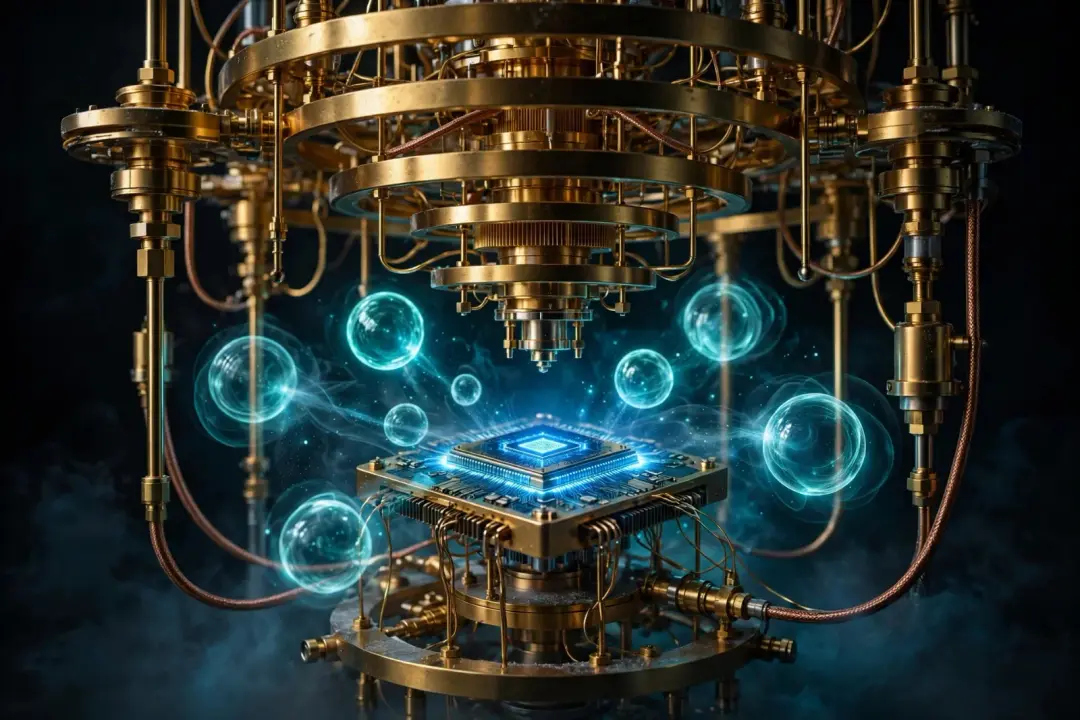
| Size | Fits in your pocket | A room-sized machine built around a gold "chandelier" cooling system |
Qubits are so fragile that the slightest heat, vibration or stray field destroys their quantum state — a problem called decoherence. That is why these machines live in refrigerators colder than outer space.
What Can Quantum Computers Actually Do?
Quantum computers are specialists, expected to beat classical computers on a fairly narrow set of problems:
- Simulating nature. Molecules are quantum systems, so a quantum computer could help design new medicines, better batteries and more efficient fertilisers by simulating molecules exactly.
- Breaking encryption. Shor's algorithm could factor the huge numbers behind RSA encryption — but only on a machine far larger than anything built so far.
- Optimisation. Some logistics, finance and scheduling problems might benefit, though the advantage is still unproven.
What they will not do is make your laptop faster or run games better. For almost everything you do, an ordinary computer is faster, cheaper and more reliable. A quantum computer is a specialist instrument, like a particle accelerator: extraordinary at its job, useless at everything else.
Where the Technology Stands in 2026
Quantum computing in 2026 is in the NISQ era — Noisy Intermediate-Scale Quantum. Today's machines have 50 to a few hundred physical qubits, with error rates that make long calculations unreliable. As of September 2026, no vendor has demonstrated a useful, end-to-end advantage on a real-world problem.
But 2024–2026 brought the field's most important milestone: proof that error correction works.
- Google's Willow (December 2024). A 105-qubit superconducting chip that demonstrated below-threshold error correction for the first time: as the code grew from distance 3 to 5 to 7, the logical error rate fell by roughly 2.1 times per step. Adding qubits made the result better, not worse.
- IBM's Nighthawk. A 120-qubit processor announced in November 2025, with a 520-qubit version in November 2026. IBM's Starling roadmap targets 200 error-corrected logical qubits by 2029. Its largest chip, Condor, holds 1,121 physical qubits — but raw count is not the number that matters.
- Quantinuum's Helios (November 2025). A trapped-ion machine turning 98 physical qubits into 48 error-corrected logical qubits.
The number that matters is logical qubits — qubits protected by error correction. A distance-7 surface code on Willow uses 49 physical qubits to make one logical qubit. By a 2021 estimate, breaking RSA-2048 would need around 20 million physical qubits; the best hardware today has a few hundred. Error correction works, but useful scale is years away — planners estimate 2033–2035 for "Q-Day".
Should You Worry About Your Passwords?
Not today. No machine in existence can break RSA encryption, and none is close. But the security world is already moving, because of "harvest now, decrypt later": an adversary can record encrypted data today and wait for a quantum computer powerful enough to open it. Secrets that must stay secret for decades are already at risk in that sense.
That is why the US National Institute of Standards and Technology (NIST) published the first post-quantum cryptography standards in August 2024 — new encryption designed to resist quantum attacks. Banks, governments and tech companies are migrating to them now.
Takeaway Checklist
- What is quantum computing? Computing with qubits instead of bits, using superposition, entanglement and interference.
- A qubit is a blend of 0 and 1 until measured. The power comes from interference — amplifying the right answer and cancelling the wrong ones.
- Quantum computers are specialists. They may transform drug discovery, materials science and cryptography — they will not replace your laptop.
- Error correction now works: Willow proved in 2024 that adding qubits can reduce errors. The race is now about logical qubits, not raw counts.
- Breaking today's encryption needs around 20 million physical qubits; today's best machines have a few hundred. Planners estimate 2033–2035.
- No useful quantum advantage on a real problem has been demonstrated yet.
Internal links: How CPUs Actually Work · How Does Encryption Actually Work?