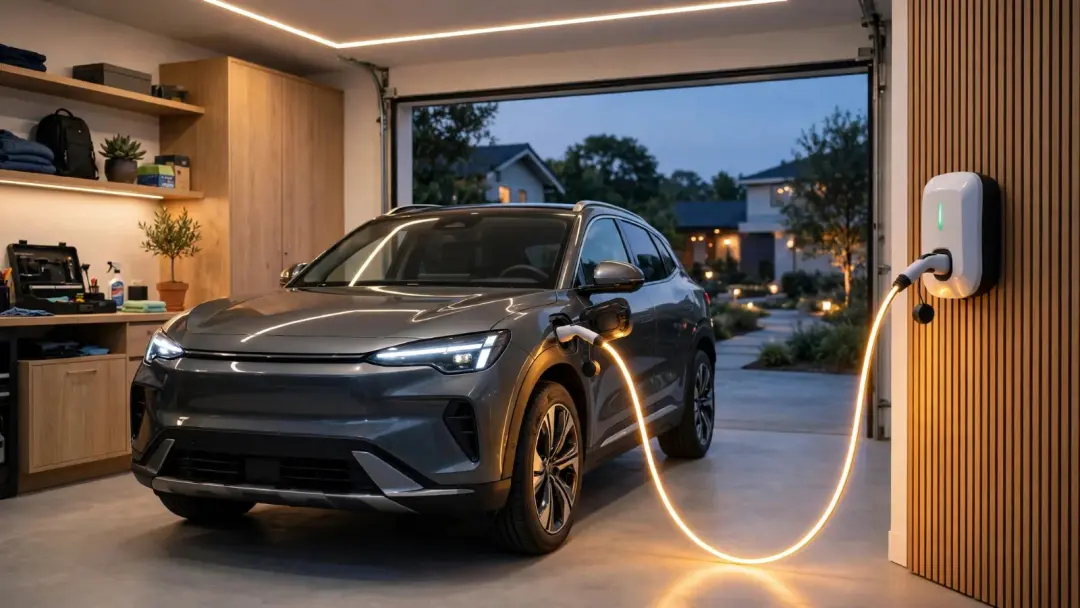
How do electric cars charge? You plug them in — but where you plug in, and how much power flows through the cable, changes everything. The same car can take 40 hours to charge from an ordinary wall socket, or under an hour at a motorway fast charger. The difference comes down to three charging levels, and once you understand them, the whole subject falls into place.
The short answer: AC at home, DC on the road
Every electric car battery stores direct current (DC) electricity. But the electricity in your home and in the grid is alternating current (AC). So before energy can enter the battery, AC has to be converted into DC — and where that conversion happens is what separates the three charging levels.
- Level 1 and Level 2 send AC to the car, and a device inside the car called the onboard charger converts it to DC. The onboard charger sets the speed limit.
- DC fast charging does the conversion in the big cabinet at the charging station, bypassing the onboard charger entirely — which is why it is so much faster.
If you are new to electric cars in general, our explainer on how electric cars actually work covers the motor, battery and drivetrain first.
Level 1: any ordinary wall socket
Level 1 is the simplest option: plug the car into a standard household outlet (120 volts in North America, 230 volts in most of the rest of the world) using the portable cable that comes with the car. It needs no installation and no extra equipment.
The catch is speed. Level 1 delivers only about 1.4–1.9 kW of power, adding roughly 2–5 miles of range per hour. According to US Department of Transportation figures, charging a 60 kWh battery from empty on Level 1 can take 40–50 hours.
That sounds useless — but for many drivers it is enough. Drive 30 miles a day, plug in for 12 hours overnight, and Level 1 quietly replaces what you used. It is also the fallback that works anywhere there is a socket, and for plug-in hybrids with small batteries it is often all you ever need.
Level 2: the home wallbox
Level 2 is the setup most EV owners rely on every day. It uses a 240-volt circuit — the same voltage that runs an electric dryer or oven — and a dedicated wall-mounted charger at home, at work, or in a public car park.
- Power: typically 7.2–19 kW, depending on the car and the charger.
- Speed: roughly 10–20 miles of range per hour by US Department of Transportation data, though manufacturers often quote 25–40 miles per hour for cars with faster onboard chargers.
- Full charge: about 4–10 hours from empty — an easy overnight job.
- Cost to install: typically $800–$3,000 all-in, covering the charger, an electrician and any electrical panel work.
Because the car's onboard charger does the AC-to-DC conversion, a more powerful wallbox does not always mean faster charging: most cars cap AC charging at around 7.4 or 11 kW. The car, not the wall, is the bottleneck. One cost note: the US federal tax credit that covered 30% of home charger costs (up to $1,000) expired for installations placed in service after 30 June 2026.
DC fast charging: the road-trip charger
DC fast charging — sometimes called Level 3 — is what you find at motorway services and busy public stations. It feeds direct current straight into the battery, skipping the onboard charger, at 50 to 500 kW.
- Speed: US Department of Transportation figures put it at roughly 180–240 miles of range per hour.
- A typical stop: charging from 10% to 80% takes about 20 minutes to an hour, depending on the car and the charger.
- Where: public rapid-charging stations, motorway services and busy urban hubs — not at home, because the equipment is commercial-grade and far too expensive for a house.
The key habit for road trips: charge to 80%, not 100%. Charging speed drops sharply after 80% to protect the battery, so stopping more often and charging to 80% is usually faster overall than waiting for a full battery each time.
The three levels, side by side
| Level | Power | Range per hour | 10–80% time | Where you find it | Best for |
|---|---|---|---|---|---|
| Level 1 (household outlet) | 1.4–1.9 kW | ~2–5 miles | 20–40+ hours | Any wall socket | Low-mileage drivers, plug-in hybrids |
| Level 2 (240V AC) | 7.2–19 kW | ~10–20 miles | 4–10 hours | Home, work, car parks | Daily overnight charging |
| DC fast charging | 50–500 kW | ~180–240 miles | ~20 min–1 hour | Motorway services, public hubs | Road trips, top-ups |
Why fast charging slows down near the top
If you have ever watched a fast-charging session, you will have seen the speed fall as the battery fills. This is deliberate. A lithium-ion battery accepts charge fastest when it is fairly empty; as it fills, the charger tapers the power to keep heat and voltage within safe limits. Pushing full power into a nearly full battery would stress the cells and shorten their life.
Temperature matters too. In cold weather, the car may first warm the battery before it accepts full charging speed, and in very hot weather it may slow down to keep cool. That is why the same charger can feel fast in summer and sluggish in winter. Our guide to lithium-ion batteries explains the chemistry behind all of this.
Connectors: NACS, CCS and the alphabet soup
Charging plugs used to be a mess of competing standards. That is finally settling down:
- NACS (the North American Charging Standard, originally Tesla's plug) is now the standard for new EVs sold in North America, and it opens up Tesla's Supercharger network to other brands.
- CCS (Combined Charging System) is still common on older cars and across Europe, where it remains the standard.
- CHAdeMO, an older Japanese standard, is fading away as carmakers switch to NACS or CCS.
Before a long trip, it is worth checking which connector your car uses and whether the stations on your route support it. Most navigation apps and the car's own route planner now handle this automatically.
What charging actually costs
Home charging is where EVs win on cost. Electricity at home is usually far cheaper per mile than petrol, and about 80% of the total distance covered by EVs in the US comes from home recharging, according to Carnegie Mellon University research cited by IEEE Spectrum. Public fast charging costs considerably more per unit of energy, but most owners only use it on longer trips.
Does fast charging hurt the battery?
Used occasionally, no — modern cars manage charging carefully, with cooling and tapering built in. But as a daily habit, relying only on DC fast charging adds more heat and stress than gentle overnight AC charging, and studies show slightly faster battery wear for cars fast-charged all the time. The rule is simple: charge at home when you can, use fast charging when you need to.
Takeaway checklist
- Three levels: Level 1 is any wall socket (slowest), Level 2 is a 240V home wallbox (the daily default), DC fast charging is for road trips.
- The bottleneck: with AC charging, the car's onboard charger sets the speed limit — a bigger wallbox cannot beat it.
- Road-trip rule: charge to 80% at fast chargers; the last 20% is slow by design.
- Home is cheapest: about 80% of EV miles in the US are charged at home overnight.
- Connectors: NACS is now the North American standard; CCS dominates in Europe.
- Battery care: occasional fast charging is fine — daily fast charging adds wear over time.
- Costs: a Level 2 home install typically runs $800–$3,000; a full overnight charge takes 4–10 hours.